A real-time spectrum analyser with bars, peak caps and an oscilloscope, in truecolour.
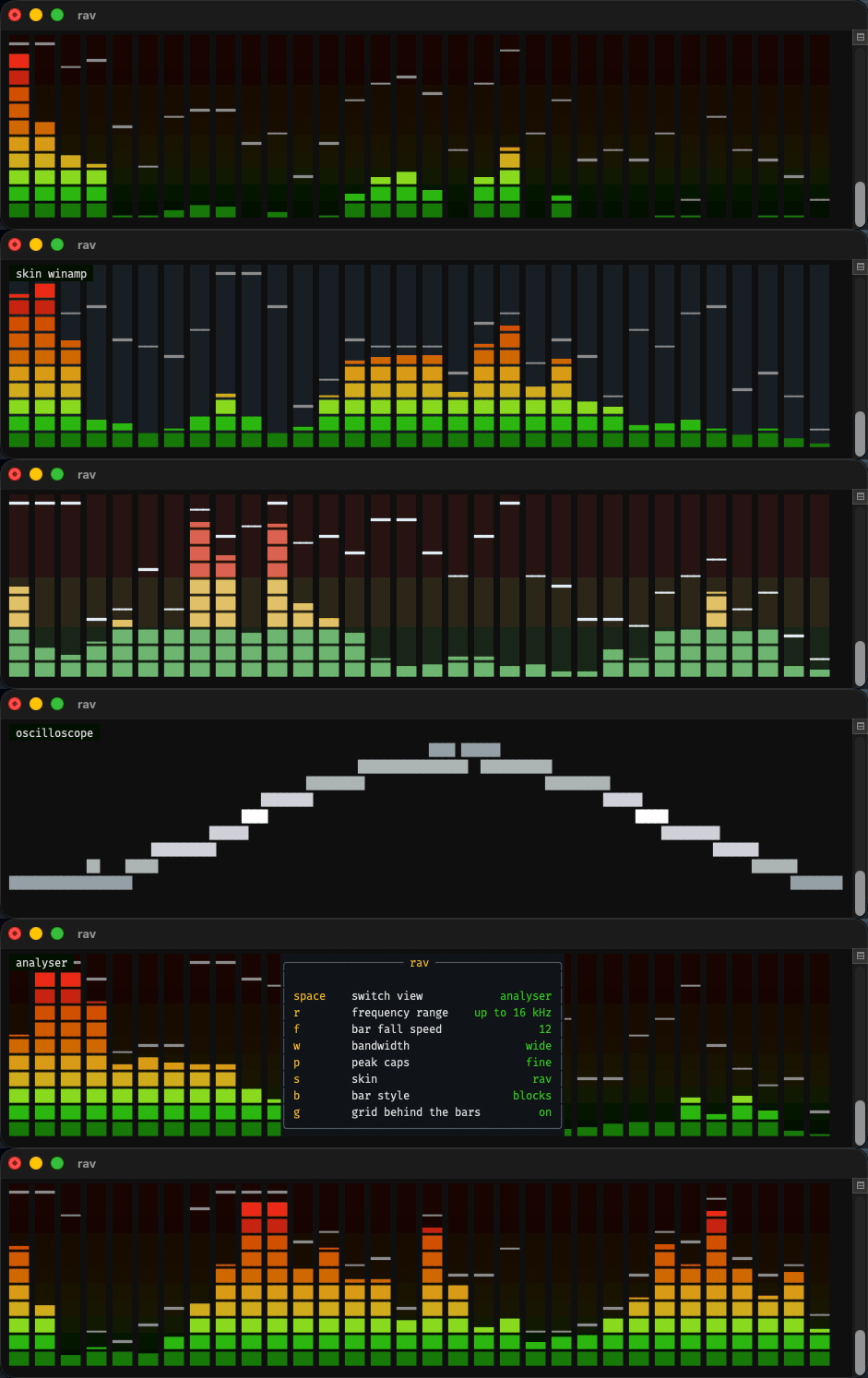

A real-time spectrum analyser with bars, peak caps and an oscilloscope, in truecolour.

Split multi-channel WAV files into single channel WAV files.
github.com/wieslawsoltes/SimpleWavSplitter

Utility for mass-downloading LRC synced lyrics for your offline music library.
LRCGET will scan every files in your chosen directory for music files, then and try to download lyrics to a LRC files having the same name and save them to the same directory as your music files.
LRCGET is the official client of LRCLIB service.
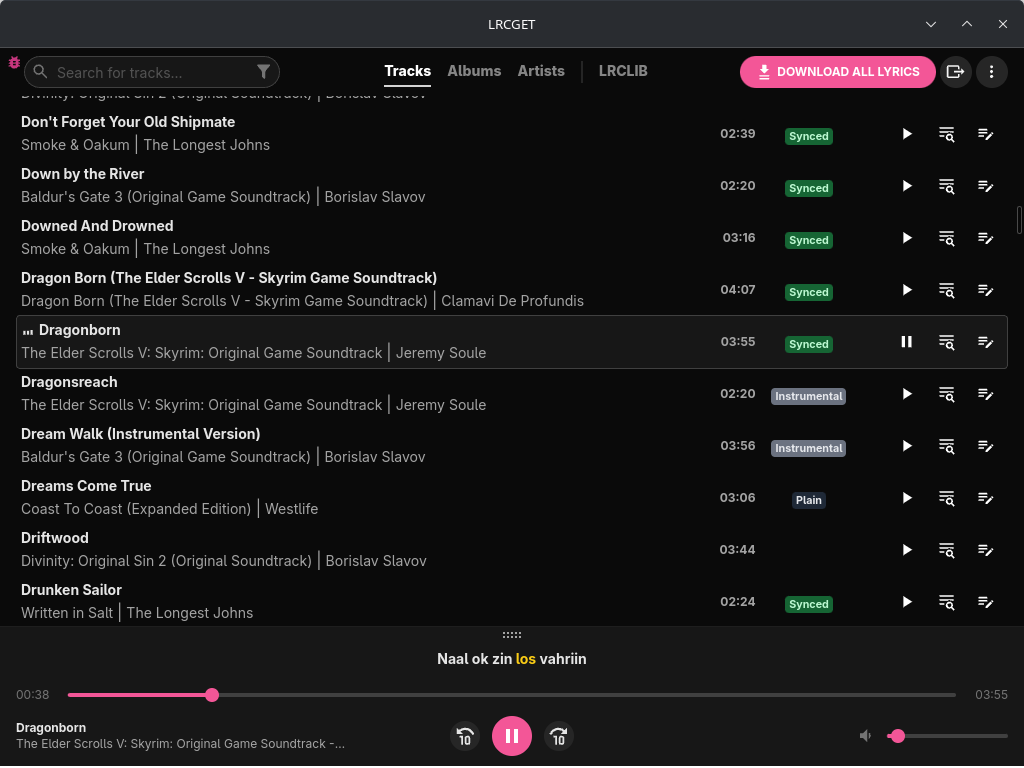
github.com/tranxuanthang/lrcget
flathub.org/en/apps/net.lrclib.lrcget
Resources:
lrclib.net
en.wikipedia.org/wiki/LRC_(file_format)

SPPAS is a scientific computer software package written and maintained by Brigitte Bigi of the Laboratoire Parole et Langage, in Aix-en-Provence, France. Available for free, with open source code, there is simply no other package for linguists to simple use in the automatic annotations of speech, the analyses of any kind of annotated data and the conversion of annotated files.
SPPAS is able to produce automatically speech annotations from a recorded speech sound and its orthographic transcription. SPPAS is helpful for the analysis of any annotated data: estimate statistical distributions, make requests, manage files, visualize annotations. SPPAS offers a file converter from & to a wide range of formats: xra, TextGrid, eaf, trs …
sppas.org
sourceforge.net/projects/sppas

SonicTree is a Linux music player for local music playback and filesystem-based navigation. It allows you to browse and play music directly from your existing folder structure without requiring a separate music library database.
Features:
- Designed around local folder-based music playback for clean and distraction-free listening experience
- Playback architecture powered by GStreamer for stable playback pipeline and decoder handling
- Audio metadata support powered by TagLib
- Low CPU usage during playback. Small and stable memory footprint with minimal background overhead
- Gapless Playback for improved listening experience for continuous albums, live recordings, and gapless music.
- Smooth and responsive playback experience with stable long-session playback behavior
- Repeat Off, Repeat Track, and Repeat Playlist modes
- Keyboard shortcuts for playback, seeking, and volume control
- Persistent application settings
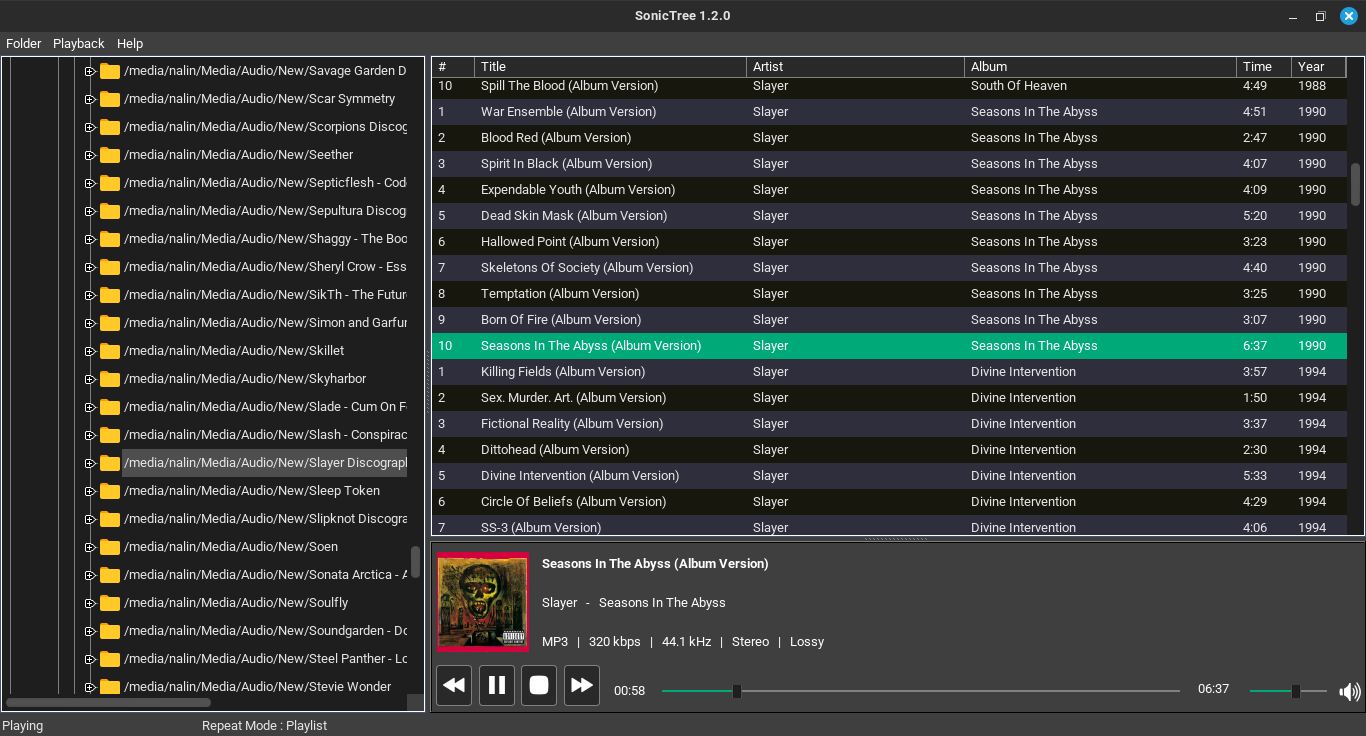
sourceforge.net/projects/sonictree
References:
itsfoss.com/sonictree-music-player/#get-sonictree
en.wikipedia.org/wiki/Gapless_playback
gstreamer.freedesktop.org
taglib.org

Show your currently playing song in a stylish way!
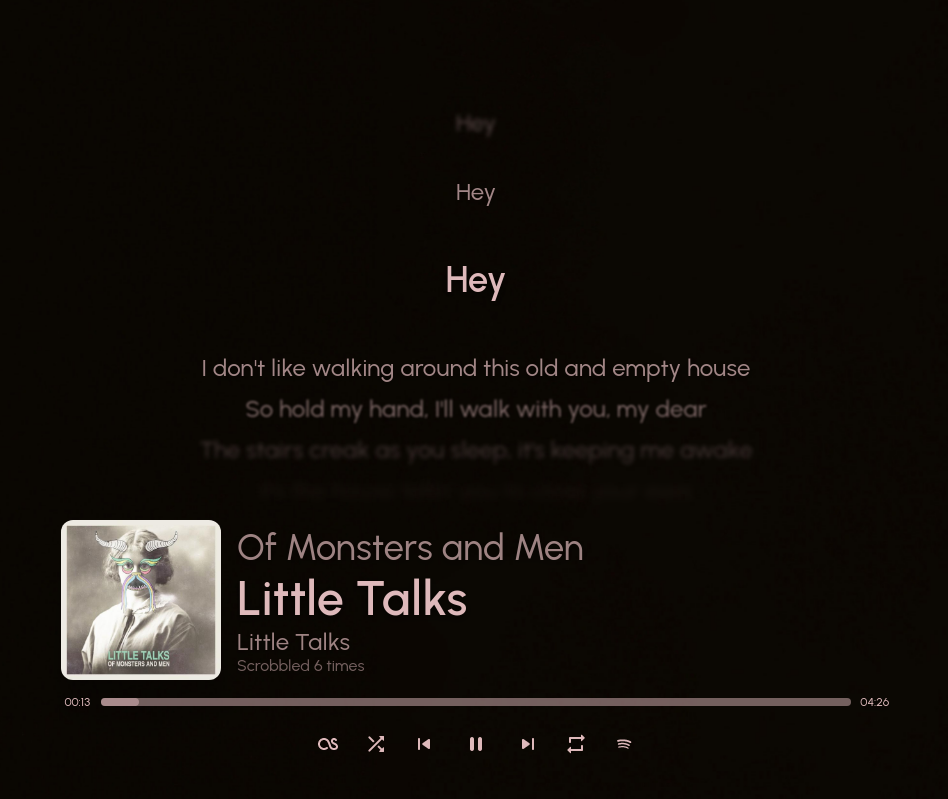
itsfoss.com/sunamu-music-widget

Listen to internet radio. Gnome style.
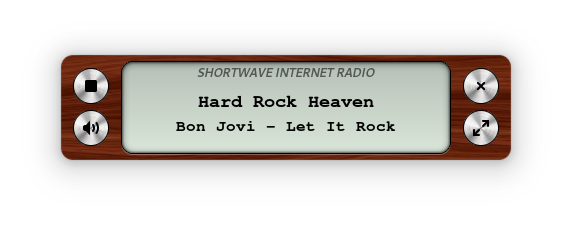
apps.gnome.org/Shortwave
gitlab.gnome.org/World/Shortwave

Cover-art for the 24seven.fm family of internet radio stations — Streaming Soundtracks, 1980s.FM, Adagio.FM, Death.FM, and Entranced.FM. A shared, host-agnostic C++ engine drives three Windows front-ends plus a cross-platform core library:
| Component | Directory | Output | Build system |
|---|---|---|---|
| Desktop viewer | desktop/ | 24sevenfm_covers.exe(x64, self-contained) | MSBuild (.vcxproj / .sln) |
| Winamp plugin | winamp/ | gen_24sevenfm_covers.dll(x86 / 32-bit) | CMake |
| foobar2000 component | foobar2000/foo_24sevenfm_covers/ | foo_24sevenfm_covers.dll(x64) | MSBuild ( .vcxproj) |
| Core library | lib/ | coverfetch static lib (cross-platform) | CMake |
All three front-ends share the same Direct2D renderer (shared/d2d_*.cpp), the cover engine (shared/cover_engine.* — cover preload, crossfade/flip transitions, remaining-time countdown), the options page (shared/options_*), and the networking/parse library (lib/). The library alone (lib/) is portable C++11 and already cross-compiles for Android/iOS.
github.com/pke/24sevenfm_covers

Dynamic Audio Normalizer is a library for advanced audio normalization purposes. It applies a certain amount of gain to the input audio in order to bring its peak magnitude to a target level (e.g. 0 dBFS). However, in contrast to more “simple” normalization algorithms, the Dynamic Audio Normalizer dynamically re-adjusts the gain factor to the input audio. This allows for applying extra gain to the “quiet” sections of the audio while avoiding distortions or clipping the “loud” sections. In other words: The Dynamic Audio Normalizer will “even out” the volume of quiet and loud sections, in the sense that the volume of each section is brought to the same target level. Note, however, that the Dynamic Audio Normalizer achieves this goal without applying “dynamic range compressing”. It will retain 100% of the dynamic range within each “local” region of the audio file.
The Dynamic Audio Normalizer is available as a small standalone command-line utility and also as an effect in the SoX audio processor as well as in the FFmpeg audio/video converter. Furthermore, it can be integrated into your favorite DAW (digital audio workstation), as a VST plug-in, or into your favorite media player, as a Winamp plug-in. Last but not least, the “core” library can be integrated into custom applications easily, thanks to a straightforward API (application programming interface).
github.com/lordmulder/DynamicAudioNormalizer

sonoscliis a modern Go CLI to control Sonos speakers over your local network (UPnP/SOAP).Features:
- Reliable discovery: SSDP + topology (
ZoneGroupTopology.GetZoneGroupState) with subnet scan fallback.- Coordinator-aware control: target any room; commands go to the group coordinator automatically.
- Playback controls: play/pause/stop/next/prev, plus
play-uri,linein, andtv.- Grouping: inspect groups, join/unjoin, party mode, dissolve groups, and solo a room.
- Queue: list/play/remove/clear queue entries.
- Favorites: list and play Sonos Favorites by index or title.
- Scenes: save/apply presets (grouping + per-room volume/mute).
- Spotify:
- Enqueue/play Spotify share links or canonical URIs (no Spotify credentials required).
- Search Spotify via SMAPI (Sonos Music API; uses your linked service in Sonos).
- Optional Spotify Web API search (client credentials) if you want it.
- YouTube handoff: resolve a YouTube URL with
yt-dlpand hand the direct audio stream to Sonos.- Smart URL streaming:
play-urlruns a short-lived local MP3 proxy for YouTube, YouTube Music playlists, podcasts, radio streams, SoundCloud-style pages, and other URLs.- Live events:
watchsubscribes to AVTransport + RenderingControl and prints changes.- Scriptable output:
--format plain|json|tsvplus--debugtracing.
This is not an official Sonos project.
github.com/steipete/sonoscli
sourceforge.net/projects/sonoscli.mirror

Real-time spatial / object-based audio rendering engine (VBAP + binaural) for multichannel and 3D audio — speakers or headphones.
Omniphony decodes object-based audio, works out where every sound should come from, and drives your real speakers with VBAP — live, with a 3D scene showing each object move and everything streamed over OSC. Nothing’s a black box: formats load as runtime bridges, and the part that decides which speaker gets what is a backend you can rewrite in a single file.
- Write your own panner in one file — it shows up in the UI on its own.
- No formats baked in — decoders load at runtime as bridges.
- PipeWire on Linux, ASIO on Windows, or raw float straight to a file or pipe.
omniphony.mgth.fr
github.com/mgth/Omniphony
mpv with the ad_orender Spatial decoder — Spatial object rendering via liborender (Omniphony)
References:
Resources:
aur.archlinux.org/packages/orender
github.com/harletty/harletty-bridge/tree/main

Record, jam, and capture your creativity whenever and wherever it strikes. Packed with authentic Fender tones, Fender Studio is fast, fun, and free for guitar players and music creators of all types.
fender.com/pages/fender-studio-app


