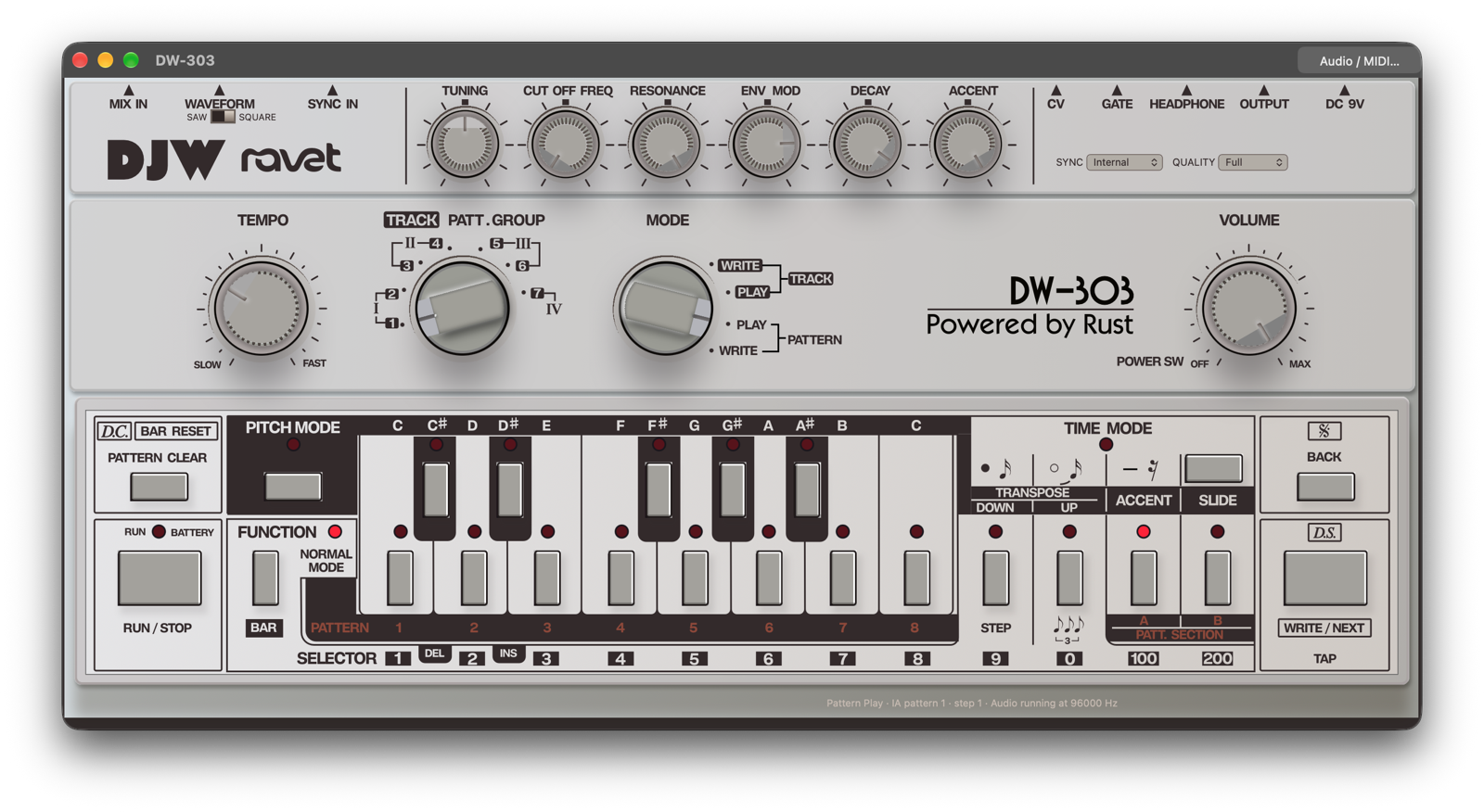
A circuit-modelled bass line synthesizer and step sequencer, built on RAVET. Formats: CLAP, AU, VST3, LV2, AAX and standalone.
References:
en.wikipedia.org/wiki/Roland_TB-303

A circuit-modelled bass line synthesizer and step sequencer, built on RAVET. Formats: CLAP, AU, VST3, LV2, AAX and standalone.
References:
en.wikipedia.org/wiki/Roland_TB-303

A physical-modeling voice synthesizer in the browser. Every sound comes from a simulated airway (lungs, vocal folds or syrinx, a branched vocal tract, lips, nose), not from samples. The engine is Rust, compiled to WebAssembly for an AudioWorklet; the same code runs natively for tests and the
chimeraCLI.What it does:
- Play: drag the tongue, lips and jaw in a live cutaway of the head; vowel pad, encoders, computer keyboard and Web MIDI.
- Speak: English text (CMUdict with a letter-to-sound fallback) or IPA, turned into gestures and prosody, with the gestural score and a consonant chart on screen.
- Sing: piano roll with lyrics per note; consonants land before the beat.
- Beatbox: pads and a step sequencer, every drum an articulatory gesture.
- Bestiary: songbird (two-voice syrinx), seal, alligator and elephant.
- Duet (
?show=<id>): two 3D heads replay a pre-rendered song.Male, female and child bodies blend continuously. Everything on screen animates from live engine state: pressure in the airway, airflow, the vocal folds, spectra and formants.
chimera-vocal-synth.vercel.app
github.com/jamesondh/chimera-vocal-synth

Hi-Audio is a free, open-source platform for musicians who want to collaborate on multitrack recordings over the internet.
Musicians can record their individual parts, upload existing recordings, and contribute to shared music projects without having to be in the same studio. Recordings are organized into synchronized tracks, making it possible to assemble performances from different contributors and locations.
The platform is also designed to support music research. Contributions help build collections of multitrack recordings that can be used to study music, develop audio analysis tools and advance music technology.
hiaudio.fr
github.com/idsinge/hiaudio_webapp
Research Project / hi-audio.imt.fr/the-hi-audio-platform
waveform-playlist

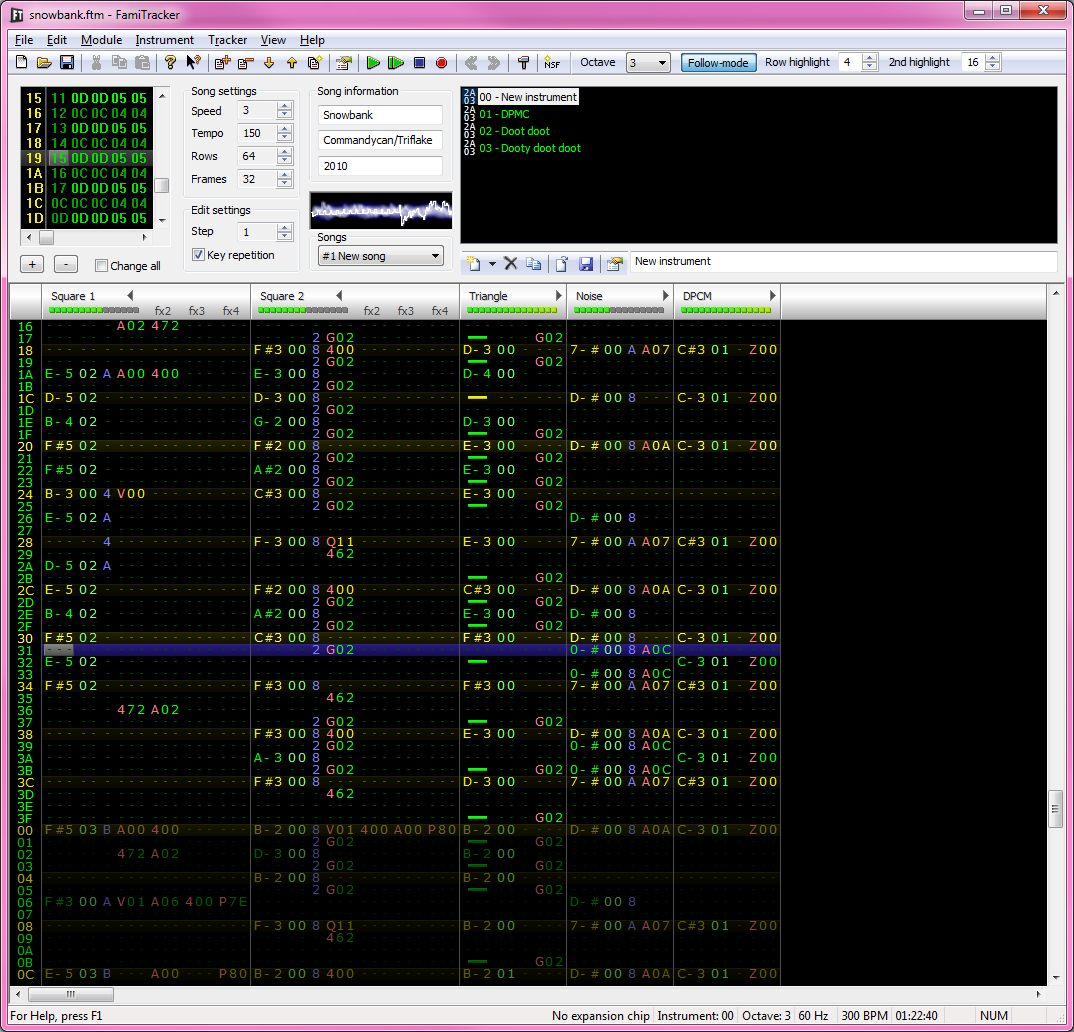
FamiTracker is a free Windows tracker for producing music for the NES/Famicom-systems. The interface is based on MadTracker and should be easy to use if you’ve been using trackers before.
One of the features is NSF-file exporting. That allows music created in this tracker to be played on the real hardware, or even for use in your own NES-applications.
Some other features:
- Full real-time emulation of all channels
- Internal PCM to DPCM-sample converter
- MIDI input devices are supported
- NTSC & PAL modes are both supported
famitracker.com
www.reddit.com/r/famitracker
en.namu.wiki/w/FamiTracker

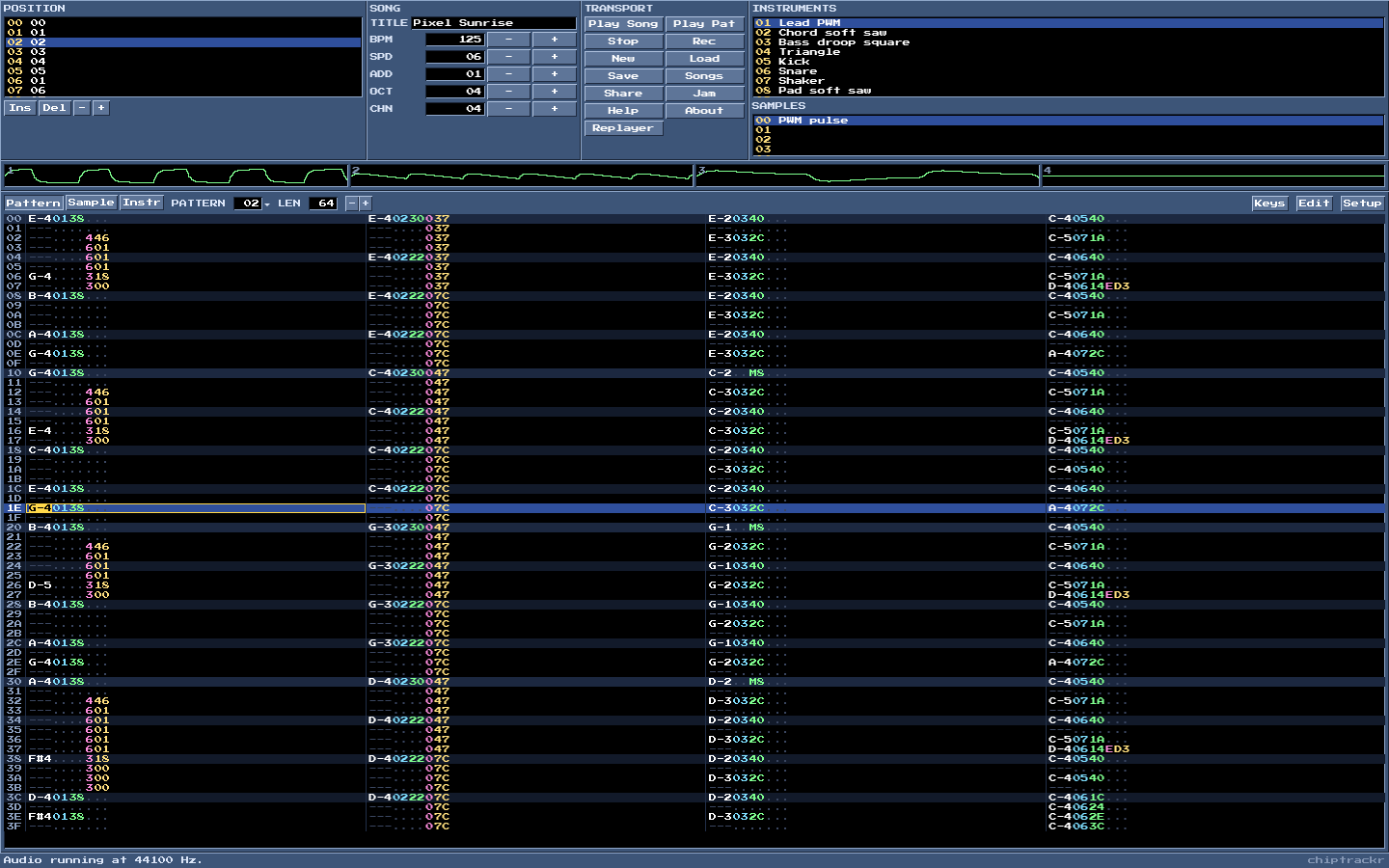
Browser-based chiptune tracker for the demoscene. Compose XM/MOD/S3M/IT in the classic tracker style, on desktop and mobile, with live jams and a tiny intro replayer.
chiptrackr.com
github.com/wirehack7/webtracker
GameBoy online tracker ~ gb.chiptrackr.com
en.wikipedia.org/wiki/Music_tracker

Extreme-fidelity synthesis of musical elements.
Music generates and manipulates sound in LPCM audio, sample by sample. It implements MASS (Music and Audio in Sample Sequences), a collection of psychophysical descriptions of musical elements expressed as equations and corresponding Python routines.
Music can synthesize musical notes, scales and chords, apply audio filters and effects, create spatial audio, and even sing lyrics to a melody. It is designed for precise sound synthesis, audio processing, and experiments with music and sound.

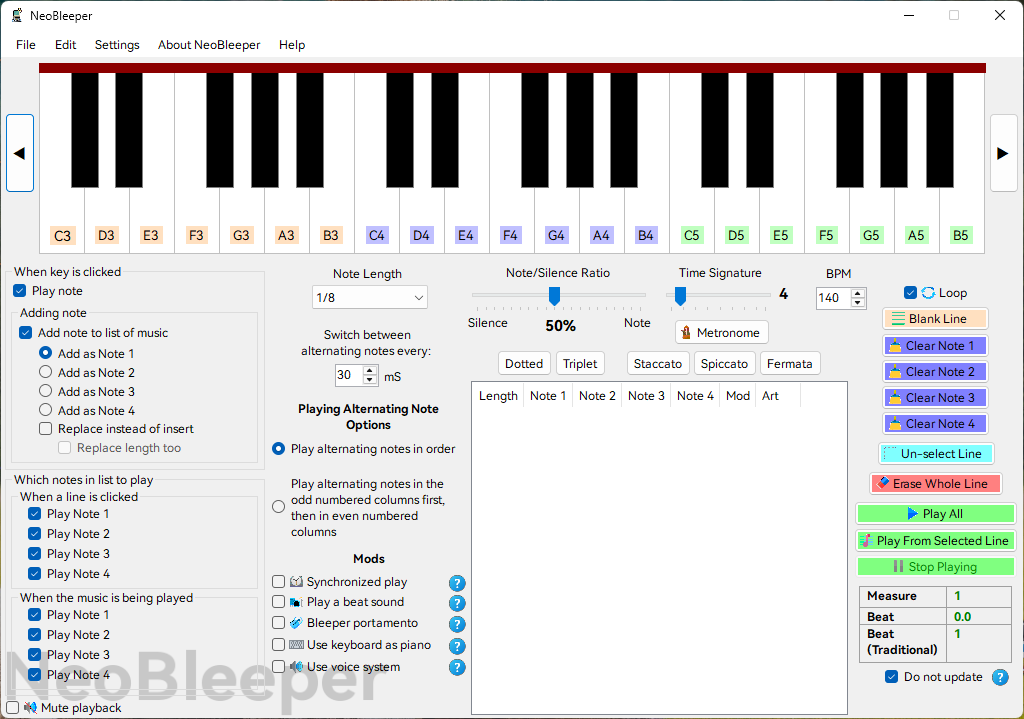
NeoBleeper is the world’s first AI-enabled tune creation software using the system speaker (aka PC Speaker) on the motherboard, inspired by the Bleeper Music Maker software that Robbi-985 (aka SomethingUnreal) developed around late 2007-early 2008 but abandoned in 2011 due to the fact that beeps were directed to the default sound device instead of the system speaker on the motherboard in newer Windows versions. NeoBleeper provides a more stable music making experience by solving the problem of system beeps being directed to the default sound device instead of the system speaker on the motherboard in newer Windows versions by accessing the physical port of the system speaker.
github.com/GeniusPilot2016/NeoBleeper

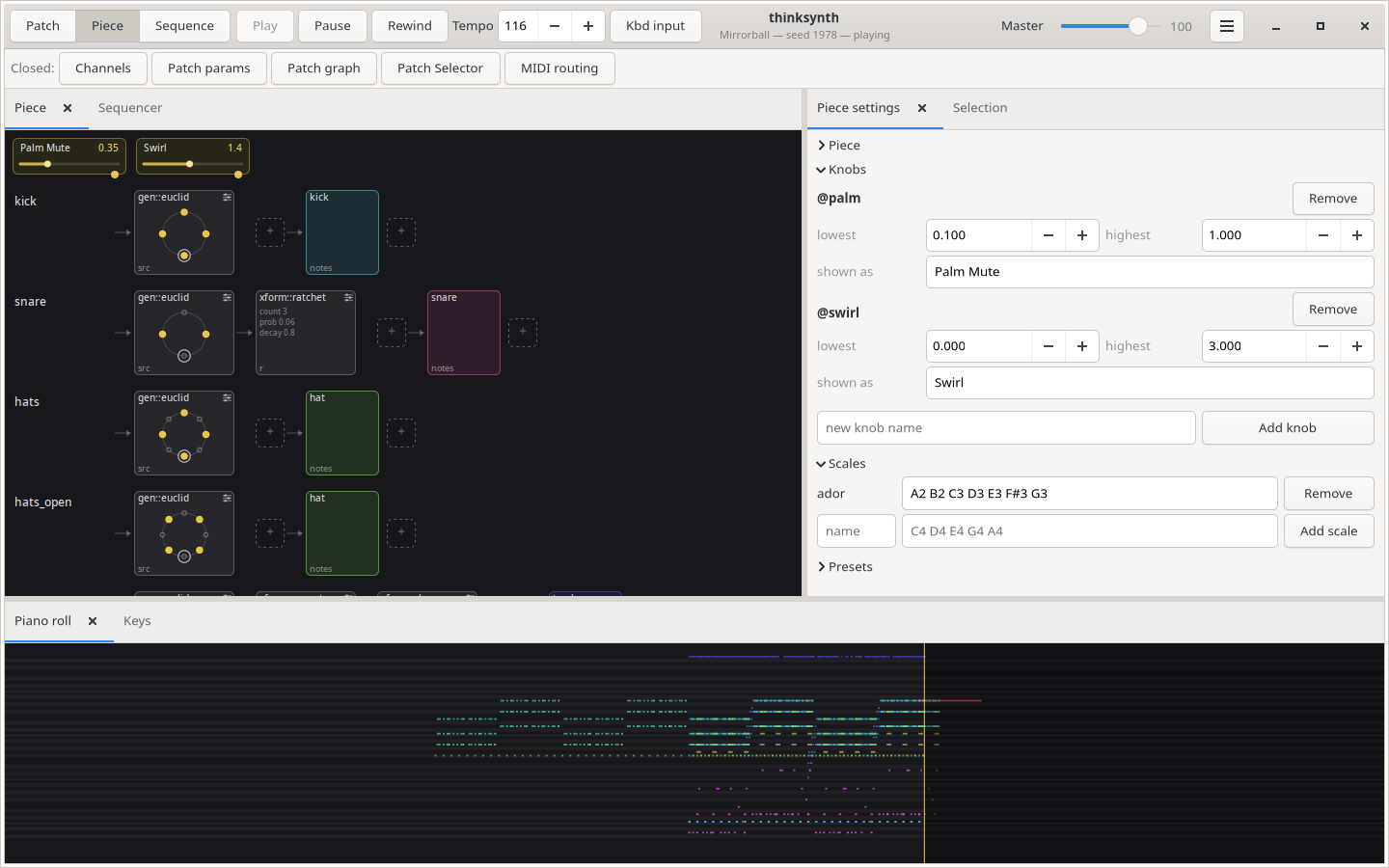
thinksynth builds sounds out of a graph of DSP nodes — oscillators, filters, envelopes, delays and arithmetic — described in a small language and rendered in real time. Patches assign those graphs to MIDI channels, so one instrument can layer several voices.
Every node is a plugin, and the set that ships covers subtractive and FM synthesis, resonators, waveshaping and a range of filters. New ones are ordinary shared libraries dropped into the plugin directory.

Tonbandfetzen is a collection of command-line tools that allow you to compose music based on audio fragments generated from plain text input. It contains:
tz mel– generate sound fragments from plain texttz guitar– read guitar tablaturetz stick– concatenate audio datatz stack– superimpose audio datatz stretch– rescale audio datatz repeat– loop audio datatz trim– strip leading and trailing silencetz mono– unzip audio channelstz harmonics– show spectra of wave samplestz inspect– show information on audio filetz riff2aiff– convert .wav(e) into .aif(f) filestz aiff2riff– convert .aif(f) into .wav(e) filestz tag– add ID3v2 metadata to .wav(e) filestz play– generate and play sound fragments
github.com/janberges/Tonbandfetzen

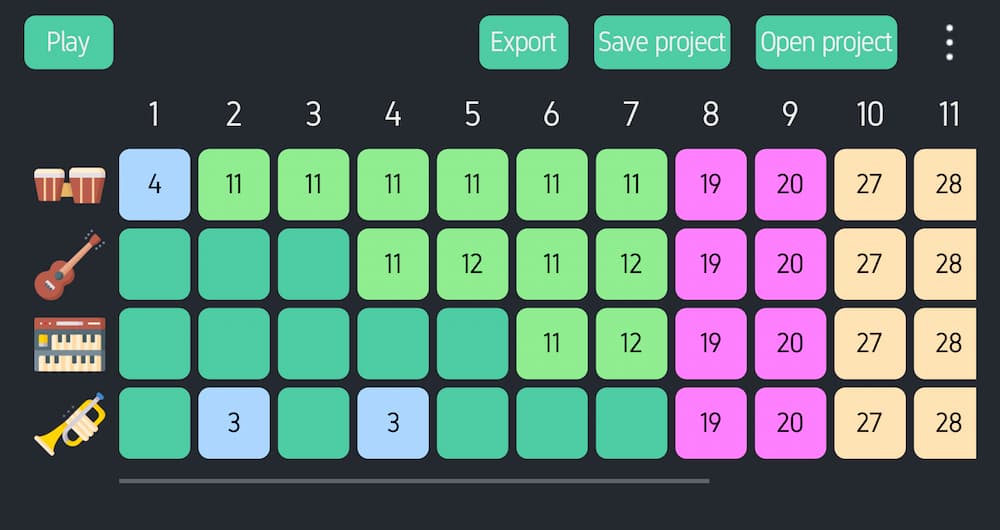
A recreation of the music making app found on Sony Ericsson devices of the 2000s.
github.com/pattlebass/Music-DJ

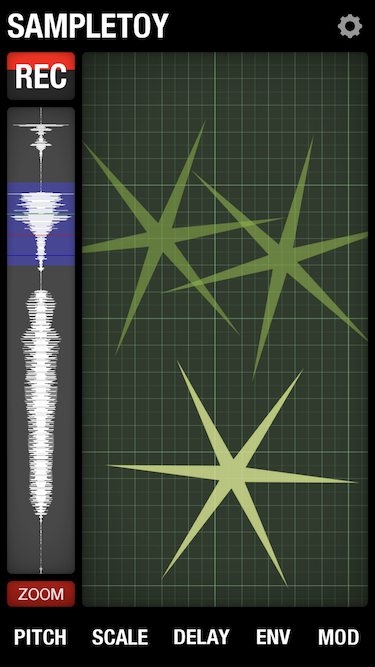
Sampletoy is a radical new musical instrument / plaything;
part sampler, part granular synthesiser.Use it to capture sounds through the microphone,
then play, loop, pitch and distort them live on the screen.
www.elf-audio.com/sampletoy
www.facebook.com/elfaudioapps


