Make hardware instruments behave like plugins. A Raspberry Pi 4B plays as an instrument track in Ableton Live today β Git-style total recall through the project’s own save/reopen, knobs as sample-accurate automation lanes, and offline bounce through the physical box.
Hardware synths, drum machines, and effects have connected to computers for forty years, and the connection is still fragile in one specific way: recall. Audio mostly works, MIDI mostly works β but reopen last month’s project and the hardware is not in the state you saved, and nothing will tell you. The deep integrations that fix this (multichannel USB audio, plugin-shell control, total recall) have existed only inside closed single-vendor ecosystems, because every vendor has to rebuild drivers, state sync, and DAW compatibility from scratch.
HARP is a complete, working implementation of that integration β with an open spec underneath, if you want to build a device on it. The reference device is a Raspberry Pi running a 16-part multitimbral, 8-voice-polyphonic synth (13 params per part); anything that speaks the protocol gets the same treatment from any conforming host:
- Total recall, Git-style β device state is content-addressed and hash-verified; a saved project reopens with the hardware provably in the saved state, every overwrite preceded by a free snapshot, every mismatch resolved through explicit safe actions β never silently. The archive doubles as patch time-travel: every state the box has ever been pushed over is one click away.
- Audio as a plugin β a dedicated stream into the plugin shell that bypasses the OS audio stack (no aggregate-device hacks), including a host-paced mode where the hardware renders deterministically, byte- identical, faster than real time: offline bounce through a physical box at ~25Γ real time, with 16 ms of reported latency at DAW buffers β€ 256 β in the neighborhood of a good audio interface.
- Multitimbral, addressed like plugins β one physical device is one session, and several shell instances can share it: drop the plugin on a handful of DAW tracks and each instance drives its own part β its own channel, params, recall state, and stereo output (16 parts, with a summed main mix alongside the per-part outputs). A recall-safe Part knob persists each track’s part in the project, and that per-part state moves intact between the VST3 and AU formats (the CLAP shell writes the same recall bundle).
- Polyphonic, with per-voice modulation β each part is an 8-voice pool with deterministic voice allocation, so overlapping notes ring out on their own voices instead of stealing one. Modulation is non-destructive and per voice: a VST3 Note Expression or a CLAP per-note parameter modulation bends a single sounding note’s filter cutoff without touching the stored patch β and the two formats render byte-identically (the device applies the Β§9.5 mod the same regardless of which shell sent it).
- Sample-accurate everything β DAW automation becomes device-interpolated ramps applied within Β±1 sample; notes travel as UMP; an event fence makes “applied late” structurally impossible rather than statistically rare. Turn a knob on the hardware and the DAW records the automation (echo).
- Musical time β devices follow the DAW’s transport: tempo, position, loops. The reference device’s arpeggiator locks to Live’s grid sample-exactly, survives loop wraps, and renders a byte-identical groove β determinism extended to musical time.
- Identity, timing, diagnostics β engine versioning and parameter-map hashing protect old songs from new firmware, latency is measured (never guessed), and error counters at every layer end “it glitched” support threads with evidence.
- Roadie-proof sessions β unplug the cable mid-song and plug it back: the shell reconnects, re-asserts the project’s state, and audio resumes. Hostile or corrupt wire input ends in a clean session reset, never a crash (every parser is fuzzed; a live abuse test is part of CI).
Category Archives: Production
jamailmar ~ Multi-threaded Ogg Vorbis Decoder
Linux code to decode Ogg Vorbis files with multi-thread support
Producer Player ~ Mastering Workspaces
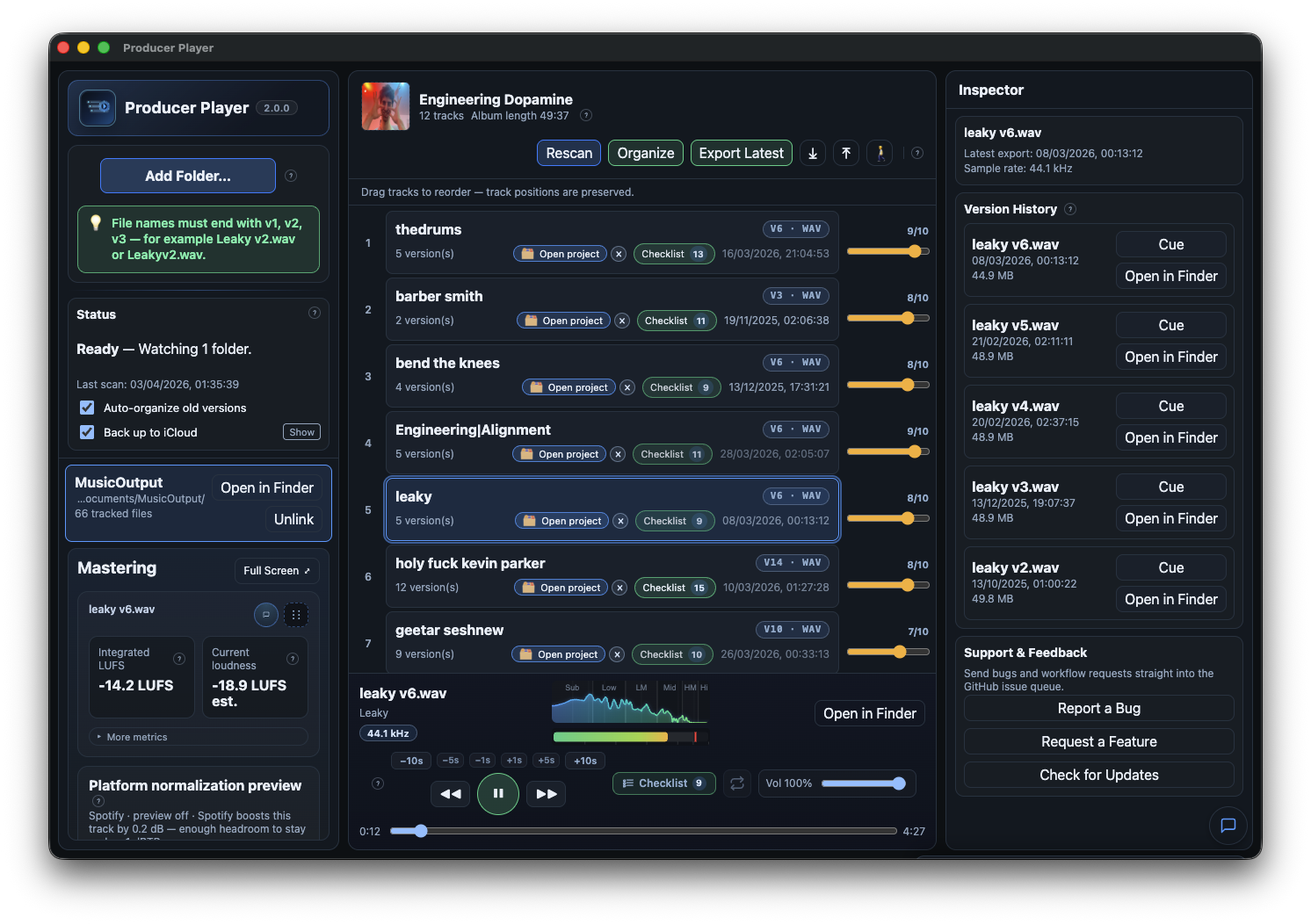
A desktop app for producers who bounce a lot. Drag in a folder of exports and Producer Player auto-groups versions, organizes your album, and gives you a full mastering workspace — all in one place.

ethansk.github.io/producer-player
github.com/EthanSK/producer-player
FlavourMTCΒ ~ Mixbus Tone Control
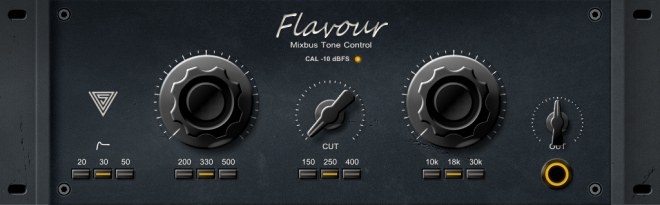
FlavourMTC follows classic βpassiveβ equalizer designs where the EQ circuits itself are not able to amplify signals but a dedicated amplifier stage takes care of it. Those EQ designs are well known for allowing very transparent frequency changes while their amplifier designs do add some icing on the cake quite often.
FlavourMTC implements this by utilizing 1st order shelving filter designs avoiding unwanted resonances and takes advantage of βzero delayβ implementations for most accurate higher order filtering and w/o introducing curve warping near Nyquist frequency. The output amplifier stage of the plugin can be calibrated according specific mixing levels, provides a distinct βbox toneβ and glues everything together. Parts of the plugin are oversampled internally for maximum transparency and sound quality.

shntool ~ WAVE Processing & Reporting Utility
shntool is a multi-purpose WAVE data processing and reporting utility. File formats are abstracted from its core, so it can process any file that contains WAVE data, compressed or not – provided there exists a format module to handle that particular file type.
shntool has native support for .wav files. If you want it to work with other lossless audio formats, you must have the appropriate helper program installed. The “Helper programs” section below contains links to helper programs for each format that shntool supports.
CLAMPS ~ Common Lisp Aided Music Production System
Clamps, short for “Common Lisp Aided Music Production System”, is a software system for realtime and non-realtime music production written in Common Lisp. It enables a seamless workflow between high-level structures to define musical processes all the way down to low level DSP definitions for sound creation including browser based interfaces for interactive work and control useable for live performances. In that respect it combines features of systems like OpenMusic, SuperCollider or the Pure Data/Max family of software.
codeberg.org/ormf/clamps
codeberg.org/ormf/clamps-install
github.com/arclanguage/Clamp
Cakewalk ~ Free Digital Audio Workstation
The most complete music production package
The creative experience. Only Cakewalk by BandLab offers: advanced technology, effortless workflow, and an interface that amplifies inspiration.
Compose ~ Easily compose complete songs and performances with creative songwriting tools and instruments
Record ~ Capture inspired performances with pristine quality and unlimited audio and MIDI tracks
Edit ~ Fix mistakes, arrange parts, and manipulate pitch, time, and any other aspect of your recordings
Mix ~ Achieve pristine pro-studio sounds and create big, clear, dynamic mixes with advanced mixing tools
Master ~ Polish your finished mixes to perfection with built-in mastering tools
Share ~ Export and publish your songs directly to YouTube, SoundCloud, Facebook and more
www.bandlab.com/products/cakewalk

Correlometer ~ Multi-band Correlation Meter
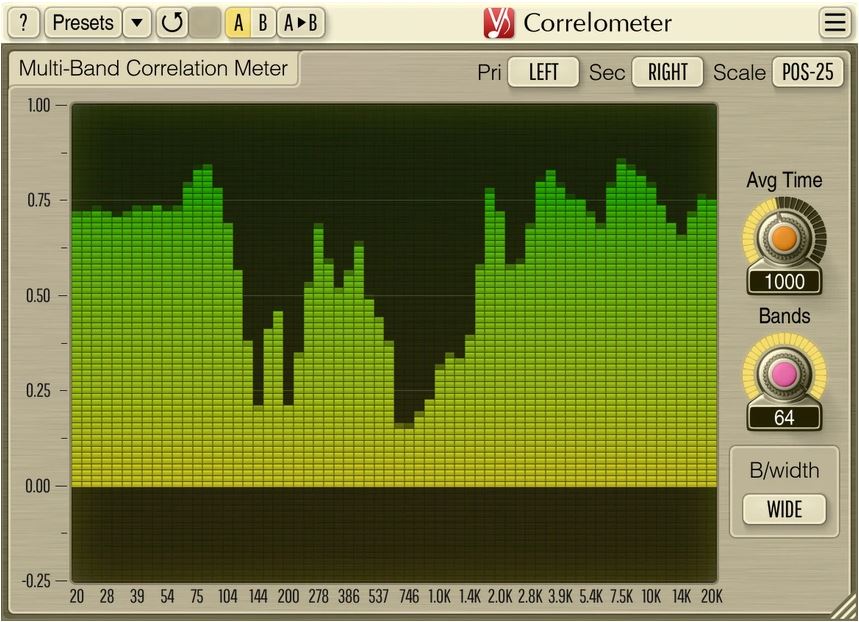
Correlometer is an analog-style stereo multi-band correlation meter.
Multi-band correlation meter is an advanced way to check for presence of out-of-phase elements in the mix. Broadband correlation metering reports overall phase issues and may misrepresent problems present in select spectral bands, while multi-band correlation meter easily highlights problems present in mid to high frequencies that are not easily heard by ear, but may still reduce clarity of the mix. Another application of multi-band correlation metering is phase- and time-aligning of channels and tracks, especially bass and bass-drum pairs, guitar mic and D.I. source pairs, two-microphone stereo recordings, etc.
Correlometer can display 4 to 64 individual spectral bands, with adjustable band quality factor that controls the degree of band’s selectivity. Averaging time of correlation estimator can be adjusted. Correlometer supports side-chain inputs for easy correlation estimation between separate audio tracks.plugins4free.com/plugin/2957/
- 4 to 64 band correlation meter.
- Adjustable band quality factor.
- Adjustable averaging time.
- Side-chain input.
- Resizable user interface.
- All sample rates support.
- Zero processing latency.
- User interface color schemes.
- Retina and High DPI support.

JJazzLab ~ Generate Backing Tracks
JJazzLab is a Midi-based application dedicated to backing tracks generation. You type in chord symbols, select a rhythm (style), then the application generates a complete backing track with drums, bass, guitar, piano, strings, etc.
The objective is to generate intelligent and interesting backing tracks, i.e tracks which are:
github.com/jjazzboss/JJazzLab
- realistic
- non-boring (with variations)
- easily customizable, even for complex songs
jjazzlab.gitbook.io/user-guide
www.facebook.com/jjazzlab/
www.youtube.com/channel/UC0L3SwjY6bhTj6jsbOYzzAw

JJazzLab-X ~ Generate Backing Tracks
JJazzLab-X is a Midi-based framework dedicated to backing tracks generation -some people talk about “play-along songs” or βauto-accompaniment applicationsβ. You type in chord symbols, select a rhythm (style), then the application generates a complete backing track with drums, bass, guitar, piano, strings, etc.
The objective is to develop a jam buddy able to quickly generate intelligent and interesting backing tracks: realistic and non-boring backing tracks which you can easily adjust to a specific song.
github.com/jjazzboss/JJazzLab-X
TDR Kotelnikov ~ Wideband Dynamics Processor
TDR Kotelnikov is a wideband dynamics processor combining high fidelity dynamic range control with deep musical flexibility. As a descendant of the venerable TDR Feedback Compressor product family, Kotelnikov has directly inherited several unique features such as a proven control scheme, individual release control for peak and RMS content, an intuitive user interface, and powerful, state of the art, high-precision algorithms.
With a sonic signature best described as βstealthyβ, Kotelnikov has the ability to manipulate the dynamic range by dramatic amounts, while carefully preserving the original tone, timbre and punch of a musical signal. As such, it is perfectly suited to stereo bus compression as well as other critical applications.
The concept is βproudly digitalβ in the sense that it doesnβt try to emulate any previously existing device. This is the original!
Features:
- 64bit multi-rate processing structure for highest accuracy
- βDeltaβ oversampled signal path (bit transparent at 0dB gain reduction)
- Super fast, yet natural sounding compression
- βCrest factorβ based control scheme offering independent release controls for peak and RMS events
- Flexible sidechain highpass filter
- Advanced stereo linking options optimized for the stereo bus
- Delta preview mode previews the difference between compressed and original signal
- Latency compensated, click free bypass (i.e. processing never interrupted)
- User interface rescaling (100%, 125%, 150%)
TAP-plugins ~ LADSPA Linux Plugins
Tom’s Audio Processing plugins is a selection of LADSPA plugins for audio engineering on the Linux platform. Intended for use in a professional DAW environment such as Ardour, it includes high quality reverberation, echo, eq, limiter & more.
tomscii.sig7.se/tap-plugins/index
sourceforge.net/projects/tap-plugins
github.com/tomszilagyi/tap-plugins