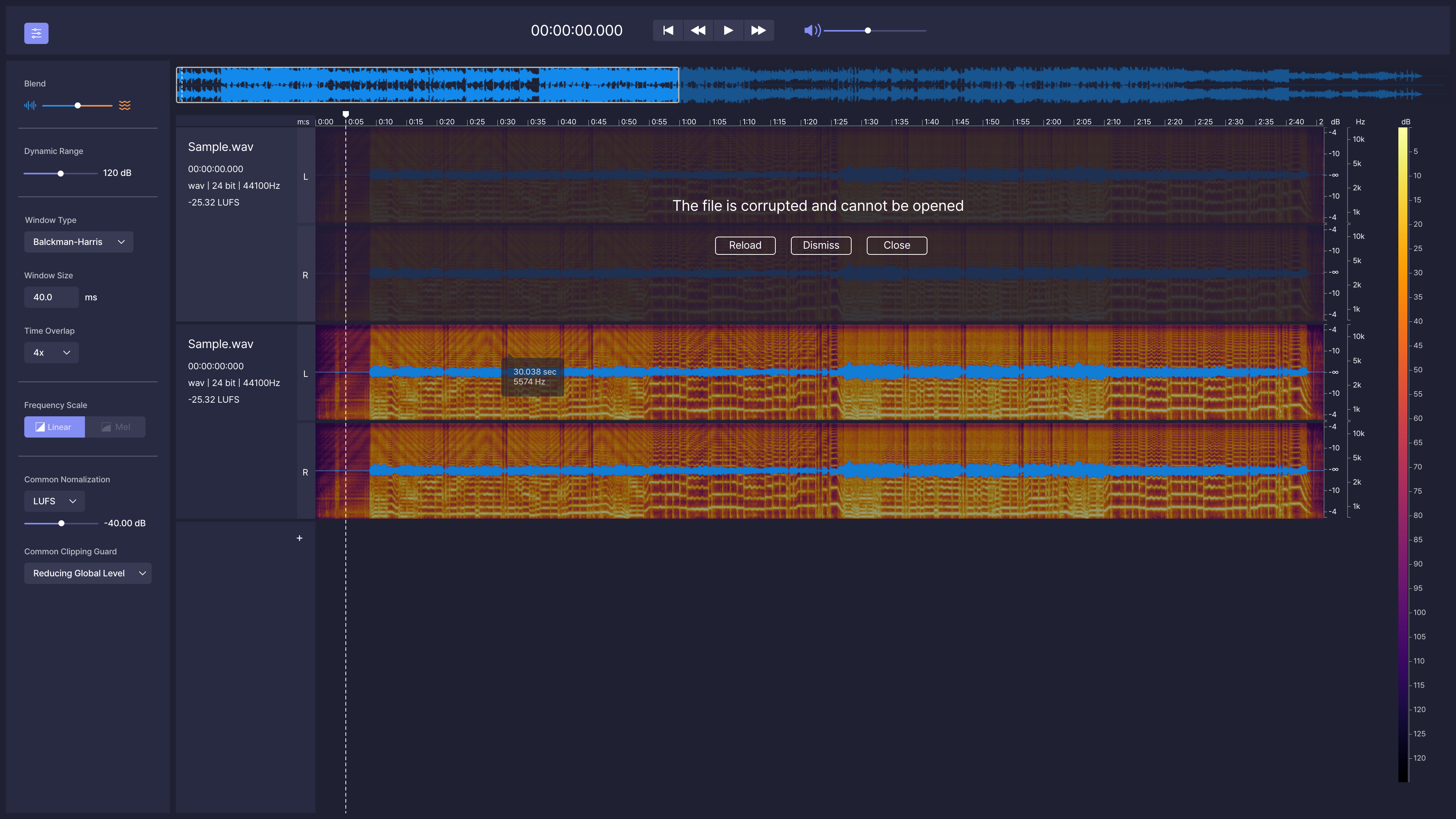
Analyze audio files or microphone input with a real-time spectrum and spectrogram. Check clipping, noise, hum, loudness, and True Peak.
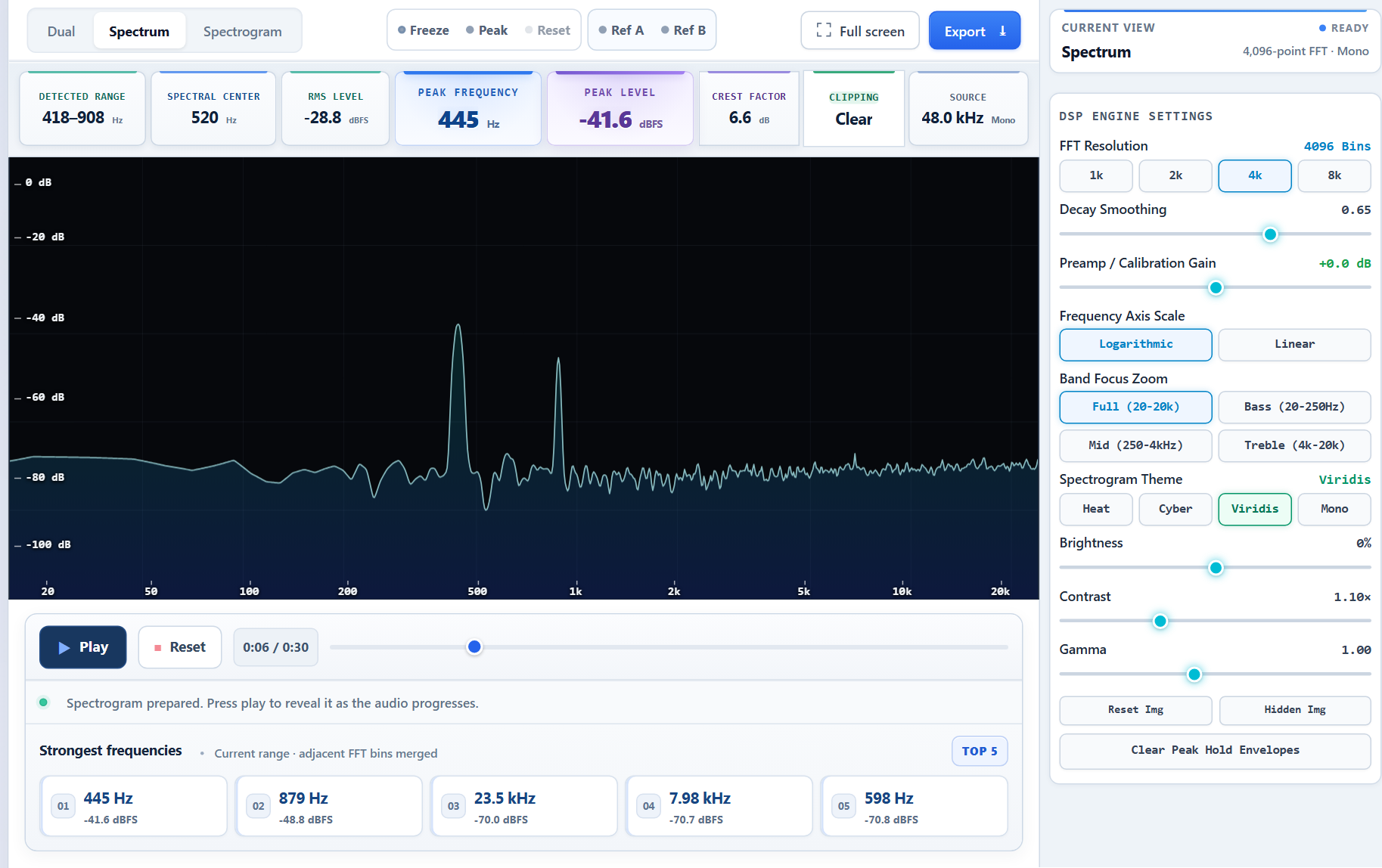

Analyze audio files or microphone input with a real-time spectrum and spectrogram. Check clipping, noise, hum, loudness, and True Peak.

Detects the tempo of a track and which of Tango, Vals, Milonga it is – or none of the three – from the audio alone, without reading the genre tag.
The two answers are linked. The tempo a dancer taps is not a property of the audio by itself: a tango is tapped on the beat, a vals once per 3/4 bar, a milonga once per 2/4 bar, a reggae on the quarter note – under the skank rather than on it. So the rhythm is settled first and the tempo reported on the level that rhythm implies. Measured against 3,692 hand-tapped tracks the estimate lands within 2 BPM of the tap 88.7% of the time, which is about as close as the same person tapping the same track twice; rhythm classification is 93.6% accurate. docs/tango-analysis.md has the method and the full numbers, and docs/cortina-genres.md covers the cortina genres that were measured and left alone.
Originally written by Michael Balzer+Holger Stenger as BPM Analyser, but bpmcore engine was completely rewritten.
github.com/shaforostoff/foo_rubato
hydrogenaudio.org/index.php/topic,129923.0
en.wikipedia.org/wiki/Tempo_rubato

Manifold is a desktop audio batch-processing tool built for inspecting, transforming, and exporting large collections of audio files with a visual workflow editor. Useful for checking and pre-processing audio for game-audio production, podcasts and broadcast, it is designed to make repetitive tasks more efficient and reproducible.
It combines a polished ImGui-based interface with a custom node-based audio pipeline, allowing you to build repeatable processing chains for tasks such as loudness normalization, peak limiting, DC offset cleanup, resampling, and format conversion.Why Manifold?
Manifold was designed to make audio batch work feel more structured and reproducible. Instead of manually running ad-hoc commands or scripting every step, you can:
This makes it useful for workflows such as podcast preparation, mastering prep, broadcast delivery, and game-audio asset processing.
Manifold includes a growing set of audio processing and analysis nodes, including:
These nodes can be chained together to create custom pipelines for different production scenarios.

Drop a track. EarChord reads the chord progression, the key and the tempo. The audio is analysed on this device and never leaves your browser.

getID3() is a PHP script that extracts useful information from MP3s & other multimedia file formats.
www.getid3.org
github.com/JamesHeinrich/getID3
sourceforge.net/projects/getid3
www.drupal.org/project/getid3
github.com/Owen-oj/laravel-getid3
github.com/plutuss/getid3
packages.debian.org/sid/php-getid3

A pure-Python inspector, editor, and forensic tool for audio files and synth/DAW presets: read the metadata, decode the format structure byte by byte, flag anomalies, repair broken containers, and identify how a file was made.
Reads BPM, key, duration, tags, and format info from WAV, AIFF, MP3, FLAC, OGG, Opus, M4A, MIDI, and Serum presets. Also structurally decodes Bitwig (.bwpreset/.bwclip), Native Instruments (Massive/Absynth/Kontakt/NKS/KORE), Vital, NCW, SoundFont (SF2/SF3), tracker modules (MOD/XM/IT), MP4, VST FXP, ReCycle RX2, and RMID containers via
inspect. Beyond reading:repairandvalidatefix and check container structure (stale sizes, offset tables, counts, pad bytes) without touching a byte of audio, andauditgives a forensic verdict (structure, integrity, hidden data, and the writing tool). One pure-Python dependency (mutagen); the nativeinspectwalkers need nothing. Optional librosa analysis for BPM/key detection and ML feature extraction.Also ships per-library SQLite indexes (
acidcat index) tracked in a small global registry, plus an MCP server (acidcat-mcp) so an LLM can query your whole collection across libraries by bpm, key, tags, or full-text.
github.com/hed0rah/acidcat
github.com/hed0rah/acidcat-playground
www.databurn.org

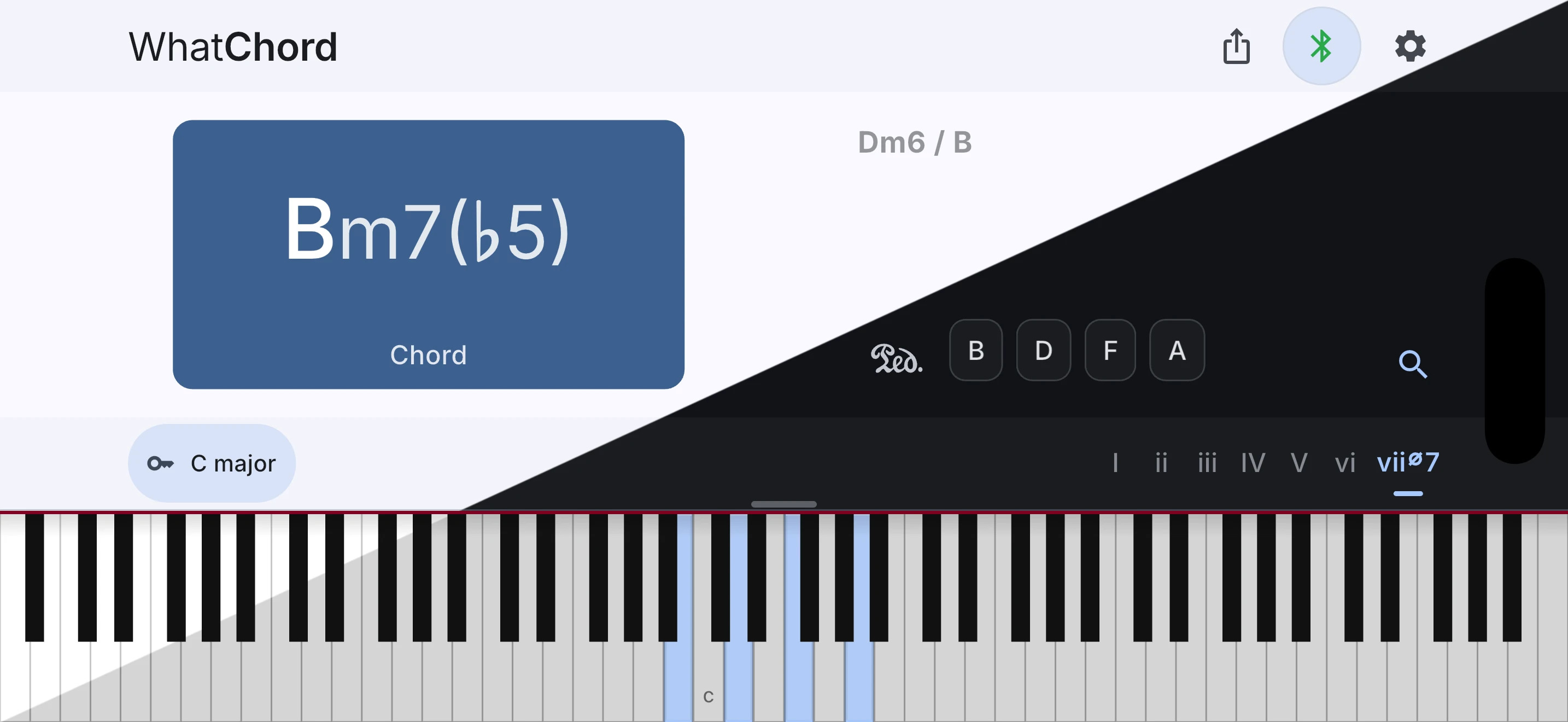
WhatChord is an interactive chord identification, key detection, and harmony exploration app. Identify voicings from live Bluetooth or USB MIDI input or manual note entry, follow the key as you play, then explore chords, scales, keyboard patterns, and harmonic context. It is optimized for speed, accuracy, and musician-expected naming, favoring stable, conventional interpretations over simple note-matching.
whatchord.earthmanmuons.com
github.com/EarthmanMuons/whatchord

Compare your mix against a reference track. Level-matched A/B with spectrum overlay and detailed metrics.

LUFS, True Peak, BPM, Key, Stereo Width, Frequency Spectrum — everything runs locally in your browser. No uploads.

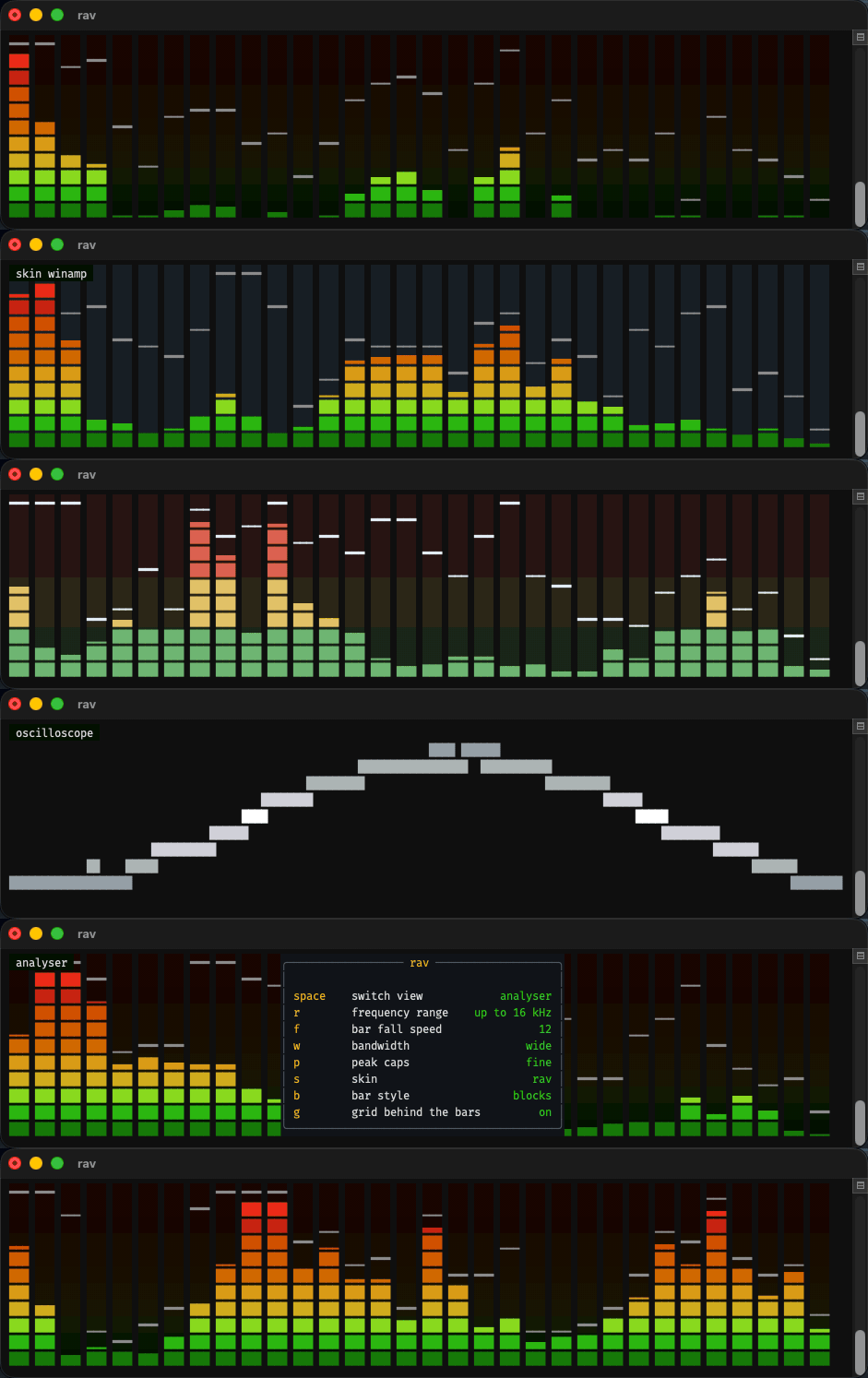
A real-time spectrum analyser with bars, peak caps and an oscilloscope, in truecolour.

SPPAS is a scientific computer software package written and maintained by Brigitte Bigi of the Laboratoire Parole et Langage, in Aix-en-Provence, France. Available for free, with open source code, there is simply no other package for linguists to simple use in the automatic annotations of speech, the analyses of any kind of annotated data and the conversion of annotated files.
SPPAS is able to produce automatically speech annotations from a recorded speech sound and its orthographic transcription. SPPAS is helpful for the analysis of any annotated data: estimate statistical distributions, make requests, manage files, visualize annotations. SPPAS offers a file converter from & to a wide range of formats: xra, TextGrid, eaf, trs …
sppas.org
sourceforge.net/projects/sppas

Thesia is a Multi-track Spectrogram / Waveform viewer This project is in beta.