Manifold ~ Audio Batch Processing Tool


Manifold is a desktop audio batch-processing tool built for inspecting, transforming, and exporting large collections of audio files with a visual workflow editor. Useful for checking and pre-processing audio for game-audio production, podcasts and broadcast, it is designed to make repetitive tasks more efficient and reproducible.

It combines a polished ImGui-based interface with a custom node-based audio pipeline, allowing you to build repeatable processing chains for tasks such as loudness normalization, peak limiting, DC offset cleanup, resampling, and format conversion.Why Manifold?

Manifold was designed to make audio batch work feel more structured and reproducible. Instead of manually running ad-hoc commands or scripting every step, you can:

  • import whole folders of audio files,
  • inspect their metadata and analysis results,
  • create reusable processing chains,
  • export processed files with consistent naming and format settings.

This makes it useful for workflows such as podcast preparation, mastering prep, broadcast delivery, and game-audio asset processing.

Key Features:

  • Batch import of files and folders
  • Drag-and-drop support from the file explorer
  • Built-in audio playback for quick previews
  • File table with metadata and analysis metrics
  • Configurable processing workflows using nodes
  • Output settings for folder, naming, format, and subtype
  • Background processing with task history and logs
  • Parallel analysis for loudness and DC offset metrics

Supported Processing Nodes:

Manifold includes a growing set of audio processing and analysis nodes, including:

  • Loudness analysis
  • Loudness normalization
  • True peak limiting
  • DC offset removal
  • Peak normalization
  • Channel mixing
  • Silence trimming
  • Fade in/out
  • Loudness compliance checks
  • Clipping detection
  • Dynamic range analysis

These nodes can be chained together to create custom pipelines for different production scenarios.

github.com/AnClark/Manifold

DXD-e ~ Experimental DXD Audio Format


This is a library that implements a proposed digital audio intermediary format, called DXD-e, that allows audio player and workstation applications to handle DSD (Direct Stream Digital) audio with only minor modifications to their input and output plugins. This is accomplished by embedding the original 1-bit DSD audio stream, along with a digital pilot signal, into a conventional decimated 24-bit PCM version of the DSD stream (which is known otherwise as DXD). This embedding consumes the 9 LSBs of each 24-bit sample (8 for the DSD and 1 for the pilot) while noise-shaping filters are employed to completely bury the resulting noise underneath the existing high-frequency DSD quantization noise always found in a DXD stream. In short, the DXD stream is made to hold a lossless copy of the original DSD stream without any degradation.

github.com/dbry/DXD-e
hydrogenaudio.org/index.php/topic,129787.0

SPPAS ~ Speech Annotation & Analysis


SPPAS is a scientific computer software package written and maintained by Brigitte Bigi of the Laboratoire Parole et Langage, in Aix-en-Provence, France. Available for free, with open source code, there is simply no other package for linguists to simple use in the automatic annotations of speech, the analyses of any kind of annotated data and the conversion of annotated files.

SPPAS is able to produce automatically speech annotations from a recorded speech sound and its orthographic transcription. SPPAS is helpful for the analysis of any annotated data: estimate statistical distributions, make requests, manage files, visualize annotations. SPPAS offers a file converter from & to a wide range of formats: xra, TextGrid, eaf, trs …

sppas.org
sourceforge.net/projects/sppas

SuperLAME ~ Multithreaded MP3 Encoder


A multithreaded MP3 encoder built on LAME, using Robert Kausch’s SuperFast technique to run many libmp3lame instances in parallel and reassemble a single bit-reservoir-correct MP3 — roughly 8× faster than stock single-threaded LAME at the same quality.

It is also a small but fairly complete MP3 codec: encode, decode, wide input format support, high-quality resampling, and ID3 tagging.

github.com/MSIVST/SuperLAME
hydrogenaudio.org/index.php/topic,129699.0

References:

lame.sourceforge.io
github.com/enzo1982/superfast
en.wikipedia.org/wiki/ID3
en.wikipedia.org/wiki/MP3

Easy Audio Sync ~ Syncing & Conversion Utility


Audio library syncing and conversion utility

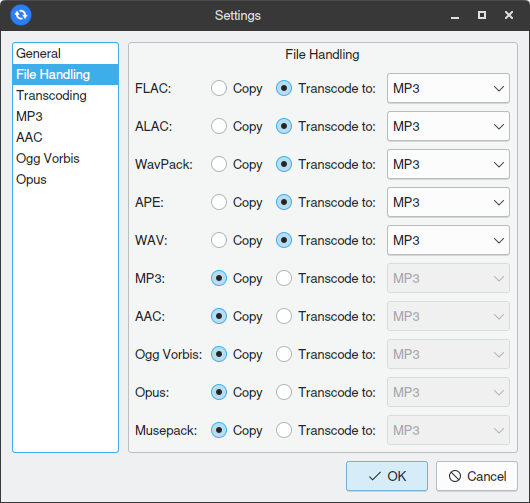
Easy Audio Sync is an audio library syncing and conversion utility. The intended use is syncing an audio library with many lossless files to a mobile device with limited storage.

The program’s design is inspired by the rsync utility. It supports folder-based source to destination syncing, with added audio transcoding capability, and is GUI-based instead of CLI-based.

Features:

  • Custom FFmpeg-based audio transcoding engine
    • Multithreaded operation for fast conversions
    • 4 lossy output codecs supported: MP3, AAC, Ogg Vorbis, and Opus
  • Robust metadata parser ensures tags and cover art are correctly transferred when converting between different formats
  • ReplayGain volume adjustments
  • Destination folder cleaning (deleting files that no longer exist in the source)
  • Cross-platform Windows/macOS/Linux

github.com/complexlogic/EasyAudioSync

Sample Rate Conversion Comparison ~ Hydrogen Audio


HydrogenAudio presents the definitive resource for testing sample rate conversion applications. Each Sample Rate Converter (SRC) is examined against multiple revealing tests, generating an overall quality ranking. A quality ranking needs careful consideration, these tests are formulated to test modern SRC routines, as such they are very sensitive way in excess of the 24 bit (-144dB) audible range. A SRC scoring 60% could very well have inaudible defects if converted to 24 bit, so why the need for high precision testing? An example might be in the studio, audio is processed in many ways, having a clean SRC converter allows further processing steps, including amplification, without fear of audible distortion. The best SRC have distortion down below -300 dBFS, giving plenty of head room for future processing and mixing of different sources.

src.hydrogenaudio.org
en.wikipedia.org/wiki/Sample-rate_conversion

wo-audio-converter ~ Audio File Converter


Offline audio file converter powered by ffmpeg wasm.

github.com/thurti/wo-audio-converter
worksoffline.app/audio-converter/

SOX-DSD ~ SoX With DSD For Windows.


Here located unofficial builds of the SoX (Sound eXchange) audio tool with DSD support and other patches (including both DSF & DFF I/O and SDM sox “effect” to convert from PCM to DSD) for OS Windows only. Provided two Windows executable files for 32 & 64 bit systems. Binaries were cross-compiled on Linux using MinGW/gcc on fully static way.

  •  DSF I/O
  •  DFF I/O
  •  SDM effect to convert from PCM to DSD
github.com/turbulentie/sox-dsd-win

MusicSync ~ Synchronize Music Libraries


MusicSync is a cross-platform tool that synchronizes your music library between devices and drives with advanced settings.

You can use it through CLI, that makes easy to sync you library with only a click using a script, or through GUI, that is more user-friendly. Here there are two examples:

python musicsync D:/Music sdcard/Music --adb --min-rating 4.5 --output-format opus --output-bitrate 128k
python musicsync D:/Music sdcard/Music --adb --min-rating 3 --min-year 2020 --output-format opus --output-bitrate

github.com/serpest/MusicSync
hydrogenaud.io/index.php?topic=121169.0

Vitomu ~ Video To Audio Converter


Vitomu stands for VIdeo TO MUsic converter. It allows easy conversion of online and offline videos to audio files. Just drop a URL or a local video file on the target to start the conversion. The current version supports dropping URLs of both YouTube videos and local MKV and MP4 files.

github.com/digimezzo/vitomu

DSD2FLAC ~ Convert DSD To FLAC


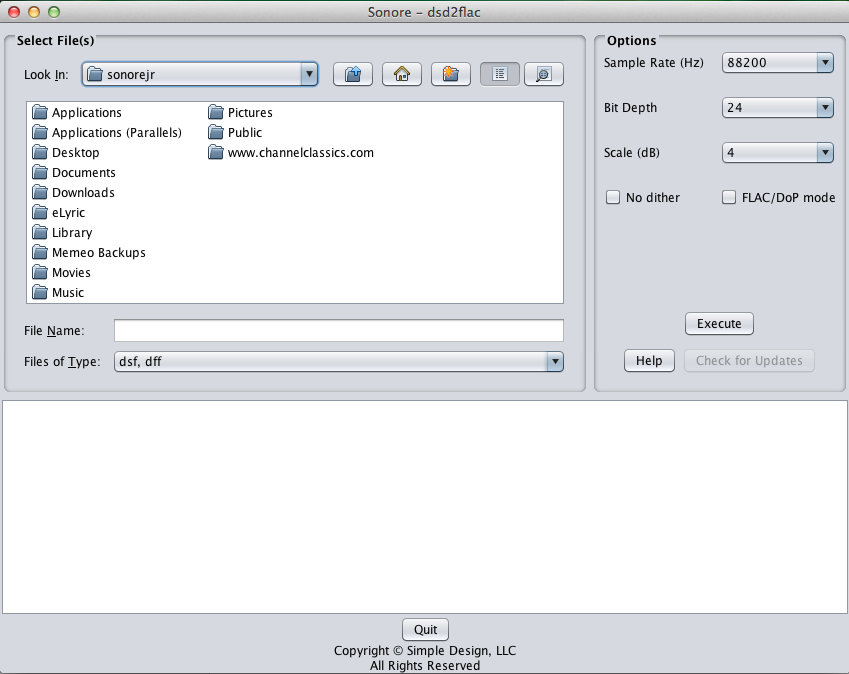
DSD2FLAC converts DSD files to FLAC

Features:

  • Supports DSD input files in .dsf and .dff formats
  • Supports DSD64 and DSD128 input rates
  • Selectable output sample rates: 88.2KHz (default), 176.4KHz or 352.8KHz
  • Selectable bit depth: 16, 20, 24 (default)
  • Volume scale: -6db to +6db (+4 db default)
  • Dither: on (default) or off
  • Optional output mode in DoP2FLAC for use by a player that supports FLAC and a DAC that supports DoP input
  • Transfers stored metadata from the original DSD file to the resulting FLAC file
  • Single title conversion or entire album conversion in a given folder

This application is provided as-is without warranty or support.
Development for this application is closed.

www.sonore.us/dsd2flac

lbl2cue/cue2lbl ~ Convert Audacity Labels To CUE Sheets


Convert between Audacity labels and cue sheets

lbl2cue