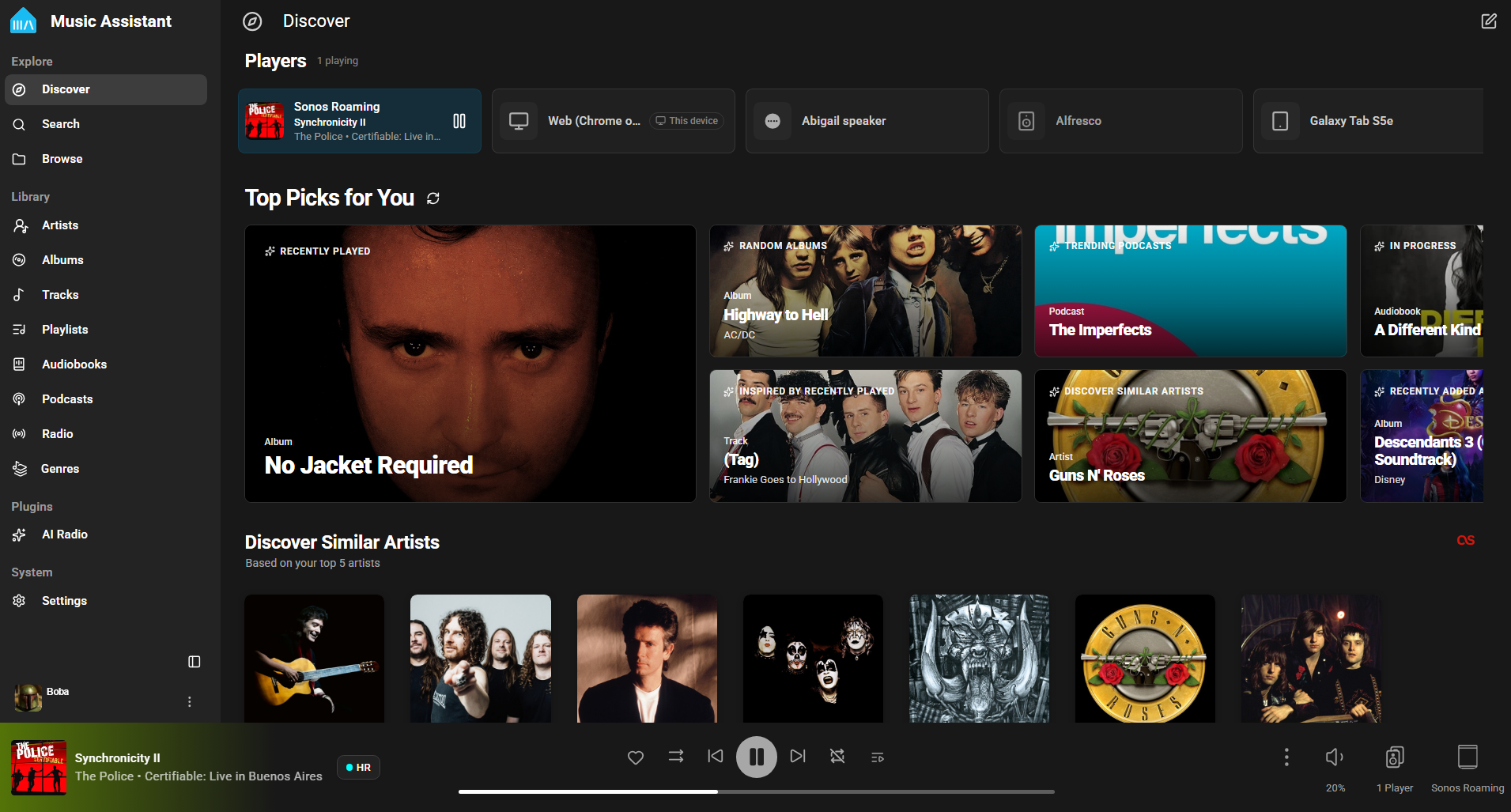
Music Assistant is a free, opensource media library manager that connects to your streaming services and a wide range of connected speakers. The server is the beating heart, the core of Music Assistant and must run on an always-on device like a Raspberry Pi, a NAS or an Intel NUC or alike.
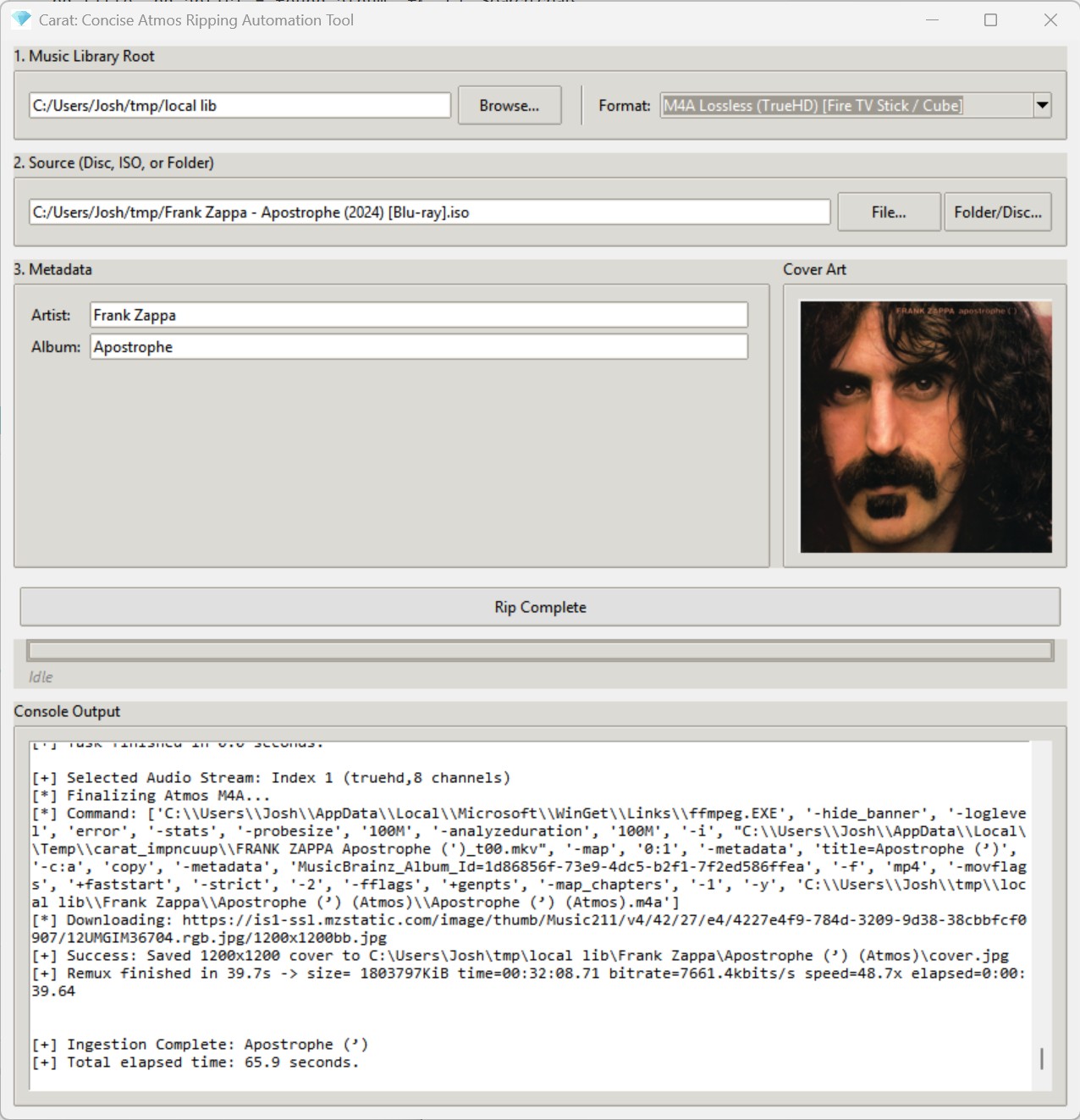
Carat is a lightweight, automated GUI utility designed to accept Dolby Atmos music releases in practically any format, locate the primary title in the release, retrieve metadata and cover art from the internet, and incorporate the release directly into your digital music library in a single click.
From the moment a new Blu-ray arrives in your mailbox, Carat handles the entire pipeline—extraction, processing, metadata acquisition, and cover art—with zero friction. If your source files are already on your SSD, Carat will process an entire release in a minute or two (depending on the speed of your computer). If you are starting from a physical disc, the time is limited by the read speed of your optical drive (expect five to ten minutes).
eyeD3 is a Python tool for working with audio files, specifically MP3 files containing ID3 metadata (i.e. song info).
It provides a command-line tool (eyeD3) and a Python library (import eyed3) that can be used to write your own applications or plugins that are callable from the command-line tool.
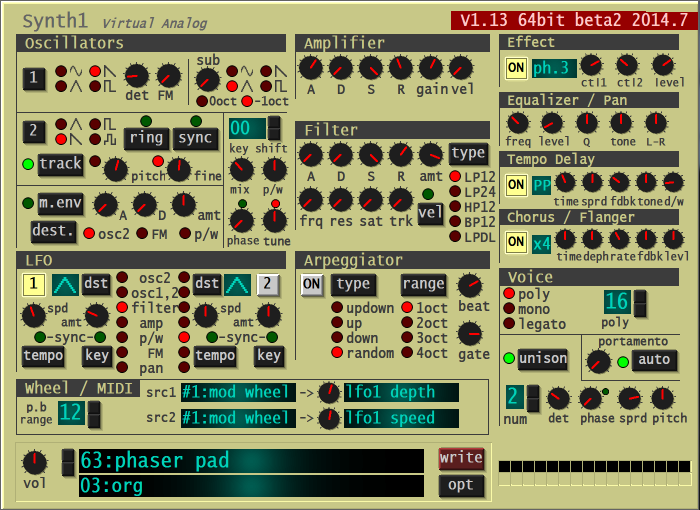
A software synthesizer intended for use with DTM software. Supports VSTi plug-in / AU plug-in format. This software is freeware. Functionally, it is modeled after the red synth Clavia NORD LEAD2 and has the following features:
2 Oscillator + 1 Sub Oscillator, FM Modulation, Ring Modulation, Synchro, Modulation Envelope
4 types of filters and distortion
2LFO (host sync possible)
Equipped with arpeggiator (host synchronization)
Equipped with tempo delay (host synchronization) and stereo chorus / flanger
Legato mode, portamento
32-tone polyphonic
With 128 preset tones.
Thorough reduction in operation weight. Use of SSE, etc.
Beast is a digital synthesizer and music creation system, released as Free Software under the GNU LGPL-2.1+. It has support for Linux Audio Plugins (LADSPA), multi-track editing, unlimited undo, real-time synthesis, MIDI and various audio formats like WAV, AIFF, Vorbis, Soundfont 2, Gus Patch, FLAC and MP3 files, 32bit audio rendering, full duplex support, multi-core audio rendering, SIMD utilisation, precise timing at sample granularity, FFT spectrograms and MIDI automation. The project is translated into a variety of languages.
FOMUS is a open source software application by David Psenicka that automates many musical notation tasks for composers and musicians, facilitating the process of creating professionally notated scores by allowing the user to separate attributes such as times, durations and pitches from the representation of them in conventional music notation. It is especially useful for composers who work with algorithms and computer music software languages / environments such as CM/Grace, Pure Data and Lisp. It can also be used to import data from MIDI files into a graphical notation editor or creating scores from scratch using text files.
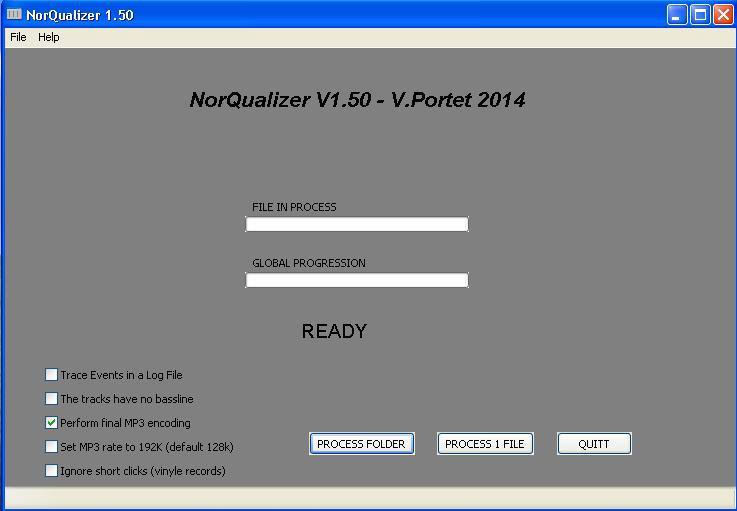
NorQualizer is a smart audio equalizer / normalizer which corrects audio files to get them all similar in terms of bandwidth and volume level. Especially useful for preparing audio CDs with files from different sources.
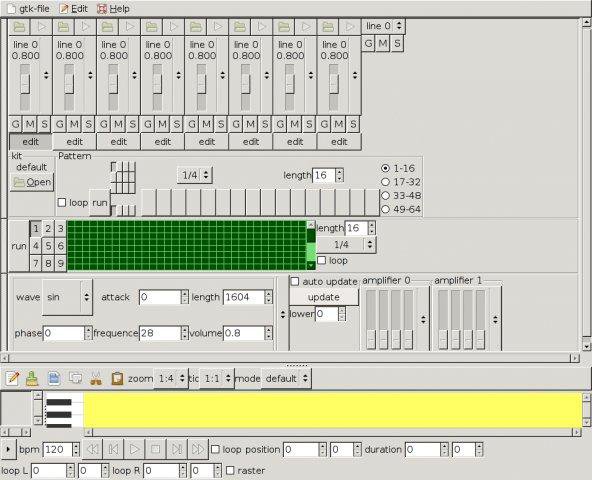
Advanced GTK+ Sequencer is intended to use for music composition. It features a piano roll, as well a synth, matrix editor, drum machine, soundfont2 player, mixer and an output panel.
It’s designed to be highly configurable, you may add effects to its effect chain, add or remove audio channels/pads.
You may set up a fully functional network of engines, therefore exists a link editor for linking audio lines.
In conjunction with AGS you need a realtime kernel and alsa support. `ags` uses conditional locks to keep several threads in sync that’s why you need at least a preemptible kernel.
Features:
save or open Advanced Gtk+ Sequencer XML files with XPath support
add or remove audio engines with adjustable audio channels and pads
link channels with property dialog
output panel, mixer, drum and matrix sequencer, soft synth and audio file player
piano roll with basic notation editing supporting copy & paste
adjustable BPM
LADSPA, DSSI and Lv2 support
export to WAV, FLAC, OGG and others
multiple sinks like Pulseaudio, JACK, ALSA and OSS
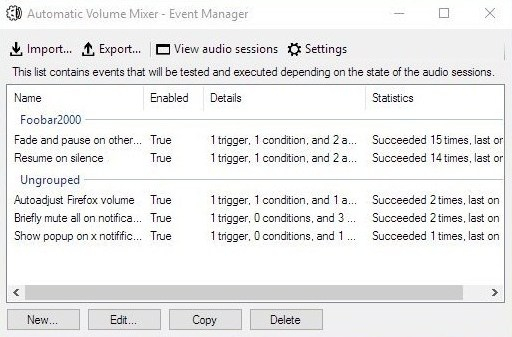
Automatic Volume Mixer is a tool that allows automatization of Windows Volume Mixer based on user rules. You can open the Volume Mixer by right-clicking on the speaker icon in the system tray and selecting Open Volume Mixer. This application is an automatic version of that applet.
Common usage examples:
Pausing your audio player (e.g. foobar2000) whenever any other application makes a noise, and resuming playback once the noise is gone. This enables you to keep your audio player running in the background at all times.
Briefly muting all applications while a notification is playing.
Forcing application’s volume to a set level.
Automatically lowering volume during night.
Launching processes / popups when some application makes noise.
Features:
Detect volume levels of applications and act on that information.
Fully configurable rules for detection, filtering, and executing actions.
Ability to automatically adjust audio levels of applications.