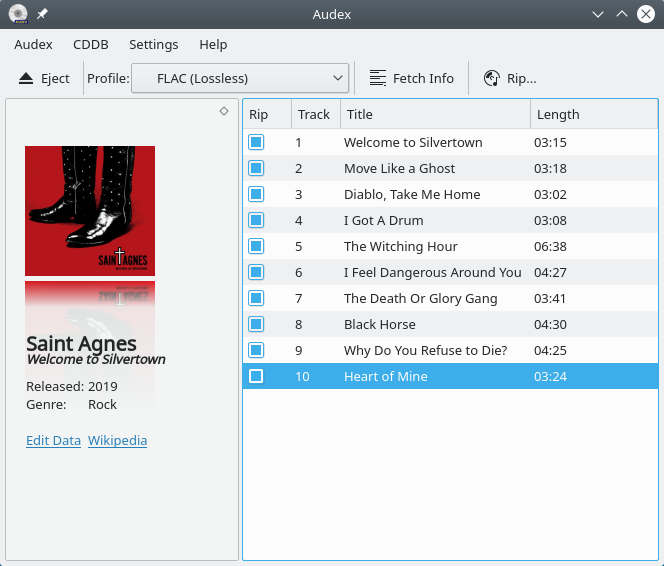
Audex is a CD ripper application. It lets you extract the audio from your CDs to let you listen to them on your computer and your other devices. It includes CDDB and MusicBrainz integrations to fetch the metadata and covers for your CDs if available.
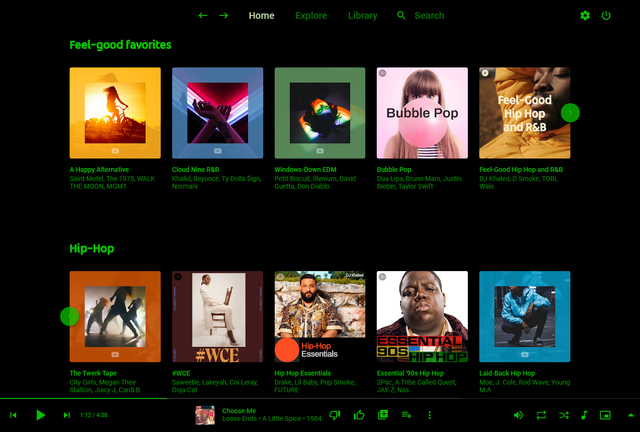
Pear Desktop is an Electron-based desktop client for YouTube Music designed for Windows, Linux and macOS. The project keeps the standard YouTube Music interface while adding desktop integration, plugins, themes and additional playback features.
The application is open source and distributed under the MIT license.
Features:
Native desktop-style window and controls
Plugin framework
Ad blocker
Lyrics support
Last.fm scrobbling
Discord Rich Presence
Media key support
Custom themes and CSS
Audio compressor
Equalizer
Crossfade
Skip silences
SponsorBlock integration
Video/audio mode toggle
Notification support
Downloader plugin
OBS integration
System tray support
Global keyboard shortcuts
How It Works
Pear Desktop loads the standard YouTube Music web interface inside a desktop application window and extends it through plugins and Electron desktop integration. It is not a standalone music service and still requires a YouTube Music or Google account for normal use.
Basic Usage
Download the correct installer for your operating system from the Releases page.
Install and launch the application.
Sign into your Google account.
Use YouTube Music normally.
Optional plugins can be enabled or disabled from the Plugins menu.
Platforms
Windows
Linux
macOS
Notes
Because Pear Desktop uses Electron, memory and CPU usage are generally higher than lightweight native audio players such as foobar2000 or AIMP. The project is intended primarily as a feature-enhanced desktop frontend for streaming music from YouTube Music rather than as a traditional local-library music player.
A monorepo for Casio CZ-101 phase distortion synthesis — including a preset manager web/desktop app, an in-browser phase distortion synthesizer, and a VST3/CLAP/AUv2 plugin.
A set of utilities for working with Byzantine sheet music.
PsalticTools includes:
• a set of utilities (plugins) for typing of Byzantine notes in parallel double notation (Byzantine and Western), based on MuseScore free music editor; • the PsalticHelper program for searching for formulas of Byzantine music in music books. • the UniPsaltica2 font with the characters of the musical Byzantine notation in Unicode.
Features:
MuseScore-based editor for creating scores in parallel double notation
Simple input neumes from the keyboard
Check typed notes for errors
PsalticHelper: Search by accents pattern or by musical phrase
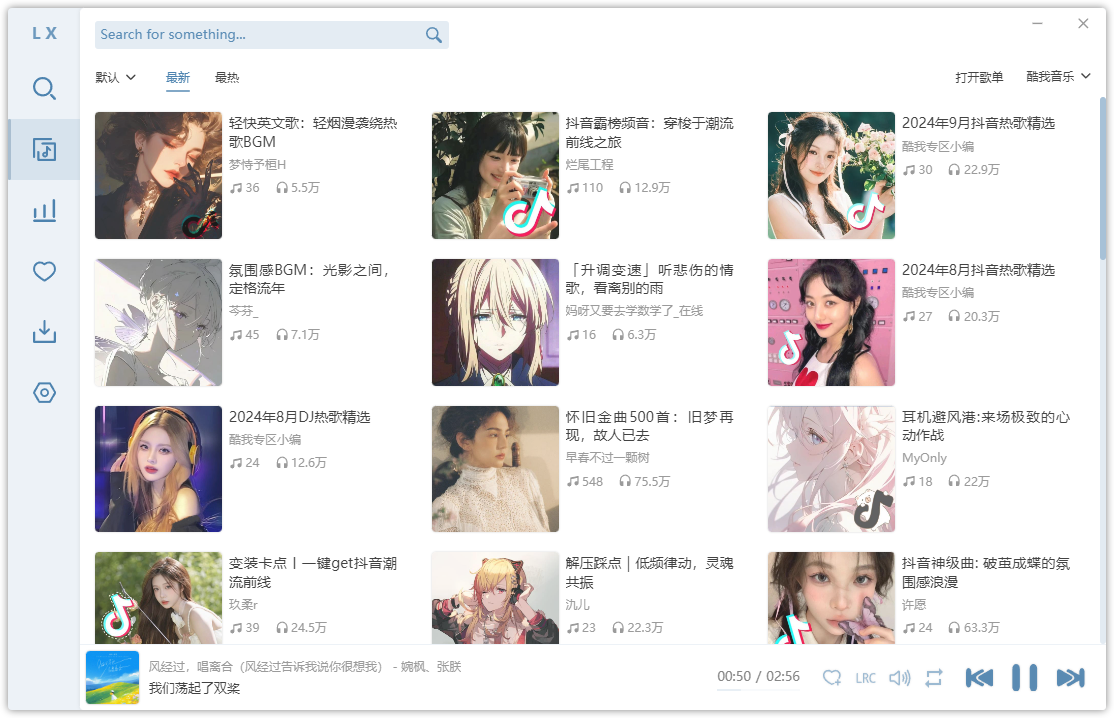
LX‑Music‑Desktop is an open‑source, Electron‑based music player built with Vue 3, offering a simple, fast interface for managing and playing local music libraries on desktop systems.
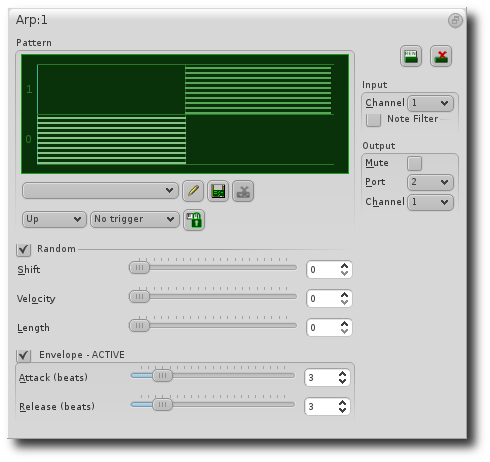
QMidiArp is a MIDI arpeggiator, phrase generator and controller LFO for ALSA and JACK. It can run multiple synchronized arpeggiators, LFOs and step sequencers. The modules are also available as LV2 plugins with Qt user interface. QMidiArp has been growing since June 2009 on top of Matthias Nagorni’s original arp idea.
Features:
Programmable arpeggio patterns, LFO waveforms and sequences
Modular setup of arpeggiators, MIDI LFOs and step sequencers
MIDI-controllable (MIDI-Learn)
Synchronization with MIDI Clock or JACK Transport possible
Optional triggering by keyboard or continuous play mode for all modules
Patterns can be stored and switched by MIDI control while running
The Sound Description Interchange Format (SDIF) is an established standard for the interchange of sound descriptions and analysis data. This project provides libraries, SDIF (in C) and Easdif (in C++), tools, and wrappers to read and write SDIF files.
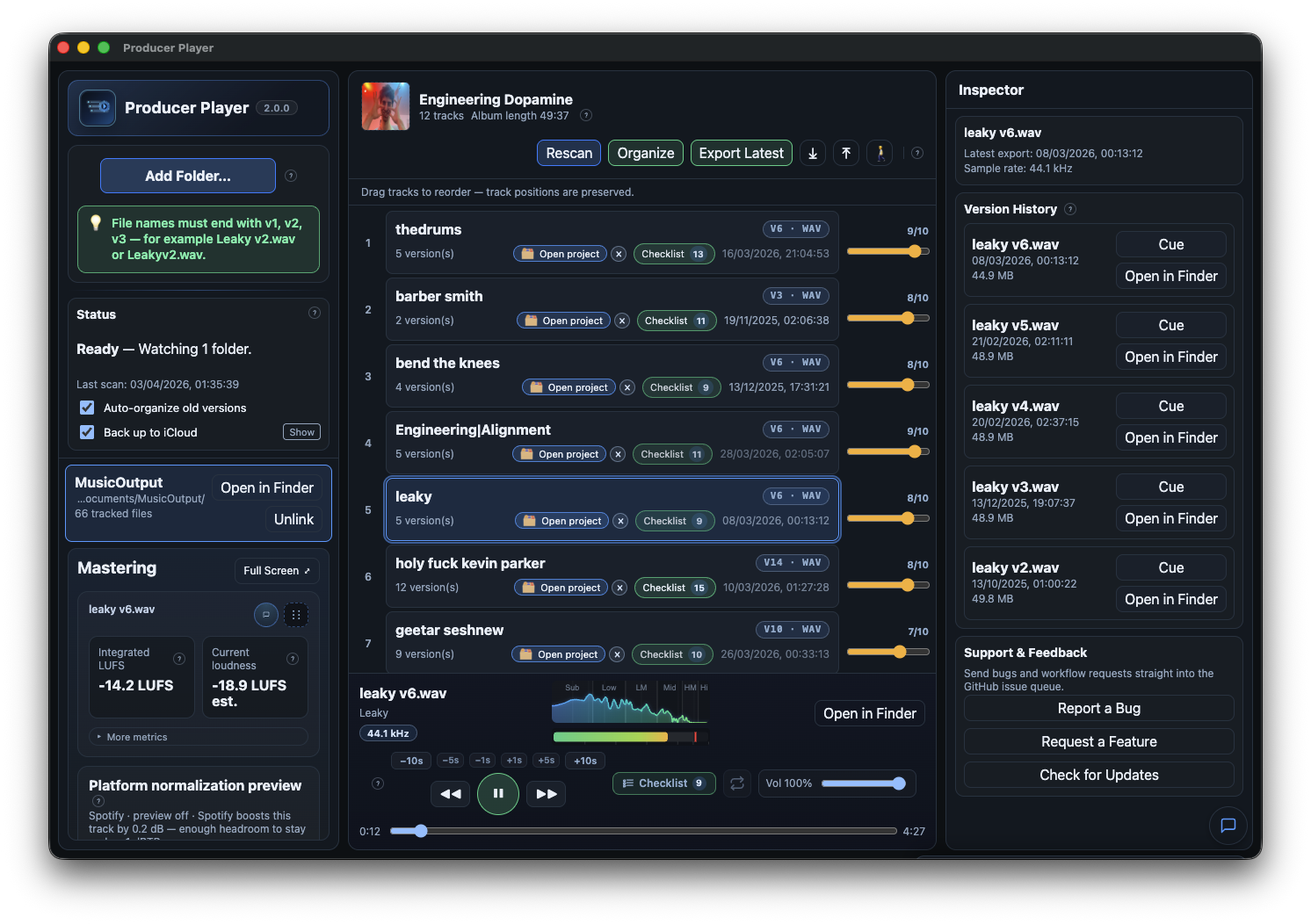
A desktop app for producers who bounce a lot. Drag in a folder of exports and Producer Player auto-groups versions, organizes your album, and gives you a full mastering workspace — all in one place.
A high-performance CLI toolkit for music collectors who manage their own libraries. Lattice provides a suite of tools for library visualization, integrity verification, cover art extraction, and metadata auditing — all from a single, zero-dependency script.
Why this exists
Modern music players often hide your library behind proprietary databases. Lattice is built for collectors who treat the filesystem as the source of truth. It reads tags directly via mutagen, ensuring your library is portable and player-agnostic.
Features:
Mode
Flag
Description
Library Tree
--library
Generate a formatted ASCII/Unicode tree of your entire collection.
AI Library
--ai-library
Token-efficient export designed for LLM recommendation prompts.
Genre Wings
--all-wings
Generate separate library catalogs segmented by genre.
Integrity Checks
--testFLAC
Parallel verification of FLAC/MP3/Opus/WAV integrity via FFmpeg.
Art Extraction
--extractArt
Extract embedded covers with format-priority ranking (FLAC > Opus).
Tag Audit
--auditTags
Identify and report files with missing or inconsistent metadata.