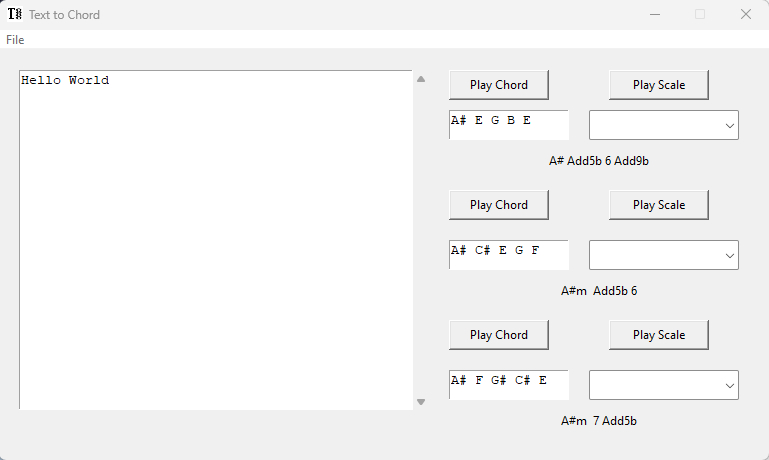
Convert words and sentences to 5 note chords you can use to inspire music creation. Have fun turning your name, your city name, your friends’ names, your team’s name, your pet’s name into wild and original harmonies that go beyond serialism and classic jazz.
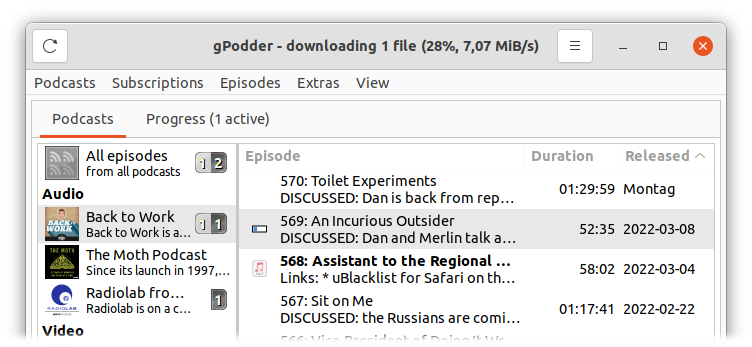
gpodder.net is a libre web service that allows you to manage your podcast subscriptions and discover new content. If you use multiple devices, you can synchronize subscriptions and your listening progress.
It works best with the gPodder application, but you can also use it with Amarok, other supported clients or as standalone web application without any client app.
Features:
Share your favorite content with others
Keep track of your playback progress
Back up your subscriptions
Discover new content, based on your listening habits
Create and share lists of related podcasts
For publishers: Find out which parts of your content are popular
Shellify is a terminal-based application that allows you to download and play Spotify playlists and albums directly from your terminal. It uses various Python modules to fetch songs from Spotify, download their audio from YouTube, and play them using a built-in MP3 player. Shellify lets you enjoy spotify, without the need of the spotify app and helps you have peace of mind while listening to your favorite songs without annoying ad breaks. You need a spotify developer account to use this application.
Optional fetch limit for things like top-10 playlists.
Graphical rules editor with live error checking.
Save a dynamic playlist’s current state as an MPD-side static playlist whenver you want.
JSON import/export for sharing & backing up dynamic playlist rules.
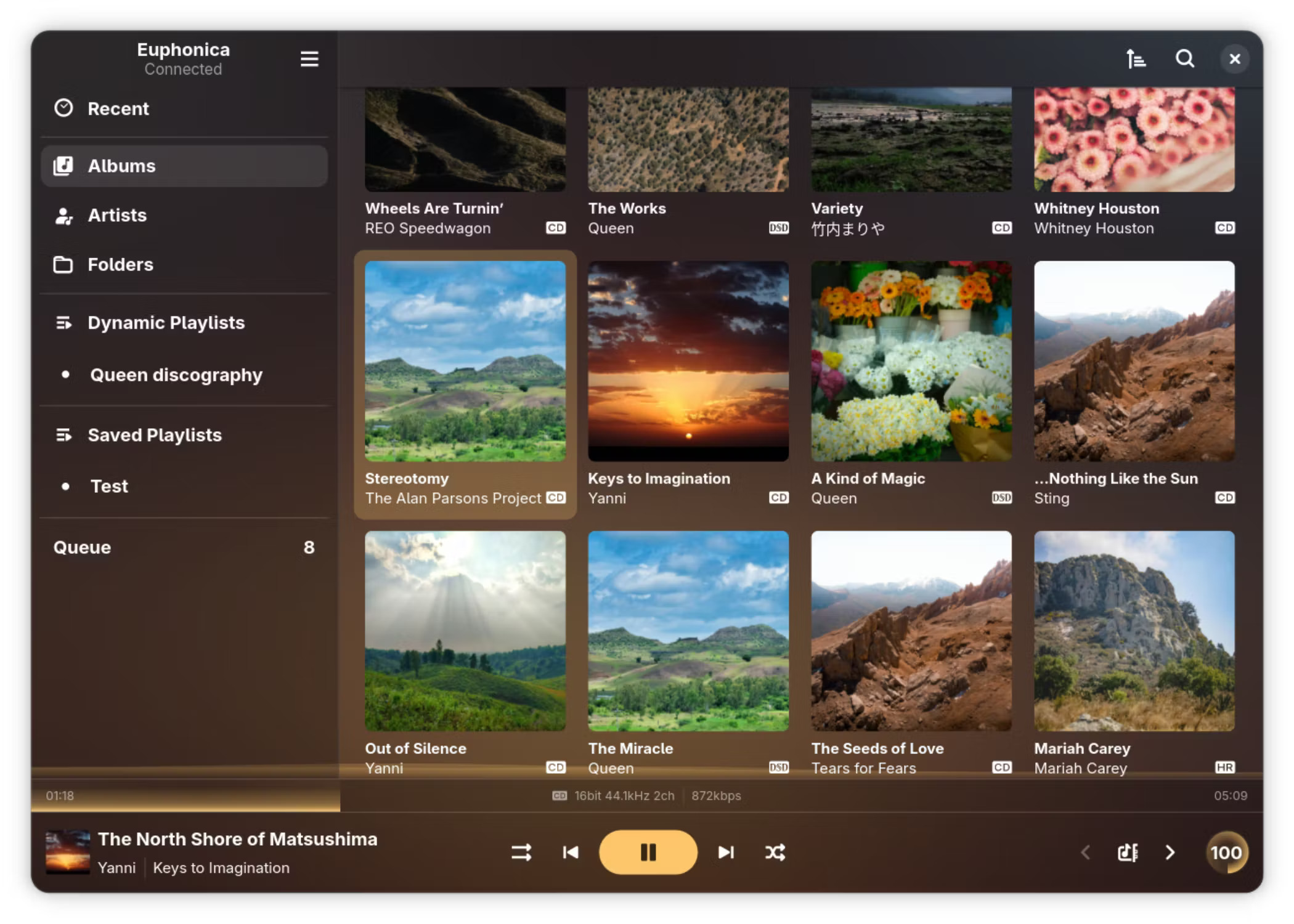
Fetch album arts, artist avatars and synced song lyrics from external sources (currently supports Last.fm, MusicBrainz and LRCLIB).
myMPD-compatible stickers handling.
Integrated MPRIS client with background run supported. The background instance can be reopened via your shell’s MPRIS applet, the “Background applications” section in GNOME’s quick settings shade (if installed via Flatpak) or simply by launching Euphonica again.
Rate albums (requires MPD 0.24+) and individual songs.
Audio quality indicators (lossy, lossless, hi-res, DSD) for individual songs as well as albums & detailed format printout.
Asynchronous search for large collections. The app as a whole should work with any library size (tested with up to 30K songs).
Configurable multi-artist tag syntax, works with anything you throw at it.
In other words, your artist tags can be pretty messy and Euphonica will still be able to correctly split them into individual artists.
Performant album art fetching & display (LRU-cached to both cut down on disk reads and RAM usage).
Volume knob with dBFS readout support (‘cuz why not?).
GSonic Reference is a high-quality speaker and room correction tool that generates precision FIR correction filters from in-room measurements. It combines spatial measurement averaging with advanced filter generation to deliver studio-grade correction for any stereo listening environment.
Features:
Integrated Measurement & Filter Generation — Measure and generate in a single application
Spatial Averaging — Multi-position measurement for robust, position-independent correction
Automatic Clock Drift Compensation — No need for loopback cables or synchronized clocks
Low Latency Filters — 32,768-tap FIR filters at 48 kHz (pure C++ codebase, 341 ms processing latency)
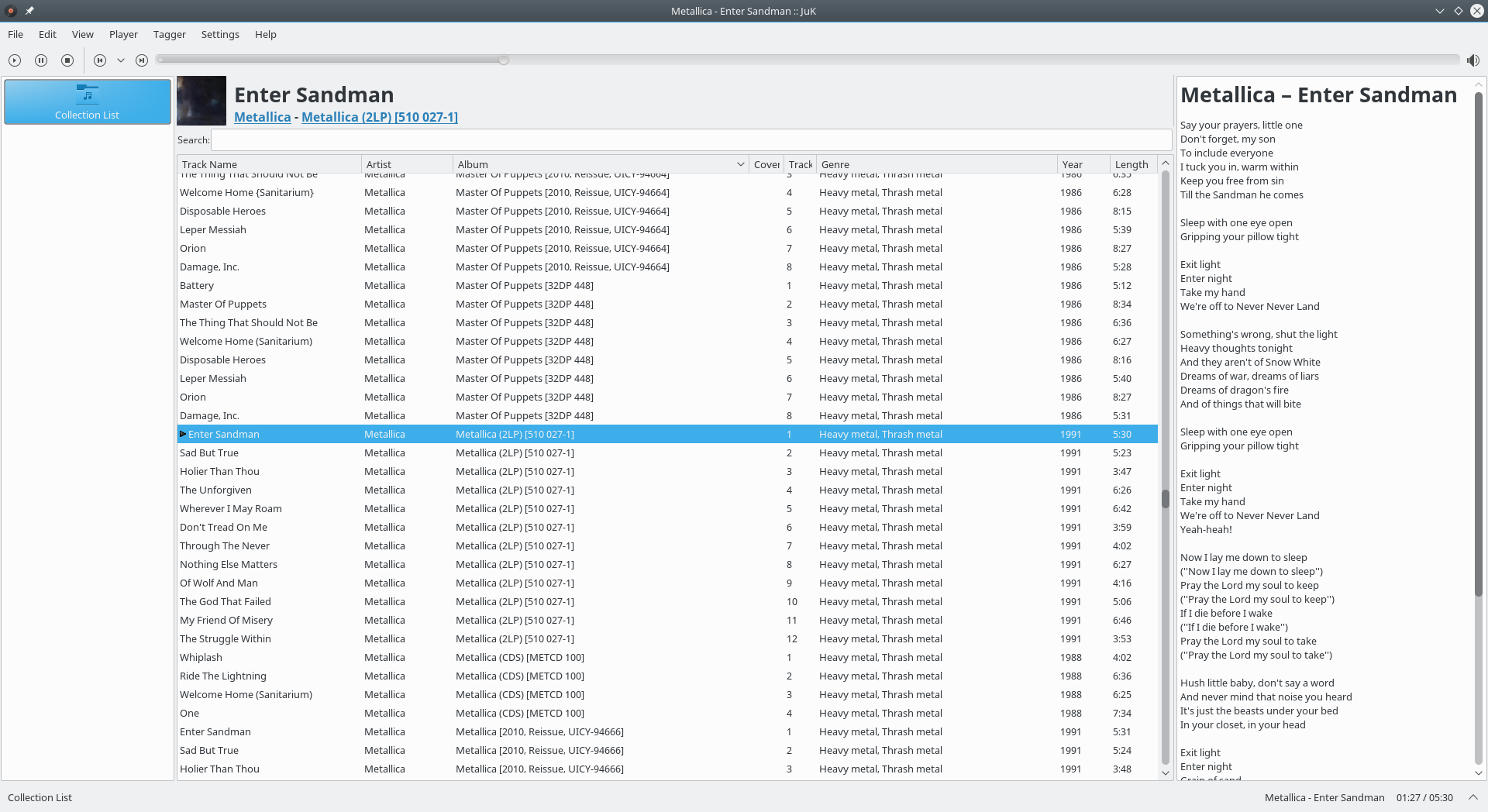
JuK is an audio jukebox application, supporting collections of MP3, Ogg Vorbis, and FLAC audio files. It allows you to edit the “tags” of your audio files, and manage your collection and playlists. Its main focus, in fact, is on music management.
Features:
Collection list and multiple user defined playlists
Ability to scan directories to automatically import playlists and music files on start up
Dynamic Search Playlists that are automatically updated as fields in the collection change
A Tree View mode where playlists are automatically generated for sets of albums, artists and genres
Playlist history to indicate which files have been played and when
Inline search for filtering the list of visible items
The ability to guess tag information based on the track’s file name
File renamer that can rename files based on the tag content
Tag reading and editing support for many formats including ID3v1, ID3v2 and Ogg Vorbis