Muine is an innovative music player, featuring a simple, intuitive interface. It is designed to allow users to easily construct a playlist from albums and/or single songs. Its goal is to be simply a music player, not to become a robust music management application. This doesn’t mean Muine has no features! Some feature highlights:
Ogg/Vorbis, FLAC, AAC and MP3 music playback support
Automatic album cover fetching via MusicBrainz and Amazon
Support for embedded album images in ID3v2 tags
ReplayGain support
Support for multiple artist and performer tags per song
Plugin support
Translations into many languages
Muine is targeted at the GNOME desktop and uses GTK+ for the interface. Most of the code is written in C#, with some additions/bindings/glue in plain C. Muine was originally written by Jorn Baayen, but now maintained mostly by others.
Pine Player is an exclusive listening digital music player for music lovers who use the OSX operating system. It can play almost all existing digital audio forms such as MP3, FLAC, APE, AAC, M4A, WAV, AIFF, OGG, WMA, DSD, SACD ISO etc. and it also has a strong playing capability for listening to CUE files in the most convenient way.
1. Maximum 32Bit 768kHz Up Sampling Function
Pine Player supports various kinds of PCM formats, so it can play sound sources from 16 to 32 bit; it can also reproduce clear and abundant sound quality by supporting a maximum of 768kHz.
Pine Player’s unique Over Sampling Filter is a technique that upconverts an ordinary MP3 file into a 32bit, maximum of 768kHz, and high sound quality sound source and sends it to the DAC for it to be played in best performance. Ordinary MP3 files’ sound quality can actually be heard more clearly and plentifully. Obviously, HD audio files such as MQS and DSD can be upconverted to a maximum of 768kHz as well.
2. Convenient and Strong Playlist & Prevention of Text Cracking
Pine Player has a very convenient playlist because users can save and manage the music they wish to listen to, change the order of the music being played by simply dragging, and express any kind of language or text encoding perfectly because of its flawless decoding function. There is no Korean code cracking.
3. Cross Fade and Gapless set-up
Cross Fade function, which is a technique that decreases the gap between songs when listening to files on the playlist or overlaps the songs for no gaps at all, can be set into seconds.
4. Mass Storage of Audio Queue for Real Time Converting
Pine Player prevents damage of sound quality by having a high-powered Audio Queue for processing excessive amount of digital data. Therefore, it takes a considerable amount of memory compared to other music players.
5. Automatic Isolation of Damaged Sound Sources
Pine Player has an automatic isolation function for damaged sound sources called Vault. If a damaged sound source is detected while playing the music, the music is stopped and taken to the Vault file for isolation. Through this convenient function, users can easily figure out which sound source is damaged and restore it.
Even with all these functions, Pine Player is a free app. Moreover, there are not any marketing or advertising material. Especially, no information including personal ones are sent to the outside or the Internet.
The Daphile is the heart of a digital music system. Its primary focus is in storage and playback of your digital music library. It enables the best possible audio quality and future-proof flexibility by providing plug&play support for USB connected digital-to-analog converters (DAC). You can easily setup a multi-zone system just by connecting another USB DAC for each zone.
Features:
Headless music server OS
Bitperfect and gapless playback
Extensive audio format support
Native DSD playback up to DSD512
PCM resolutions up to 384kHz/24bit
High quality audio resampling including PCM to DSD conversion
Convolution filtering for DRC and equalizer
“Play from RAM” to minimize CPU load and disk activity during playback
Automatic audio device configuration with multiplayer support
CD ripping with AccurateRip™ verification, automatic metadata tagging and cover art
Supports external file servers as music source
Easy configuration and installation through the web interface
WiFi hotspot support (if compatible hardware exists)
Software update via web interface
Network-attached storage (NAS) service
Whole system included in about 200MB ISO-file
Daphile is based on the open source Squeezebox Server, Squeezelite and Linux. Since Daphile is used and configured completely via the web interface the user is not required to have any Linux skills.
DSF_FillMute is a program that replaces a series of trailing zeros created by the standard of DSF files with a silent signal (0x69,1001 0110b). It is effective for devices that generate noise by playing a series of trailing zeros. There is no change in the actual sound or ID3 tag because no processing is added except at the end.
PCM-DSD Converter is a program that converts a PCM WAV format sound source to DSD DSDIFF format. You can convert from PCM 16bit ~ 64bit Float / 44.1 ~ 768kHz to DSD16-DSD2048.
This collection hosts complete, freely downloadable / streamable, often Creative Commons-licensed catalogs of ‘virtual record labels’.
These ‘netlabels’ are non-profit, community-built entities dedicated to providing high quality, non-commercial, freely distributable MP3 / OGG-format music for online download in a multitude of genres. Styles include:
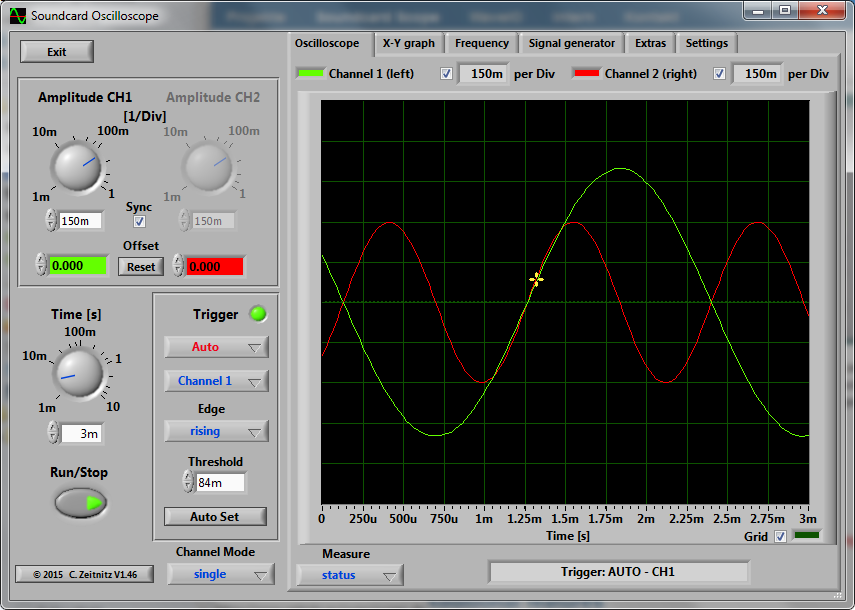
The PC based Soundcard Oscilloscope receives its data from the Soundcard with 44.1kHz and 16 Bit resolution. The data source can be selected in the Windows mixer (Microphone, Line-In or Wave). The frequency range depends on the sound card, but 20-20000Hz should be possible with all modern cards. The low frequency end is limited by the AC coupling of the line-in signal. Be aware, that most microphone inputs are only mono.
The oscilloscope contains in addition a signal generator for 2 channels for sine, square, triangular, sawtooth wave forms and different noise spectra in the frequency range from 0 to 20kHz. The signal can be defined by a mathematical formula as well. The signals are available at the speaker output of the sound card. These can be fed back to the oscillocope in order to generate Lissajous figures in the x-y mode.
Features:
Trigger modes: off, automatic, normal and single shot
Triggerlevel can be set with the mouse
The signals of the two channels can be added, subtracted and multiplied
x-y mode
Frequency analysis (Fourier spectrum)
Waterfall diagram (frequency spectrum as function of time)
Frequency filter: low-, high-, band-pass and band-stop
Cursors to measure amplitude, time and frequency in the main window
Audio Recorder to save data to a wave file
For multi soundcard system, the used card can be selected in the settings tab
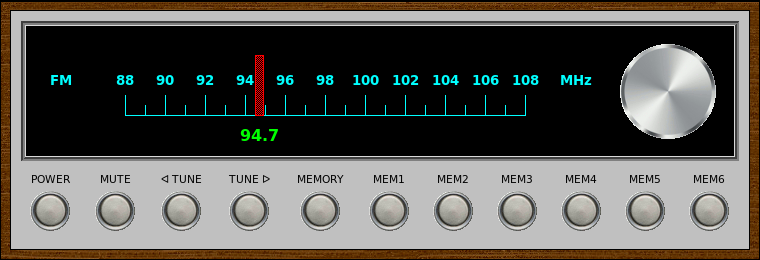
VintageRadio is a GUI front-end for the fm command-line application included with fmtools <http://benpfaff.org/fmtools>. It is written in [incr Tcl/Tk], an object-oriented extension package for Tcl/Tk. VintageRadio is not part of fmtools.
Features:
A vintage 70s-era look, inspired by a number of stereo tuners and receivers with the classic silver face.
A rotary tuning dial that actually works.
Ability to store up to 6 stations as presets.
Keyboard shortcuts for all application functionality.
This project provides an open source MacOS v10.14, v10.15, v11.6 (Mojave, Catalina, Big Sur) compatible CoreMIDI 64 bit device driver for M-Audio’s MIDISPORT range of USB MIDI interfaces. This driver supports the following devices:
MIDISPORT 1×1
MIDISPORT 2×2
MIDISPORT 4×4
MIDISPORT 8×8/S
Oxygen 8 Keyboard
Other devices which are compatible may also work, although presently, these are the only ones which have been tested.