Voxengo MSED ~ Mid-Side Encoder Plugin


  • Mid-side encoder/decoder
  • Mid-side stereo widener
  • Stereo imaging
  • Stereo channels swapper
  • 180-degree channel phase flipper
  • Stereo correlation and balance meter
  • Unique “plasma” vector scope

Step into a new dimension of stereo control with Voxengo MSED – a professional, no-compromise free audio mid-side encoder-decoder AudioUnit, AAX and VST plugin designed for audio engineers and creative producers alike.  Whether you’re tightening a mix, widening a synth pad, or repairing phase issues, MSED gives you surgical command over the heart and soul of your stereo image.

At its core, MSED effortlessly splits any stereo track into its Mid (center) and Side (ambient) components – and seamlessly reconstructs them back.  But it doesn’t stop there.  With the “Inline” mode, you can adjust gain, panning, and mute status for Mid and Side channels independently without needing multiple plugin instances.  That means faster workflow, cleaner routing, and zero clutter.

Need to flip phase by 180°, swap channels, or extract only the Mid or Side signal?  MSED handles it instantly.  And with its stunning Plasma Vector Scope, you don’t just hear the stereo field – you see it.  This unique, frequency-aware visualizer places low frequencies at the outer edge and high frequencies toward the center, helping you spot phase issues, balance problems, and correlation irregularities at a glance.

Add to that stereo correlation and balance meters, zero processing latency, and 64-bit floating-point precision, and you have a lightweight yet powerful tool that fits seamlessly into any session.

Voxengo MSED isn’t just a utility – it’s your stereo scalpel.  Clean.  Fast.  Visual.  Essential.
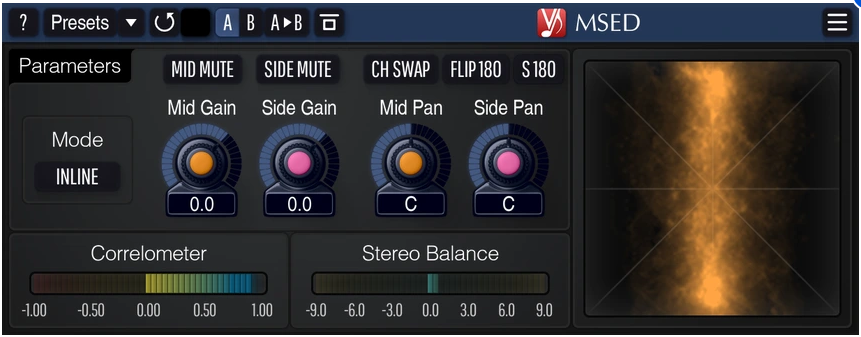
MSED user interface

www.voxengo.com/product/msed

WMAEncodeRS ~ CLI WMA Windows Encoder


A command-line Windows Media Audio encoder for Windows — a Rust port of lvqcl’s WMAEncode, extended to also emit xWMA (the RIFF format used by XAudio2 in games, à la Microsoft’s xWMAEncode). It turns WAV / raw PCM into fully-working .wma or .xwma using the built-in Windows Media Format runtime (wmvcore.dll) — the same encoder Windows itself uses — so output is maximally compatible and DRM-free. It is bidirectional: a .wma input is decoded back to WAV.

WAV/PCM -> WMA via the built-in Windows Media Format SDK (wmvcore). Supports WMA Standard, Professional, Lossless, and Voice in CBR / VBR / two-pass modes, with tagging, raw-PCM input, stdin input, stdout piping, and .xwma output.

Highlights:

  • Memory-safe at the boundary. All unsafe is confined to src/encoder.rs and src/xwma.rs (the COM/FFI boundary); the crate root sets #![deny(unsafe_code)], so every other module is compiler-guaranteed unsafe-free. (Calling the Windows Media SDK requires unsafe; it can only be isolated and audited, not removed.)
  • Bug fixes vs. the original C++: tag strings include the UTF-16 NUL terminator (WMT_TYPE_STRING length); 64-bit WAV offset/seek (two-pass on files > 2 GB); broken-pipe-safe stdout (--print-formats | head won’t panic).
  • xWMA output with an accurate dpds seek table (total length exact; seek points sub-millisecond), validated by round-tripping through Microsoft’s xwmaencode.exe.
  • Unicode-safe. Non-ASCII filenames and tags (incl. CJK) are handled without panic or mojibake; the console output code page is set to UTF-8 at startup.
  • Bidirectional. Encodes WAV→WMA/xWMA and decodes WMA→WAV and xWMA→WAV.

github.com/MSIVST/WMAEncodeRS#wmaencoders

Resources:

github.com/misgender/WMAEncode

SuperLAME ~ Multithreaded MP3 Encoder


A multithreaded MP3 encoder built on LAME, using Robert Kausch’s SuperFast technique to run many libmp3lame instances in parallel and reassemble a single bit-reservoir-correct MP3 — roughly 8× faster than stock single-threaded LAME at the same quality.

It is also a small but fairly complete MP3 codec: encode, decode, wide input format support, high-quality resampling, and ID3 tagging.

github.com/MSIVST/SuperLAME
hydrogenaudio.org/index.php/topic,129699.0

References:

lame.sourceforge.io
github.com/enzo1982/superfast
en.wikipedia.org/wiki/ID3
en.wikipedia.org/wiki/MP3

Grip ~ GTK Encoder, Player & Ripper


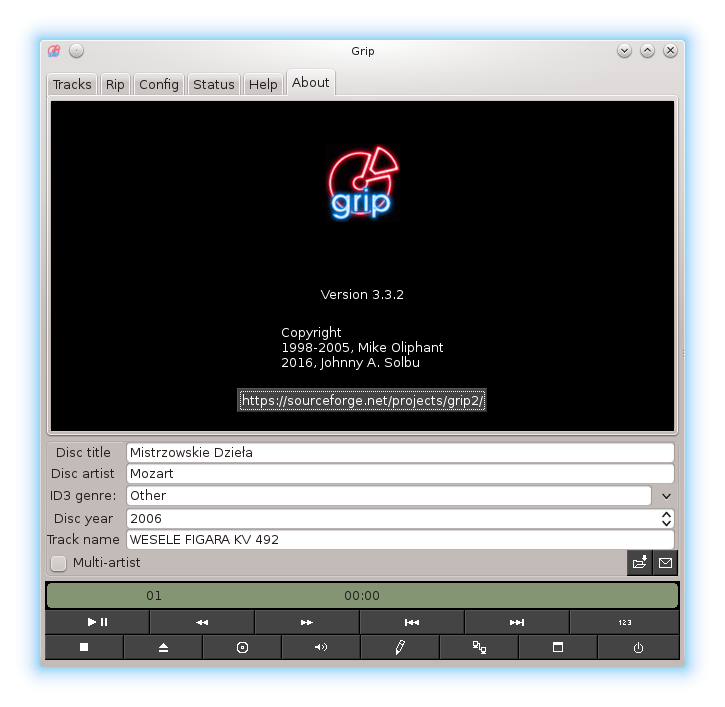
Grip is a GTK-based CD-player and CD-ripper / MP3 encoder. It has the ripping capabilities of cdparanoia built in, but can also use external rippers (such as cdda2wav). Encoder presets are provided for oggenc, bladeenc, lame, l3enc, xingmp3enc, mp3encode, gogo, flac, faac and opusenc.

sourceforge.net/projects/grip

microenc ~ Linux/BSD Batch Encoding Script


microenc is a small Bash shell script for Linux/BSD for encoding directories with audio files to other formats using FFmpeg as encoder.

Features:

  • Encodes to MP3, AAC, Vorbis, Opus, AC-3, E-AC-3, DTS, FLAC, ALAC, WavPack, AIFF and WAV audio
  • Auto-copying of metadata and, for MP3/AAC/FLAC/ALAC/AIFF, cover art
  • Optional high-quality audio resampling
  • Requires only ffmpeg and ffprobe
sourceforge.net/projects/microenc

LCDex ~ A Linux CDEX Clone


A ripper and encoder frontend for Linux. Requires libsndfile and lame to work.

sourceforge.net/projects/lcdex

wavtoac3encoder ~ WAV To AC3 Encoder


WAV to AC3 Encoder an audio encoder which generates compressed audio streams based on ATSC A/52 specification

wieslawsoltes.github.io/wavtoac3encoder/

fdkaac ~ Command Line Frontend For libfdk-aac Encoder


dkaac reads linear PCM audio in either WAV, raw PCM, or CAF format,
and encodes it into either M4A / AAC file.

If the input file is "-", data is read from stdin. Likewise, if the
output file is "-", data is written to stdout if one of streamable AAC
transport formats are selected by **-f**.

When CAF input and M4A output is used, tags in CAF file are copied into
the resulting M4A.

github.com/nu774/fdkaac
github.com/mstorsjo/fdk-aac
launchpad.net/ubuntu/bionic/+package/fdkaac
packages.debian.org/stretch/fdkaac

TAK ~ Tom’s Lossless Audio Kompressor


TAK stands for (T)om’s lossless (A)audio (k)ompressor. Besides, it’s a throwback to a (not very philanthropic) character from Stephen King’s “Regulators”. Early semi-public evaluation versions operated under the working title YALAC .

Characteristics:

  • High compression . The strongest mode is on a par with Monkey’s Audio High and OptimFrog’s Normal; for specific files such as classical music or voice recordings, it often outperforms both. This classification is based on the evaluation of hundreds of files of various styles; it definitely does not apply to every single file.
  • High compression speed . I am currently not aware of any other compressor that works faster than TAK’s Turbo or Fast mode and achieves similar compression rates.
  • Multi-core compressor . The compressor optionally generates up to four threads in order to take advantage of multi-core cpus.
  • Very high decompression speed . It is at the level of FLAC and therefore significantly higher than most symmetrical compressors.
  • Support for every popular audio format (not yet fully implemented).
  • Streaming support . An info frame, which contains all the information required for decoding, is inserted into the compressed audio data every 2 seconds.
  • Fault tolerance . A single bit error never damages the audio data for more than a maximum of 250 ms, since it is stored in completely independent frames of a maximum of this duration. The decoder processes even extremely damaged files, optionally replacing or removing the affected data with silence.
  • Error detection . Every single frame is protected by a 24-bit checksum (CRC).
  • MD5 checksums for quick identification of audio material (e.g. for searching for duplicates).
  • Fast, sample-accurate access to any playback position . The file header contains a look-up table with index positions every second. Even without this table, efficient random access is possible; for this purpose, the synchronization codes of the frame headers and / or the offset values ​​optionally recorded in the frame header, which refer to the beginning of the previous and next frame, can be used.
  • Metadata . A flexible and expandable structure allows the recording of non-audio data such as images or cuesheets.
  • Playback plugins for Winamp and Foobar are currently available.
  • An SDK provides other developers with decoding functions for integration into their applications. An extension to include coding functions is planned.

www.thbeck.de/Tak/Tak
wiki.hydrogenaud.io/index.php?title=TAK
hydrogenaud.io/index.php?topic=120760
www.foobar2000.org/components/view/foo_input_tak
foobar.hyv.fi/?view=foo_input_tak

dsfTAKSource ~ TAK  DirectShow  Source  Filter
  • Playback TAK audio files in any DirectShow Player (Windows Media Player, MediaPlayerClassic, …)
  • Now supporting TAK 2.2.0 (multi-channel audio, …)
  • Support UNICODE filenames and Sample Rates > 44.1 KHz
  • Upgrade: now correctly works in Windows 7 64bit !  (and other 64bit Windows versions)

liviocavallo.altervista.org

qaac ~ AAC / ALAC Encoder GUI


qaac is a command line AAC / ALAC encoder frontend based on Apple encoder, strongly influenced by tmkk.pv.land.to/qtaacenc/.

qaac requires Apple Application Support that is included in iTunes or QuickTime. If you are using 64 bit Windows, recent 64 bit iTunes (ver 12.1 or later) is recommended. 64 bit installer for iTunes (iTunes6464Setup.exe) includes both of 32 bit and 64 bit Apple Application Support, therefore you can run both of qaac.exe and qaac64.exe with its installation.

Features:

  • AAC-LC, AAC-HE, ALAC encoding are supported. m4a container (just a MP4 container with ‘M4A ‘ brand, created by Apple) is used by default, but you can also mux into ADTS.
  • Filenames and tags are treated with Unicode. Very long file names are supported.
  • Support for multichannel / surround.
  • Fine quality control over AAC encoding.
  • Support for hi-resolution / multichannel ALAC.
  • WAV, raw PCM, ALAC, and all LPCM formats supported by CoreAudio AudioFile interface (such as AIFF, CAF, and Sun/AU) are directly available as input. MP3 is also decodable through CoreAudio.
  • Cue sheet input is also available.
  • FLAC, Wavpack, TAK, and other LPCM formats are optionally supported when libFLAC.dll, wavpackdll.dll, tak_deco_lib.dll, and libsndfile-1.dll are installed.
  • Piped input is available for WAV and raw PCM.
  • Piped output (streaming) is supported for ADTS.
  • Automatically fetch tags from AIFF, FLAC, Wavpack, Tak, and ALAC. Major tags are copied to the result. Also, you can manually set tags via command line options.

sites.google.com/site/qaacpage
github.com/nu774/qaac

FFmpeg ~ Open Source Audio Video Toolset


A complete, cross-platform solution to record, convert and stream audio and video. FFmpeg is the leading multimedia framework, able to decode, encode, transcode, mux, demux, stream, filter and play pretty much anything that humans and machines have created. It supports the most obscure ancient formats up to the cutting edge. No matter if they were designed by some standards committee, the community or a corporation. It is also highly portable: FFmpeg compiles, runs, and passes our testing infrastructure FATE across Linux, Mac OS X, Microsoft Windows, the BSDs, Solaris, etc. under a wide variety of build environments, machine architectures, and configurations.

ffmpeg.org

Frontends:

Resources:

GXLame ~ Low Bitrate MP3 Encoder


GXLame is an MP3 encoder based off of LAME v3.98.4 and v3.99b0 which has been heavily optimized for high-quality, low-bitrate VBR encoding. It is similar in concept to other popular encoders at these bitrates such as some AAC codecs, Vorbis mods, and so forth at bitrates down to 56kbps. This codec does not rely on aggressive lowpassing or resampling to achieve these low bitrates, and the quality aims to be acceptable at much lower bitrates than have come to be expected of the standard.

hydrogenaud.io/index.php?topic=80510.0
hydrogenaudio.org/index.php/topic,80509.0