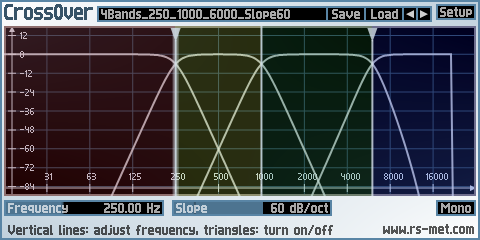
CrossOver is a plugin to split an incoming signal into several (at most 4) frequency ranges. It can be used to build your own multiband effects within a modular (sub)host environment. By using only 2 bands, you can also create bass-effects. These are effects which keep the low frequency range dry and affect only the high frequency range. The band-splitting is done by complementary pairs of Linkwitz-Riley lowpass/highpass filters, the slope of which is adjustable between 12 and 96 dB/oct. For configurations with more than 2 output bands, the signal is first split into 2 bands (low and high) and then the low or high or both bands is/are split further, thus the splitting is done in a hierarchical manner.
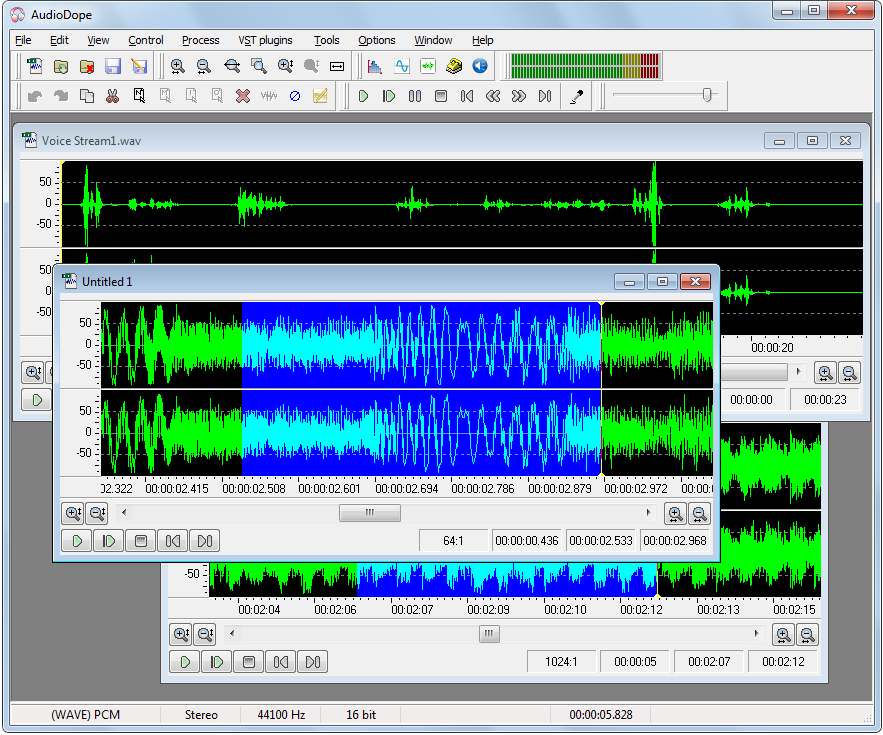
Audiodope is an audio editor. You can load and listen to music files of various formats such as wave, MP3, WMA, etc. You can also edit part or the whole stream with functions like copy, cut, paste, insert and delete. You may modify any part of the stream by applying audio effects and synthesize sound files.
Features:
Sound editing functions such as copy, cut, paste, delete, insert, trim.
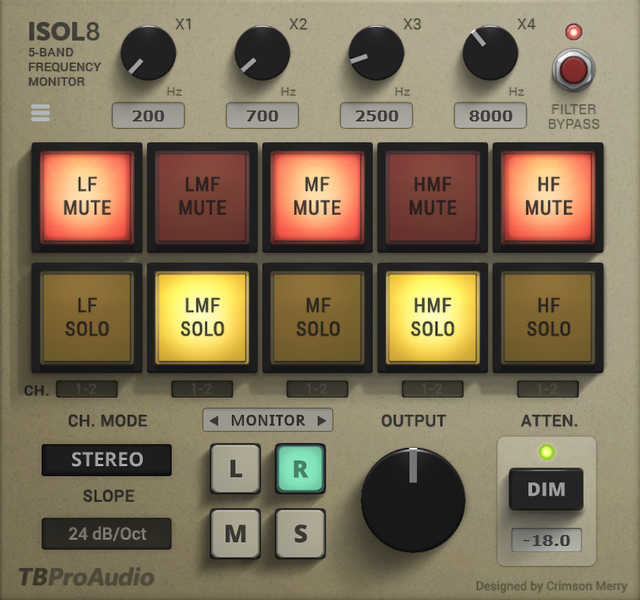
These 5 bands can be soloed or muted individually. This will help you to concentrate on certain frequency ranges during the mixing and mastering process.
On top you can use ISLO8 as a flexible multi-band splitter with following complex plugin chains. The split signal can finally be mixed together.
Isol8 is originally designed to be used on the master track, but it can also be used on individual audio track busses.
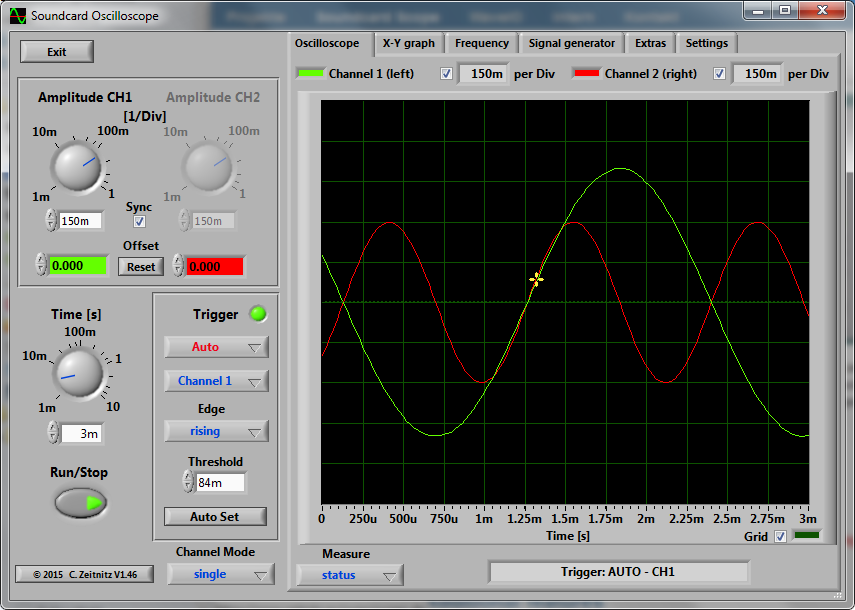
The PC based Soundcard Oscilloscope receives its data from the Soundcard with 44.1kHz and 16 Bit resolution. The data source can be selected in the Windows mixer (Microphone, Line-In or Wave). The frequency range depends on the sound card, but 20-20000Hz should be possible with all modern cards. The low frequency end is limited by the AC coupling of the line-in signal. Be aware, that most microphone inputs are only mono.
The oscilloscope contains in addition a signal generator for 2 channels for sine, square, triangular, sawtooth wave forms and different noise spectra in the frequency range from 0 to 20kHz. The signal can be defined by a mathematical formula as well. The signals are available at the speaker output of the sound card. These can be fed back to the oscillocope in order to generate Lissajous figures in the x-y mode.
Features:
Trigger modes: off, automatic, normal and single shot
Triggerlevel can be set with the mouse
The signals of the two channels can be added, subtracted and multiplied
x-y mode
Frequency analysis (Fourier spectrum)
Waterfall diagram (frequency spectrum as function of time)
Frequency filter: low-, high-, band-pass and band-stop
Cursors to measure amplitude, time and frequency in the main window
Audio Recorder to save data to a wave file
For multi soundcard system, the used card can be selected in the settings tab
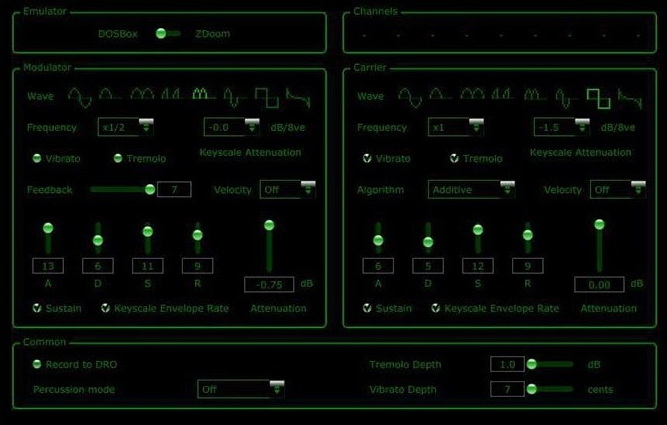
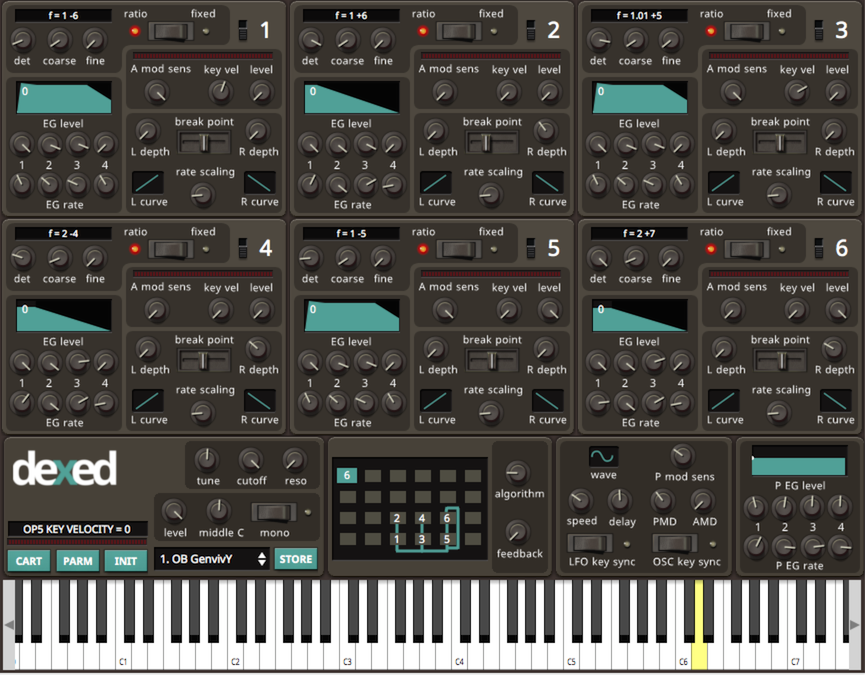
Dexed is a multi-platform, multi-format plugin synth that is closely modelled on the Yamaha DX7. Dexed is also a midi cartridge librarian / manager for the DX7.
Features:
Multi platform (OS X, Windows or Linux) and multi format. (VST, AU, LV2)
144 DAW automatable DX7 parameters available from one single panel.
Fully supports DX7 input and output Sysex messages; including controller change. This means that you can use this with a native DX7/TX7 as a patch editor and sysex manager.
Each operator has a realtime VU meter so you know which one is active.
Can load or save any DX7/TX7 sysex programs. It is also possible to save a single program into a different sysex file.
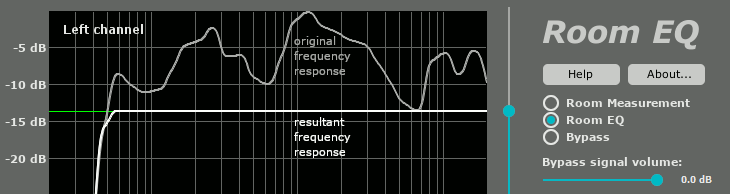
The frequency response of your room is very different in every point of the room. “Good” equalization in one point can worsen the sound in the neighboring point. Single-point equalization is not reliable and cannot be used in a professional room correction system. On the other hand, multipoint equalization is not simple; both the volume and the phase of the testing signal are very different in different points of the room. Simple averaging is not applicable. MathAudio Room EQ applies a state-of-the-art multipoint correction algorithm which ensures the best possible improvement in every point of the listening area.
Corrects deficiencies of room acoustics (multipoint compensation).
Corrects acoustic imperfections of speakers.
Avoids the pre-echo (pre-ringing) problem of conventional convolver-based room correction systems. The absence of pre-echo ensures the neutrality of the sound.
Works in rooms, halls and outdoor venues of any size.
Works with zero latency. Perfect for live performances and studio monitoring.
Doesn’t delay the audio track when playing video.
Corrects both amplitude and phase components of frequency response.
Quells resonance peaks of frequency response while leaving the deep notches.
Avoids the overcompensation which happens in conventional linearizing room correction systems.
Manually adjustable level of compensation allows one to reach the maximum transparency of the sound.
Supports full range of sample rates from 44,056 kHz up to 384 kHz. All sample rates are supported without resampling to avoid any possible loss in quality.
Includes a custom target curve feature.
Applies 64-bit signal path throughout.
Works with USB measurement microphones (e.g. MiniDSP UMIK-1 or Dayton Audio UMM-6) or standard measurement microphones (e.g. NADY CM100 or Dayton Audio EMM-6).
Supports microphone calibration files.
Applies a patented method of frequency response correction.













 The Audio File