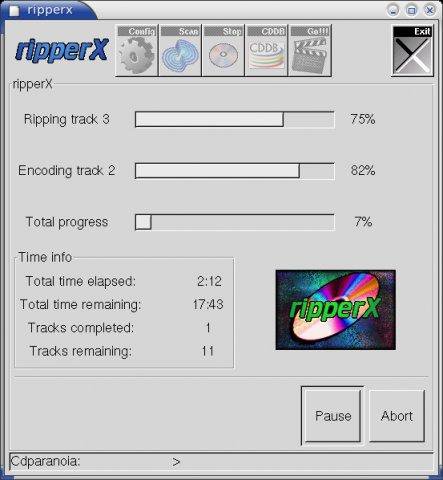
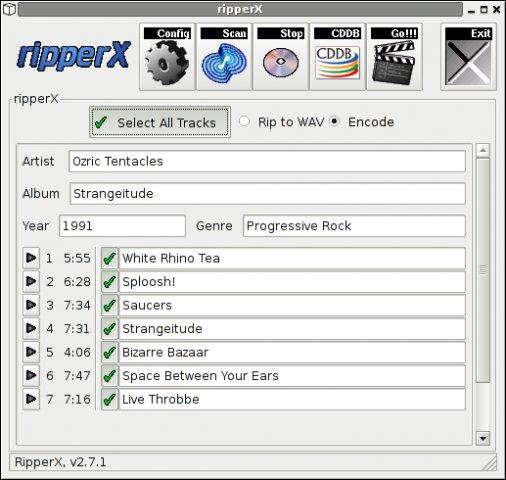
RipperX is a GTK program to rip CD audio tracks and encode them to the Ogg, MP3, or FLAC formats. It’s goal is to be easy to use, requiring only a few mouse clicks to convert an entire album. It supports CDDB lookups for album and track information.


RipperX is a GTK program to rip CD audio tracks and encode them to the Ogg, MP3, or FLAC formats. It’s goal is to be easy to use, requiring only a few mouse clicks to convert an entire album. It supports CDDB lookups for album and track information.


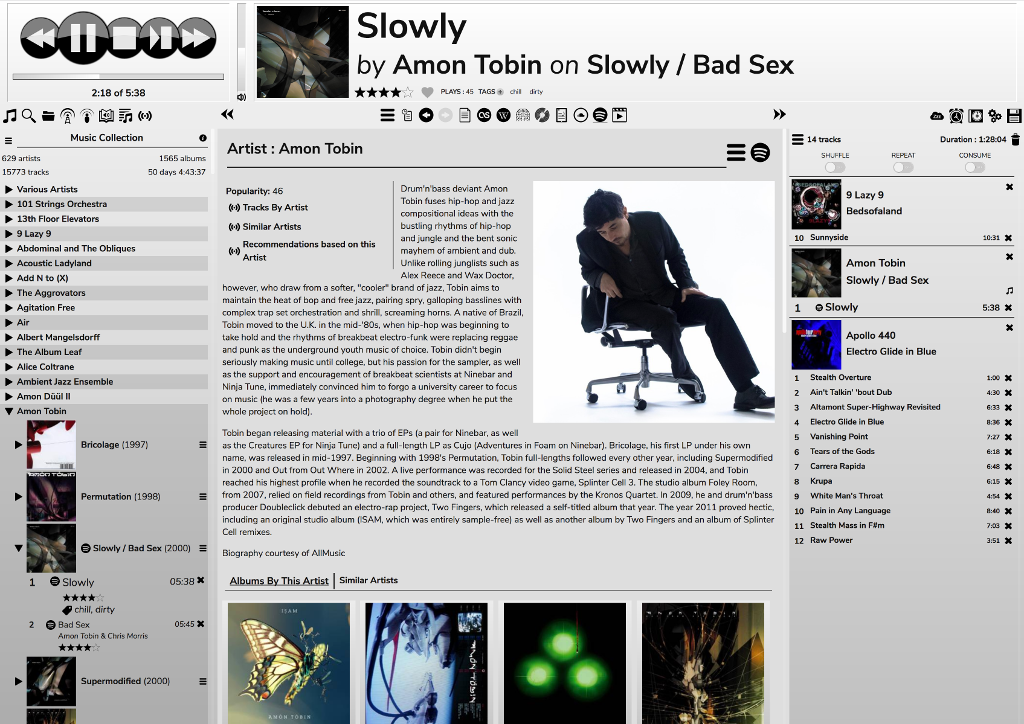
RompЯ is a music player with the emphasis on discovery – discovering more about the music you know, and discovering new music you don’t know yet. RompЯ is an interface that runs in a web browser on any device and controls a music player which can be on any other device. I recommend using Mopidy as the music player. When used with Mopidy and a Spotify Premium subscription RompЯ is a powerful Spotify client with many music discovery features.
Features:
- Collectioniser sorts your music by artist and album
- Directory browser
- Search
- Tagging and Rating of tracks
- Spotify, Soundcloud, GMusic, etc support (with Mopidy),
- Add tracks from Spotify, Soundcloud, etc to the collection on the fly
- Web Radio support, automatic Spotify search for radio tracks you like
- Podcast search and subscribe
- Alarm Clock
- Sleep Timer
- Album Cover Art
- Last.FM Scrobbling
- Automatic on-the-fly playlist generation based on tags, ratings, popularity, your listening habits, etc
- Get biographies of artists from various sources
- Album and artist suggestions based on your listening habits
- UI themes

Dynamic Audio Normalizer is a library for advanced audio normalization purposes. It applies a certain amount of gain to the input audio in order to bring its peak magnitude to a target level (e.g. 0 dBFS). However, in contrast to more “simple” normalization algorithms, the Dynamic Audio Normalizer dynamically re-adjusts the gain factor to the input audio. This allows for applying extra gain to the “quiet” sections of the audio while avoiding distortions or clipping the “loud” sections. In other words: The Dynamic Audio Normalizer will “even out” the volume of quiet and loud sections, in the sense that the volume of each section is brought to the same target level. Note, however, that the Dynamic Audio Normalizer achieves this goal without applying “dynamic range compression”. It will retain 100% of the dynamic range within each “local” region of the audio file.
The Dynamic Audio Normalizer is available as a small standalone command-line utility and also as an effect in the SoX audio processor as well as in the FFmpeg audio/video converter. Furthermore, it can be integrated into your favourite DAW (digital audio workstation), as a VST plug-in, or into your favourite media player, as a Winamp plug-in. Last but not least, the “core” library can be integrated into custom applications easily, thanks to a straightforward API (application programming interface). The “native” API is written in C++, but language bindings for C99 Microsoft.NET, Java, Python and Pascal are provided.
muldersoft.com/#dyauno
github.com/lordmulder/DynamicAudioNormalizer
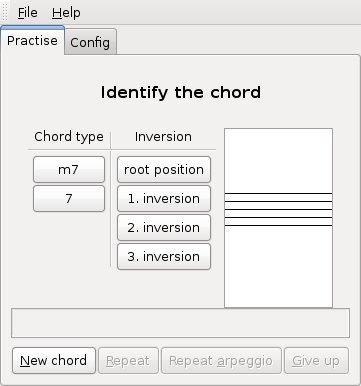
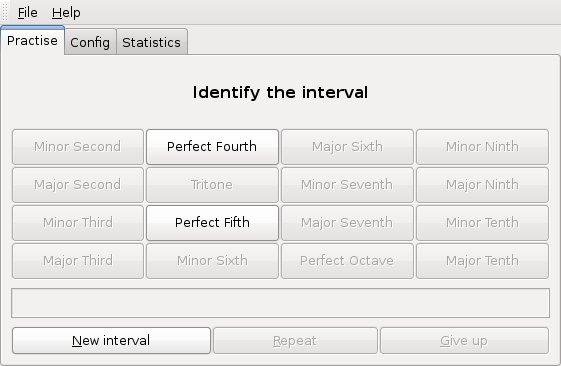
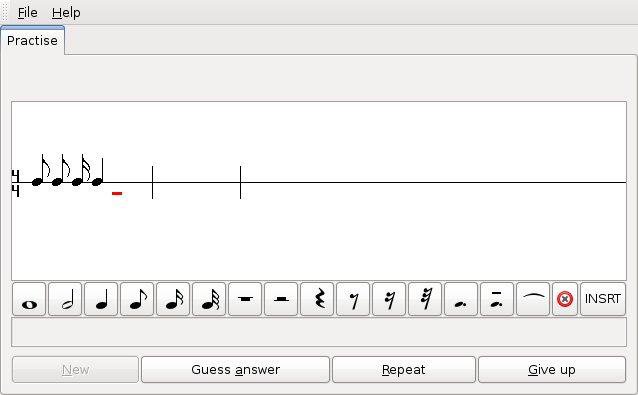
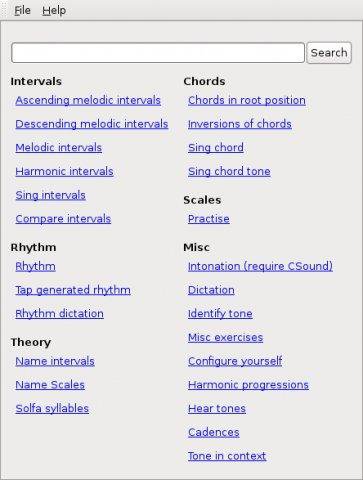
GNU Solfege is *free* ear training software written in Python 3.4 using the Gtk+ 3 toolkit. The program is designed to be easily extended with lesson files (data files), so the user can create new exercises.


www.gnu.org/software/solfege
sourceforge.net/projects/solfege
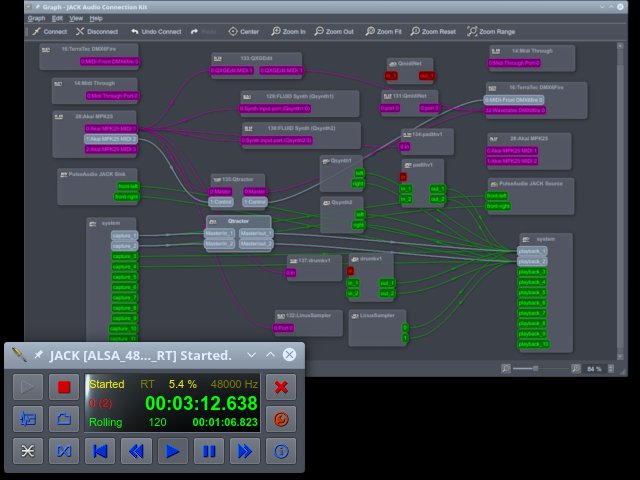
JACK Audio Connection Kit – Qt GUI Interface: A simple Qt application to control the JACK server daemon. Written in C++ around the Qt framework for X11, most exclusively using Qt Designer. Provides a simple GUI dialog for setting several JACK server parameters.

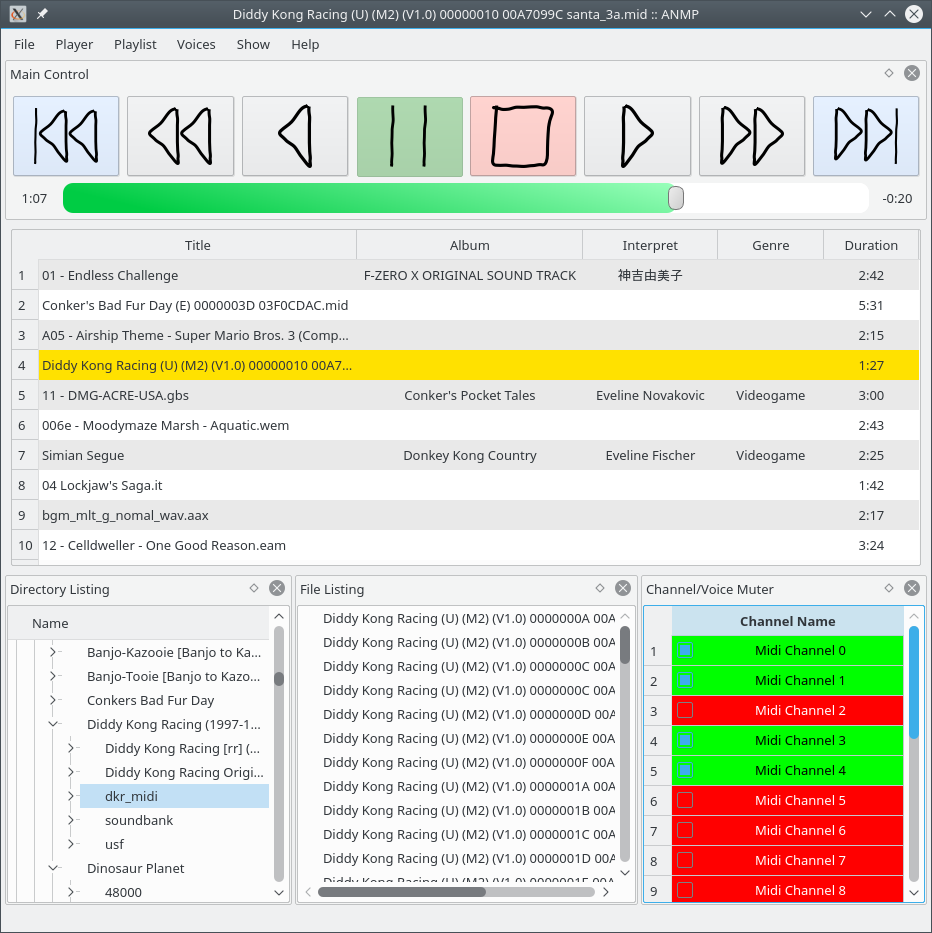
ANMP aims to be a versatile but lightweight audio player, just as the other hundred thousands out there. It is written in C++11. As being only a frontend, ANMP itself doesn’t know anything about audio formats and how to decode them. That’s why it uses 3rd party libraries to decode them. By using VgmStream, GameMusicEmu, LazyUSF and supporting looped songs natively, ANMP is esp. suited to play various audio formats from video games. Moreover it supports Looped Midi Tracks.
Main Features:
- muting multichannel audio files
- gapless playback (for most streamed audio formats)
- arbitrary (forward) looping of songs (i.e. even nested loops)
- synthesizing MIDI files using fluidsynth
- multi-channel audio rendering
- overlapping notes do not kill each other
- unrolling looped MIDI tracks
- volume response compatible to N64’s software synth
- supports an IIR lowpass filter compatible to Rareware‘s N64 games (Conkers Bad Fur Day, Jet Force Gemini)
- support for cue sheets
- support for audio normalization based on EBU R 128
- exposes basic commands via D-Bus

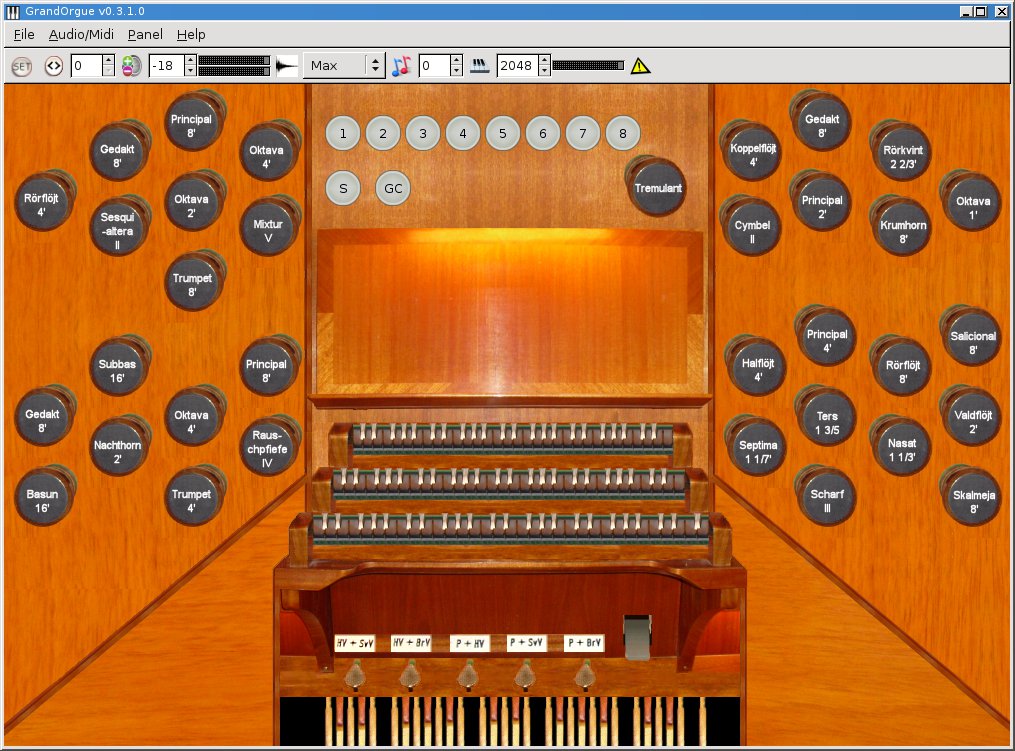
GrandOrgue is a sample based pipe organ simulator. When connected to MIDI keyboards and an audio system, it can accurately simulate the sound of a real pipe organ. This application has builds for Linux, Windows and OSX.
Features:
- Play sample sets
- GUI console

sourceforge.net/projects/ourorgan/
sourceforge.net/p/ourorgan/wiki/Home
ABC, developed by Chris Walshaw, is a format designed to notate music using plain text. It was originally designed for folk tunes of Western European origin which can be written on one staff, but has since been extended to support the notation of complete, classical music scores.
Since its introduction at the end of 1991, ABC has become very popular. Programs on many operating systems use ABC as an input and/or output format. There are programs which produce printed sheet music or allow for computer performances, search in tune databases, or that analyze tunes in some way.
The aim of this project is to promote the ABC language by maintaining the ABC standard and a set of software and source code that manipulate and present music written in ABC.
abcnotation.com
abc.sourceforge.net
The abc tune search / tune finder gives you access to thousands of folk & traditional tunes from across the web.
abcplus.sourceforge.net
sourceforge.net/projects/abcplus
ABC to HTML ~ sourceforge.net/projects/netabc
User Interfaces ~ sourceforge.net/projects/runabc
Reference: en.wikipedia.org/wiki/ABC_notation
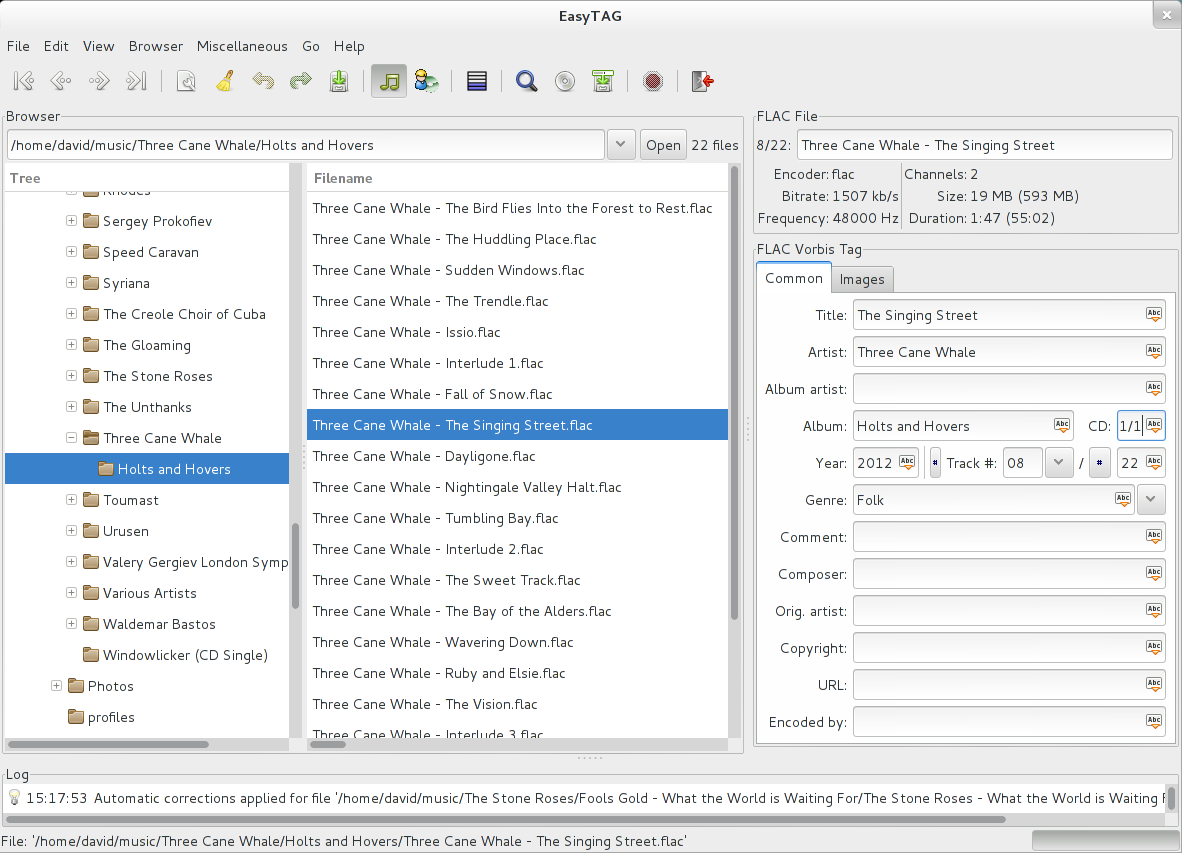
EasyTAG is a simple application for viewing and editing tags in audio files.It supports MP3, MP2, MP4/AAC, FLAC, Ogg Opus, Ogg Speex, Ogg Vorbis, MusePack, Monkey’s Audio, and WavPack files, and it works under Linux or Windows.
Features:
- View, edit, write tags of MP3, MP2 files (ID3 tag with pictures), FLAC files (FLAC Vorbis tag), Ogg Opus files (Ogg Vorbis tag), Ogg Speex (Ogg Vorbis tag), Ogg Vorbis files (Ogg Vorbis tag), MP4/AAC (MP4/AAC tag), MusePack, Monkey’s Audio files and WavPack files (APE tag)
- Can edit more tag fields: title, artist, album, disc number, year, track number, comment, composer, original artist/performer, copyright, URL, encoder name and attached picture
- Auto tagging: filename and directory to automatically complete the fields (masks)
- Ability to rename files and directories from the tag (using masks) or by loading a text file
- Process selected files of the selected directory
- Ability to browse subdirectories
- Recursion for tagging, removing, renaming, saving…
- Can set a field (artist, title,…) to all other files
- Read and display file header information (bitrate, time,…)
- Auto completion of the date if a partial one is entered
- Undo and redo last changes
- Ability to process fields of tag and file name (convert letters into uppercase, lowercase,…
- Ability to open a directory or a file with an external program
- CDDB support using Freedb.org and Gnudb.org servers (manual and automatic search)
- A tree based browser or a view by artist & album
- A list to select files
- A playlist generator window
- A file searching window
- Straightforward and explicit interface
- Translations into many languages
- Written in C and using GTK+ for the GUI
- Packages available for Linux and Windows

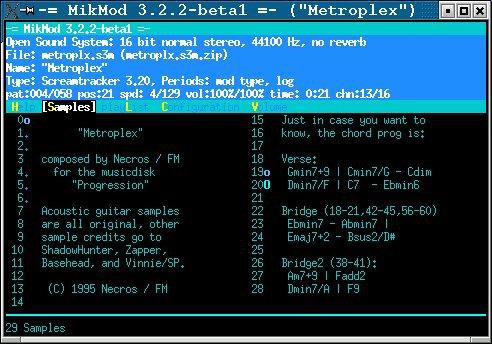
Mikmod is a module player and library supporting many formats, including mod, s3m, it, and xm. Originally a player for MS-DOS, MikMod has been ported to other platforms, such as Unix, Macintosh, BeOS, and Java(!!)

Streamripper was started sometime back in early 2000. Streamripper started as a way to separate tracks via Shoutcast’s title-streaming feature. This has now been expanded into a much more generic feature, where part of the program only tries to “hint” at where one track starts and another ends, thus allowing a mp3 decoding engine to scan for a silent mark, which is used to find an exact track separation.
Streamripper is now part of the FreeBSD standard distribution, mentioned in the Linux MP3 HOWTO, known to compile on many platforms such as Linux, Windows, FreeBSD, BeOS, OS/2. This is not surprising as portability was a constant consideration during development.
Streamripper allows you to download an entire station of music. Many of these mp3 radio stations only play certain genres, so you can now download an entire collection of goa/trance music, an entire collection of jazz, punk rock, whatever you want.
streamripper.sourceforge.net
sourceforge.net/projects/streamripper
github.com/streamripper
code.google.com/archive/p/xstreamripper
www.nongnu.org/streamtuner
tunapie.sourceforge.net
sourceforge.net/projects/kstreamripper
launchpad.net/streamtastic
A soundboard that supports almost all MP3s and WAVs. Sounds can be triggered with custom keyboard hot-keys and played through up to 2 outputs. i.e. Your speakers and a virtual audio cable. Also allows for your mic to pass into the virtual audio cable when enabling Mic Injector. This soundboard also incorporates a save feature.
Features:
- Easy to use soundboard app, allows soundboards to be saved.
- Use keyboard hotkeys to trigger sounds
- Play sounds through a virtual audio cable and still be able to hear them through your speakers
- Includes Mic Injector to route sound from your mic into your virtual audio cable
- Includes converter tool for converting almost any audio file into a compatible one

sourceforge.net/projects/expsoundboard
How To Use Microphone While Using Soundboard (Using Mic Injector)