Background Music ~ macOS Audio Utility


  • Automatically pauses your music player when other audio starts playing and unpauses it afterwards
  • Per-application volume, boost quiet apps
  • Record system audio

github.com/kyleneideck/BackgroundMusic
awesomeopensource.com/project/kyleneideck/BackgroundMusic

Snapcast ~ Synchronous Audio Player


Snapcast is a multi-room client-server audio player, where all clients are time synchronized with the server to play perfectly synced audio. It’s not a standalone player, but an extension that turns your existing audio player into a Sonos-like multi-room solution. The server’s audio input is a named pipe /tmp/snapfifo. All data that is fed into this file will be send to the connected clients. One of the most generic ways to use Snapcast is in conjunction with the music player daemon (MPD) or Mopidy, which can be configured to use a named pipe as audio output.

github.com/badaix/snapcast

WavPack ~ Hybrid Lossless Audio Compression


WavPack is a completely open audio compression format providing lossless, high-quality lossy, and a unique hybrid compression mode. For version 5.0.0, several new file formats and lossless DSD audio compression were added, making WavPack a universal audio archiving solution.

In the default lossless mode WavPack acts just like a WinZip compressor for audio files. However, unlike MP3 or WMA encoding which can affect the sound quality, not a single bit of the original information is lost, so there’s no chance of degradation. This makes lossless mode ideal for archiving audio material or any other situation where quality is paramount. The compression ratio depends on the source material, but generally is between 30% and 70%.

The hybrid mode provides all the advantages of lossless compression with an additional bonus. Instead of creating a single file, this mode creates both a relatively small, high-quality lossy file that can be used all by itself, and a “correction” file that (when combined with the lossy file) provides full lossless restoration. For some users this means never having to choose between lossless and lossy compression!

WavPack employs only well known, public domain techniques (i.e., linear prediction with LMS adaptation, Elias and Golomb codes) in its implementation. Methods and algorithms that have ever been patented (e.g., arithmetic coding, LZW compression) are specifically avoided. This ensures that WavPack encoders and decoders will remain open and royalty-free.

www.wavpack.com
github.com/dbry/WavPack
en.wikipedia.org/wiki/WavPack

mlYou ~ Music Library Utilities Suite


This is a collection of tools to help you manage, maintain, and optimize your own music library for a better experience.

It makes growing and maintaining a music collection of any size easier by automating necessary (but tedious) processes.

The tools currently aim to assist with music organizing and tagging, and playlist management.

Cross-Platform Compatible – Works and tested under Linux (Ubuntu) and Windows. Mac untested but expected to work similar to linux.

github.com/nwrobel/mlYou#playlist-root-path-fixing

Sonic Pi ~ Live Coding Music Synthesizer


Sonic Pi is a new kind of musical instrument. Instead of strumming strings or whacking things with sticks – you write code – live.

Sonic Pi has been designed with the aim to find a harmonious balance between three core principles:

  • Simple enough for the 10 year old within you
  • Joyful enough for you to lose yourself through play
  • Powerful enough for your own expressions

Sonic Pi is a complete open source programming environment originally designed to explore and teach programming concepts within schools through the process of creating new sounds.

In addition to being an engaging education resource it has evolved into an extremely powerful and performance-ready live coding instrument suitable for professional artists and DJs.

sonic-pi.net
github.com/samaaron/sonic-pi

v2strip ~ Remove mp3 ID3v2 Tags


v2strip is a simple command-line utility that lets you remove the ID3v2 tag from an MP3 file. The ID3v2 format is nice in many ways, but it can cause problems when being parsed by MP3 players and utilities that don’t support ID3v2 tags.

sourceforge.net/projects/v2strip

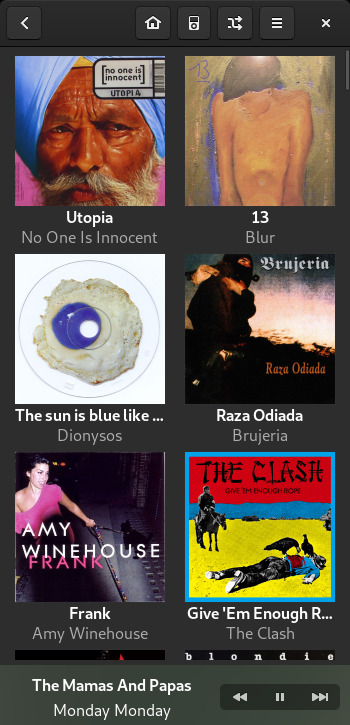
Lollypop ~ GNOME Audio Player


Lollypop is a modern music player for GNOME

  • Artist bio, lyrics Artist bio, lyrics: Get artists and tracks information from the web.
  • Intuitive browsing: Walk through your collection by genres/artists and through albums artwork.
  • Play many audio formats: mp3, mp4, ogg, and flac
  • Cover art downloader: Automatic artwork downloader from Last.fm, Itunes and Spotify.
  • MTP devices: Sync your music with Android phones and any mtp devices…
  • Fullscreen view: Visual access from your couch
  • Party mode: Let Lollypop choose music for you.
  • Native replaygain support.
  • Search in your collection by artist, album and title.

lollypop

wiki.gnome.org/Apps/Lollypop

puddletag ~ GNU \ Linux Audio Tag Editor


puddletag is an audio tag editor (primarily created) for GNU/Linux similar to the Windows program, Mp3tag. Unlike most taggers for GNU/Linux, it uses a spreadsheet-like layout so that all the tags you want to edit by hand are visible and easily editable.

The usual tag editor features are supported like extracting tag information from filenames, renaming files based on their tags by using patterns and basic tag editing.

Then there are Functions, which can do things like replace text, trim it, do case conversions, etc. Actions can automate repetitive tasks. Doing web lookups using Amazon (including cover art), Discogs (does cover art too!), FreeDB and MusicBrainz is also supported. There’s quite a bit more, but I’ve reached my comma quota.

Supported formats: ID3v1, ID3v2 (mp3), MP4 (mp4, m4a, etc.), Vorbis Comments (ogg, flac), Musepack (mpc), Monkey’s Audio (.ape) and WavPack (wv).

puddletag

docs.puddletag.net

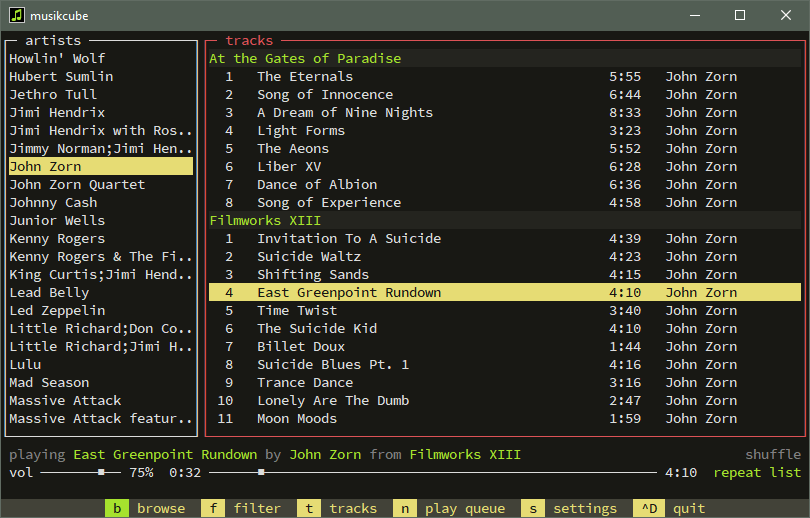
musikcube ~ Terminal-based Audio Client Server


Cross-platform, terminal-based audio engine, library, player and server written in c++. Musikcube compiles and runs easily on Windows, macOS and Linux. It also runs well on a raspberry pi with raspbian, and can be setup as a streaming audio server.

musikcube

github.com/clangen/musikcube

loudgain ~ Linux Loudness Normalizer


loudgain is a versatile ReplayGain 2.0 loudness normalizer, based on the EBU R128 / ITU BS.1770 standard (-18 LUFS) and supports FLAC / Ogg / MP2 / MP3 / MP4 / M4A / ALAC & Opus audio files. It uses the well-known mp3gain command line syntax but will never modify the actual audio data.

Just what you ever wanted: the best of mp3gain, ReplayGain 2.0 and Linux combined. Spread the word!

github.com/Moonbase59/loudgain

Cabbage ~ Audio Instrument Development


Cabbage is a software for prototyping and developing audio instruments with the Csound audio synthesis language. Instrument development and prototyping is carried out with the main Cabbage IDE. Users write and compile Csound code in a code editor. If one wishes one can also create a graphical frontend, although this is no longer a requirement for Cabbage. Any Csound file can be run with Cabbage, regardless of whether or not it has a graphical interface. Cabbage is designed for realtime processing in mind. It is possible to use Cabbage to run Csound in the more traditional score-driven way, but your success may vary.

Cabbage is a ‘host’ application. It treats each and every Csound instrument as a unique audio plugin, which gets added to a digital audio graph (DAG) once it is compiled. The graph can be opened and edited at any point during a performance. If one wishes to use one of their Csound instruments in another audio plugin host, such as Reaper, Live, Bitwig, Ardour, QTractor, etc, they can export the instrument through the ‘Export instrument’ option.

cabbageaudio.com/
csound.com/

ChucK ~ Music Programming Language


ChucK is a programming language for real-time sound synthesis and music creation. It is open-source and freely available on MacOS X, Windows, and Linux. ChucK presents a unique time-based, concurrent programming model that’s precise and expressive (we call this strongly-timed), dynamic control rates, and the ability to add and modify code on-the-fly. In addition, ChucK supports MIDI, OpenSoundControl, HID device, and multi-channel audio. It’s fun and easy to learn, and offers composers, researchers, and performers a powerful programming tool for building and experimenting with complex audio synthesis / analysis programs, and real-time interactive music.

chuck.cs.princeton.edu