The Daphile is the heart of a digital music system. Its primary focus is in storage and playback of your digital music library. It enables the best possible audio quality and future-proof flexibility by providing plug&play support for USB connected digital-to-analog converters (DAC). You can easily setup a multi-zone system just by connecting another USB DAC for each zone.
Features:
Headless music server OS
Bitperfect and gapless playback
Extensive audio format support
Native DSD playback up to DSD512
PCM resolutions up to 384kHz/24bit
High quality audio resampling including PCM to DSD conversion
Convolution filtering for DRC and equalizer
“Play from RAM” to minimize CPU load and disk activity during playback
Automatic audio device configuration with multiplayer support
CD ripping with AccurateRip™ verification, automatic metadata tagging and cover art
Supports external file servers as music source
Easy configuration and installation through the web interface
WiFi hotspot support (if compatible hardware exists)
Software update via web interface
Network-attached storage (NAS) service
Whole system included in about 200MB ISO-file
Daphile is based on the open source Squeezebox Server, Squeezelite and Linux. Since Daphile is used and configured completely via the web interface the user is not required to have any Linux skills.
DSF_FillMute is a program that replaces a series of trailing zeros created by the standard of DSF files with a silent signal (0x69,1001 0110b). It is effective for devices that generate noise by playing a series of trailing zeros. There is no change in the actual sound or ID3 tag because no processing is added except at the end.
PCM-DSD Converter is a program that converts a PCM WAV format sound source to DSD DSDIFF format. You can convert from PCM 16bit ~ 64bit Float / 44.1 ~ 768kHz to DSD16-DSD2048.
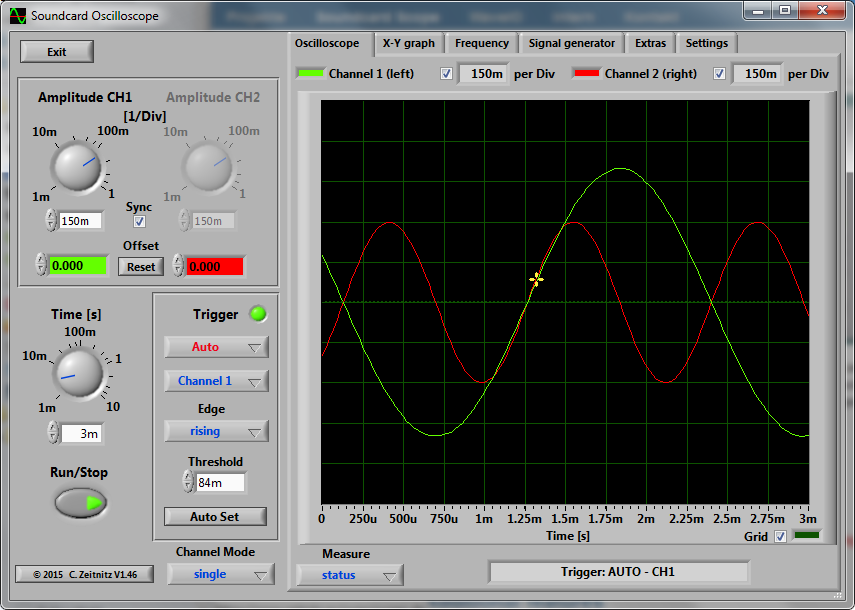
The PC based Soundcard Oscilloscope receives its data from the Soundcard with 44.1kHz and 16 Bit resolution. The data source can be selected in the Windows mixer (Microphone, Line-In or Wave). The frequency range depends on the sound card, but 20-20000Hz should be possible with all modern cards. The low frequency end is limited by the AC coupling of the line-in signal. Be aware, that most microphone inputs are only mono.
The oscilloscope contains in addition a signal generator for 2 channels for sine, square, triangular, sawtooth wave forms and different noise spectra in the frequency range from 0 to 20kHz. The signal can be defined by a mathematical formula as well. The signals are available at the speaker output of the sound card. These can be fed back to the oscillocope in order to generate Lissajous figures in the x-y mode.
Features:
Trigger modes: off, automatic, normal and single shot
Triggerlevel can be set with the mouse
The signals of the two channels can be added, subtracted and multiplied
x-y mode
Frequency analysis (Fourier spectrum)
Waterfall diagram (frequency spectrum as function of time)
Frequency filter: low-, high-, band-pass and band-stop
Cursors to measure amplitude, time and frequency in the main window
Audio Recorder to save data to a wave file
For multi soundcard system, the used card can be selected in the settings tab
VintageRadio is a GUI front-end for the fm command-line application included with fmtools <http://benpfaff.org/fmtools>. It is written in [incr Tcl/Tk], an object-oriented extension package for Tcl/Tk. VintageRadio is not part of fmtools.
Features:
A vintage 70s-era look, inspired by a number of stereo tuners and receivers with the classic silver face.
A rotary tuning dial that actually works.
Ability to store up to 6 stations as presets.
Keyboard shortcuts for all application functionality.
This project provides an open source MacOS v10.14, v10.15, v11.6 (Mojave, Catalina, Big Sur) compatible CoreMIDI 64 bit device driver for M-Audio’s MIDISPORT range of USB MIDI interfaces. This driver supports the following devices:
MIDISPORT 1×1
MIDISPORT 2×2
MIDISPORT 4×4
MIDISPORT 8×8/S
Oxygen 8 Keyboard
Other devices which are compatible may also work, although presently, these are the only ones which have been tested.
Charlatan is a polyphonic, subtractive virtual analog (VA) synthesizer VSTi plugin with focus on sound quality and easy usability. It comes with a flexible, yet not overwhelming feature set which encourages artists to start tweaking instead of just relying on presets. In spite of it’s simplicity, Charlatan’s architecture is flexible enough to create both classic sounds and rather experimental noises. While making no compromise about sound quality, the sound engine has been highly optimized for efficient CPU usage making Charlatan well suited as a “bread and butter” synth even in projects with a large number of plugin instances. Best of all, it’s freeware! Enjoy!
Key Features:
2 oscillators with shape modulation
Oscillator hard synchronization and ring modulation
Unison mode with up to seven voices and stereo spread
Stereo noise generator
2 ADSR envelope generators
LFO with host tempo synchronization
3 filter types modeled after classic analog hardware: 4-pole (24 db/oct) and 2-pole (12 db/oct) lowpass, bandpass
3 voice modes: Monophonic, Monophonic Legato and 8-voice Polyphonic
Transform an album image into a video with songs tracks.
Select your favorite artist’s albums or your own picture with songs or sounds effects and transform it into a video with audio tracks that you can upload to YouTube.
wrk2mid is a command line utility for translating WRK (Cakewalk) files into MID (standard MIDI files). This project depends on Qt and Drumstick libraries.