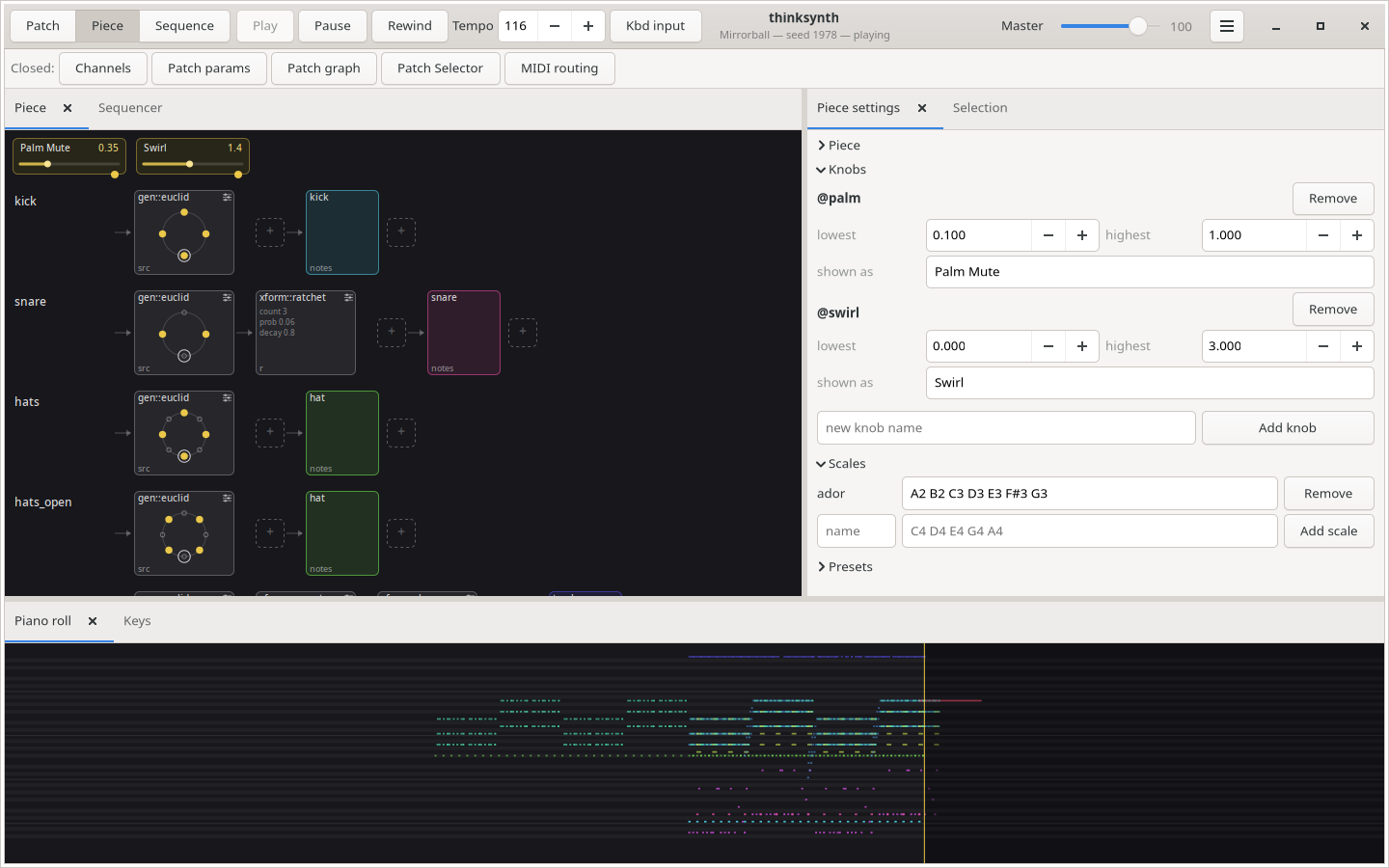
thinksynth builds sounds out of a graph of DSP nodes — oscillators, filters, envelopes, delays and arithmetic — described in a small language and rendered in real time. Patches assign those graphs to MIDI channels, so one instrument can layer several voices.
Every node is a plugin, and the set that ships covers subtractive and FM synthesis, resonators, waveshaping and a range of filters. New ones are ordinary shared libraries dropped into the plugin directory.
foo_dsp_speaker_range is a foobar2000 DSP component for Windows x64. It adds Speaker Range Crop, a configurable Linkwitz-Riley 4th-order high-pass/low-pass filter intended to limit playback to a loudspeaker’s reproducible range.
The filter sections use Vicanek matched (decramped) coefficients instead of bilinear-transform designs, so the magnitude response stays close to the analog Linkwitz-Riley prototype near Nyquist. In practice this means a 20 kHz low-pass stays active and tracks the intended response at 44.1 kHz, where bilinear/RBJ-style low-pass biquads cramp toward their forced null at Nyquist. The DSP uses causal IIR filters with no lookahead and reports zero processing latency to foobar2000. Reference: M. Vicanek, “Matched Second Order Digital Filters” (2016), vicanek.de/articles/BiquadFits.pdf.
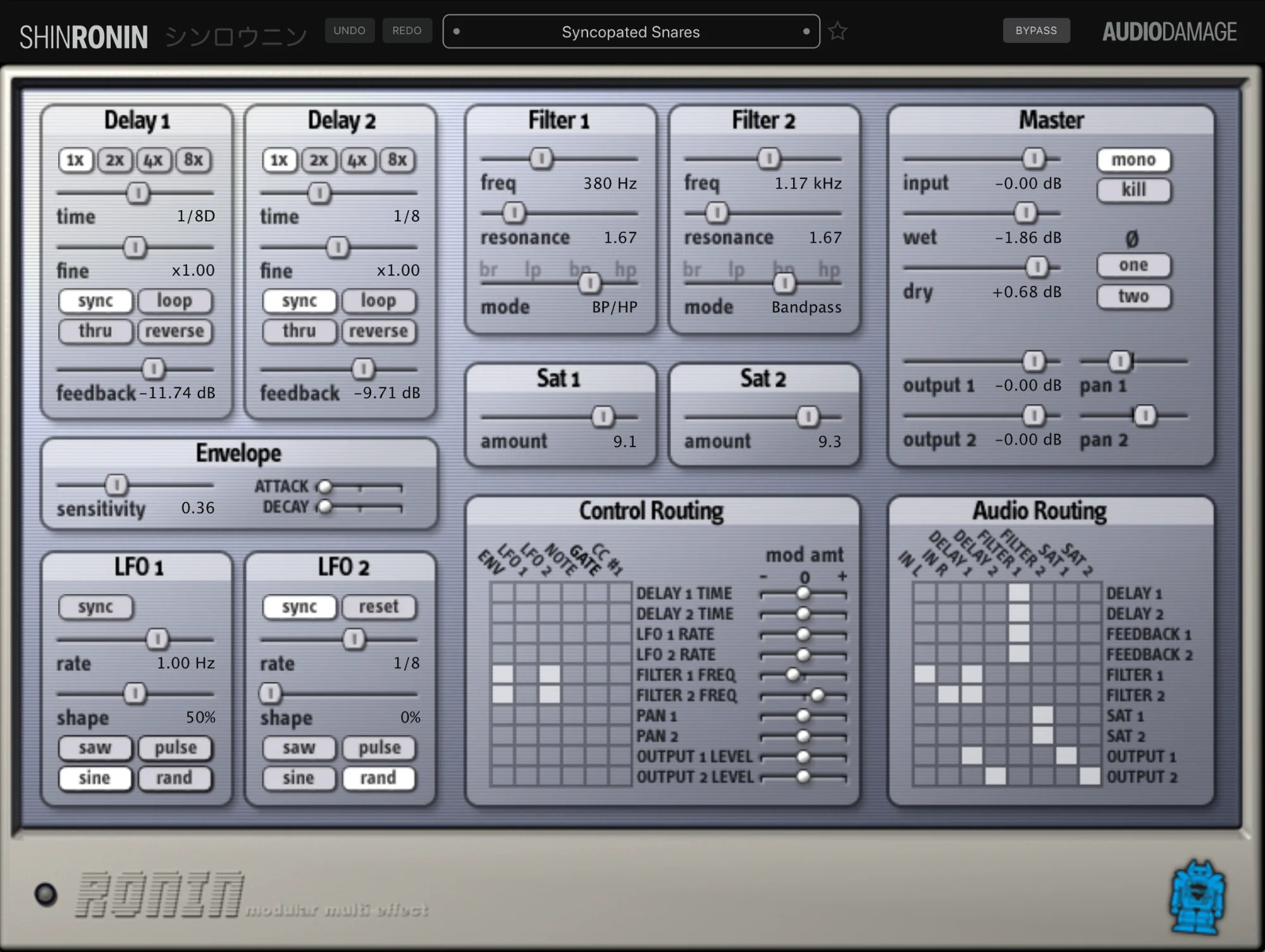
ShinRonin is a ground-up rebuild of Ronin, one of the earliest plugins we ever shipped, first released in 2003. The original paired two delay lines with a set of morphing filters and two fully patchable routing matrices, and it earned a cult following for the strange feedback networks and self-oscillating textures you could build inside it. Twenty years on, we have rebuilt it for modern systems, kept the architecture that made it worth remembering, and released it for free.
Two independent delay lines, each with tempo sync, reverse, looping, and feedback, feed a pair of morphing multimode filters that sweep continuously from notch through lowpass, bandpass, and highpass. There is saturation, two LFOs, and an envelope follower. Everything connects through two on-board matrices: a signal matrix that routes any audio source to any destination, and a modulation matrix that wires the LFOs, envelope, and incoming MIDI to nearly any parameter. It is happy doing clean stereo delays and gentle filtering, but the real fun starts when you patch a feedback loop and let it misbehave.
aubio is a tool designed for the extraction of annotations from audio signals. Its features include segmenting a sound file before each of its attacks, performing pitch detection, tapping the beat and producing midi streams from live audio.
Because these tasks are difficult, we thought it was important to gather them in a dedicated library. To increase the fun, we have made these algorithms work in a causal way, so as to be used in real time applications with as low delay as possible. Functions can be used offline in sound editors and software samplers, or online in audio effects and virtual instruments.
DSP Loudspeaker-Room correction filter wizard; transfer function modeling and equalization by fixed-pole parallel filters. Algorithm ported to Python by Mason A. Green, based on the work of Dr. Balazs Bank: home.mit.bme.hu/~bank/parfilt PORC now includes mixed-phase compensation.
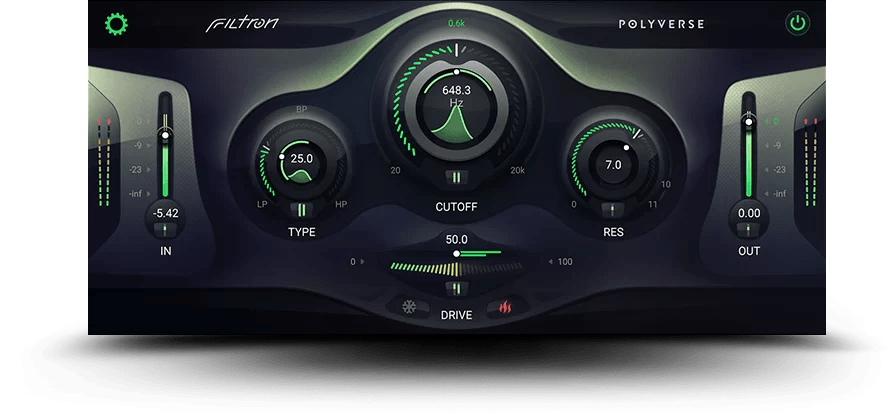
Filtron is a 12dB state variable filter that can smoothly transition between lowpass, bandpass, and highpass. It is capable of self-oscillation with resonance levels that can reach up to 11! Filtron also features a fat sounding internal saturation algorithm and a sizzly post overdrive with two modes to choose from: cold and hot.
12db state variable filter
Transition smoothly between Lowpass, Bandpass, Highpass
Aqualizer, a computer program that can be used in order to filter sound. In fact it is a digital equalizer. However, it is an equalizer for connoisseurs, so to say, as we researched how we could improve the existing equalizer to fit the needs of DJ’s and sound designers even better.
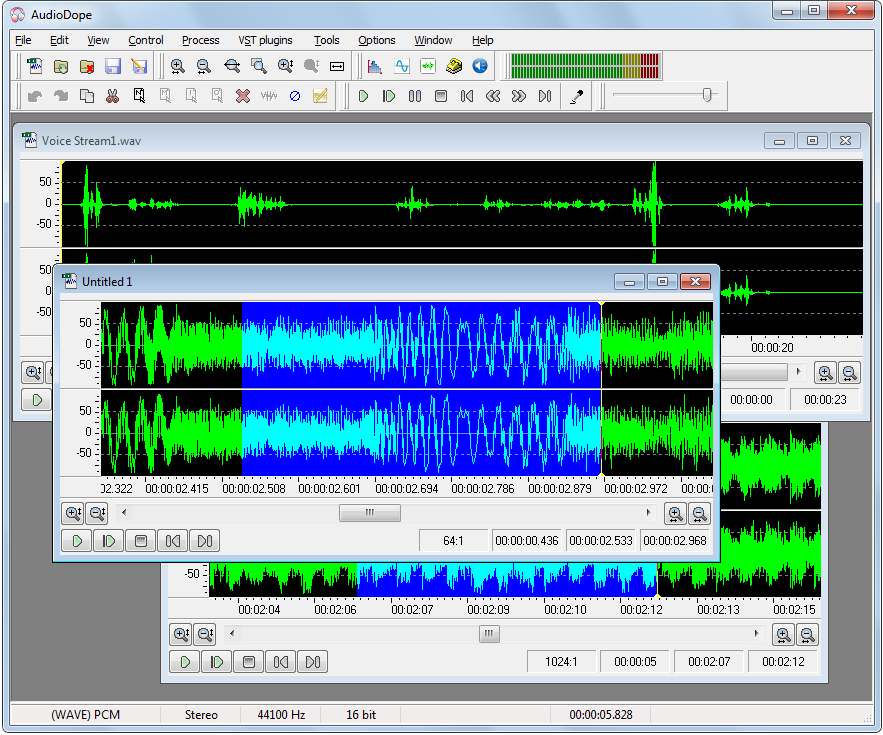
Audiodope is an audio editor. You can load and listen to music files of various formats such as wave, MP3, WMA, etc. You can also edit part or the whole stream with functions like copy, cut, paste, insert and delete. You may modify any part of the stream by applying audio effects and synthesize sound files.
Features:
Sound editing functions such as copy, cut, paste, delete, insert, trim.
With its bit crushing and downsampling algorithms, Krush combines the crispy taste of the digital realm with the warmth of its drive stage and analog modeled resonant filters. A modulation section allows you to quickly add extra life to the sound by modulating any parameter.
The sound palette produced by Krush ranges from the dirtiest digital effects to crunchy modulated colours, with all the classic and weirdest bit-crushing effects in between.