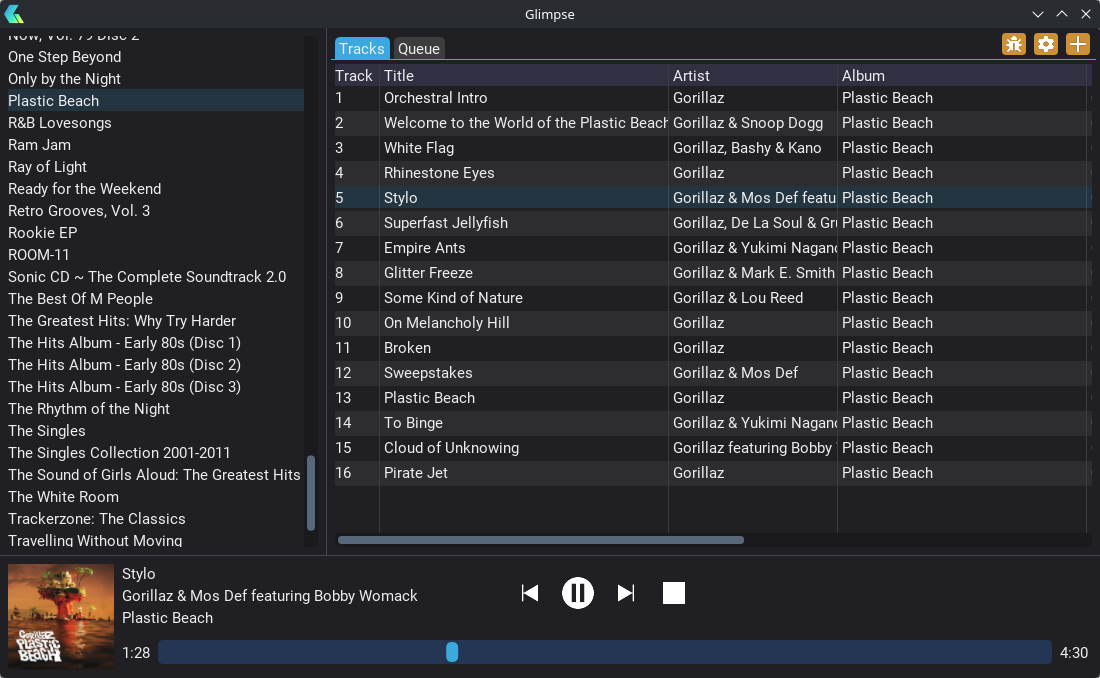
Glimpse ~ Free, Fast & Extensible Player


The free, fast and extensible music player.

glimpseaudio.co.uk
github.com/aquagoose/Glimpse

Euphonium ~ Multiplatform Extensible Audio Streaming


Euphonium is a highly extensible audio streaming software. It’s multiplatform, also supporting low cost MCU’s like espressif ESP32 series.

Features:

  • Clean and lightweight web-ui.
  • Supports multiple plugins: Spotify streaming, Bluetooth (on esp32), Web Radio, Jellyfin.
  • Fully modular architecture.
  • Easily extendible and portable to new hardware, thanks to the internal Berry-lang powered scripting engine.

Required hardware for esp32:

  • Any ESP32 chip with at least 4MB of flash and 4MB of PSRAM. Wrover chips are usually a good call. 🙂
muvox-io.github.io/euphonium
github.com/muvox-io/euphonium

Buzztrax ~ All In One Music Composer


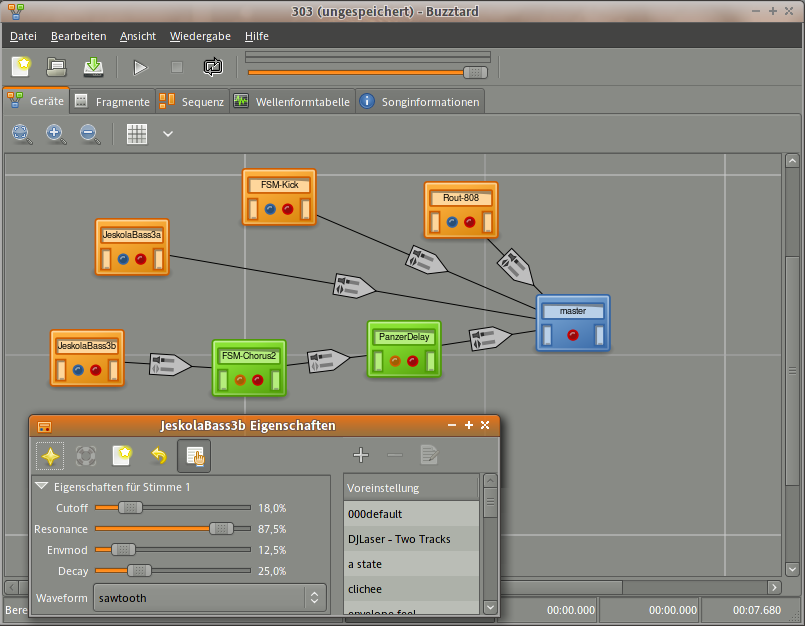
Buzztrax aims to be a music studio that allows one to compose songs using only a computer with a soundcard. If you’ve used tracker programs like FastTracker, Impulse Tracker, or the original AMIGA SoundTracker, that will give you an idea of how one can sequence music in Buzztrax.

The Buzztrax editor uses a similar concept, where a song consists of a sequence with tracks and in each track one uses patterns with events (musical notes and control changes). In contrast to other Tracker programs, tracks are not simply sample players: a user can make a song using an arrangement of virtual audio plugins that are linked together to create different effects. Each of these machines can be controlled real-time or via patterns in the sequencer.

www.buzztrax.org
Buzztrax User Interface Image

Fooyin ~ Linux Audio Player


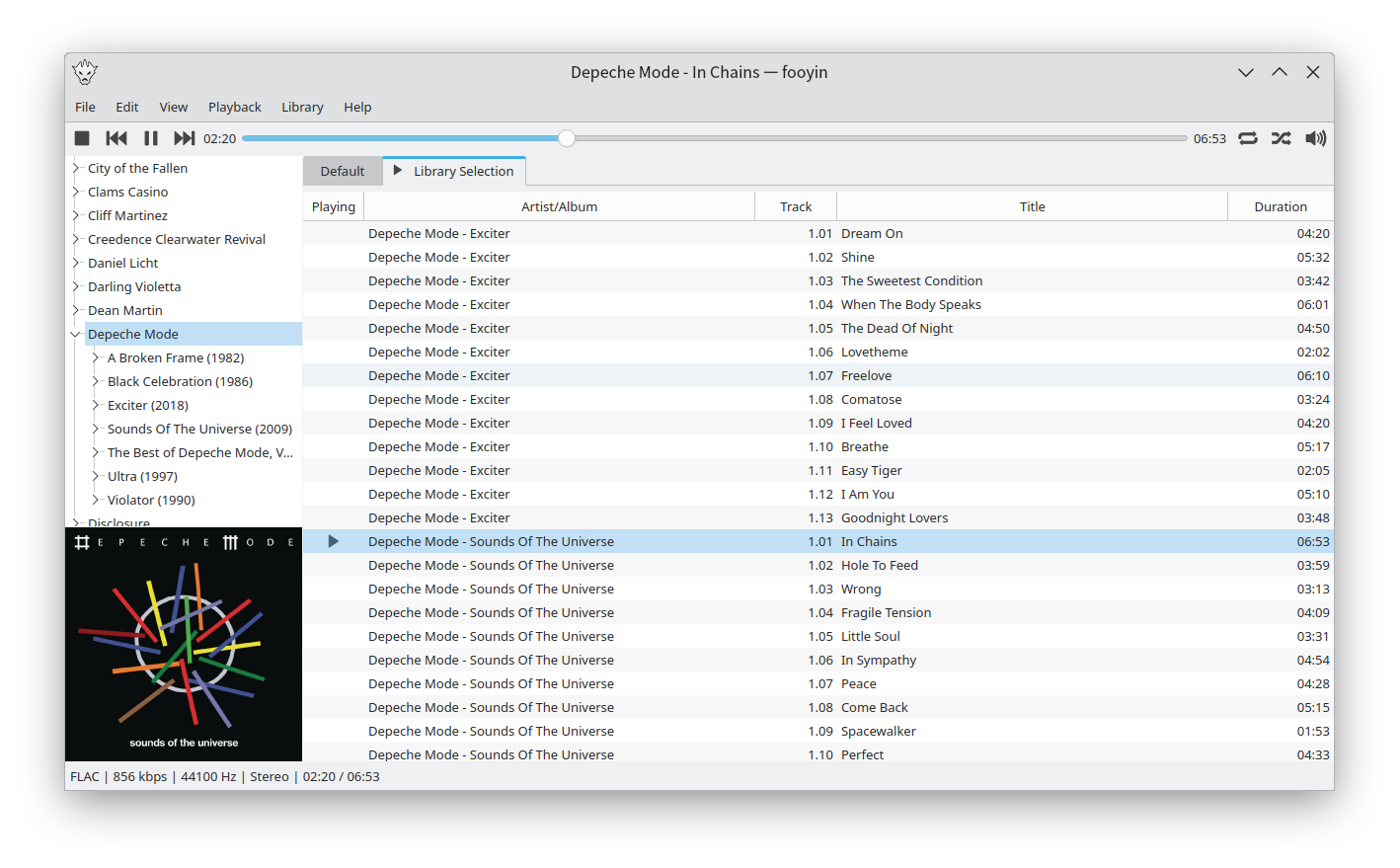
Fooyin is a customisable music player for Linux. Fooyin features a layout editing mode in which the entire user interface can be customised, starting from a blank state or a default layout. FooScript takes this further by extending the customisation to individual widgets themselves.

Features:

  • Playback FLAC, MP3, MP4, Vorbis, Opus, WavPack, WAV, AIFF, Musepack, Monkey’s Audio
  •  Playback popular VGM and tracker module formats
  •  Gapless playback
  •  Add and play files from within compressed archives
  •  Audio output and device configuration
  •  CUE sheet support (including embedded)
  •  Fully customisable layout, starting from a blank window
  •  Customisable keyboard shortcuts
  •  Filter library on any field(s)
  •  Create and manage playlists
  •  Import/export playlists (M3U/M3U8)
  •  Extensible using a plugin system
  •  Tag editing
  •  Library tree, including directory structure view
  •  Directory browser
  •  Waveform seekbar
  •  MPRIS support
  •  ReplayGain support
  •  Scrobbling

www.fooyin.org
github.com/ludouzi/fooyin

ExoPlayer ~ Extensible Android Media Player


ExoPlayer is an application level media player for Android. It provides an alternative to Android’s MediaPlayer API for playing audio and video both locally and over the Internet. ExoPlayer supports features not currently supported by Android’s MediaPlayer API, including DASH and SmoothStreaming adaptive playbacks. Unlike the MediaPlayer API, ExoPlayer is easy to customize and extend, and can be updated through Play Store application updates. ExoPlayer modules can be obtained from JCenter. It’s also possible to clone the repository and depend on the modules locally. The easiest way to get started using ExoPlayer is to add it as a gradle dependency. You need to make sure you have the Google and JCenter repositories included in the build.gradle file in the root of your project. n addition to library modules, ExoPlayer has multiple extension modules that depend on external libraries to provide additional functionality. Some extensions are available from JCenter.

Features:

  • Provides an alternative to Android’s MediaPlayer API
  • Plays audio and video both locally and over the Internet
  • DASH and SmoothStreaming adaptive playbacks
  • Easy to customize and extend, and can be updated through Play Store application updates
  • ExoPlayer modules can be obtained from JCenter
  • Clone the repository and depend on the modules locally

github.com/google/ExoPlayer

OooPlayer ~ Lightweight Windows Audio Player


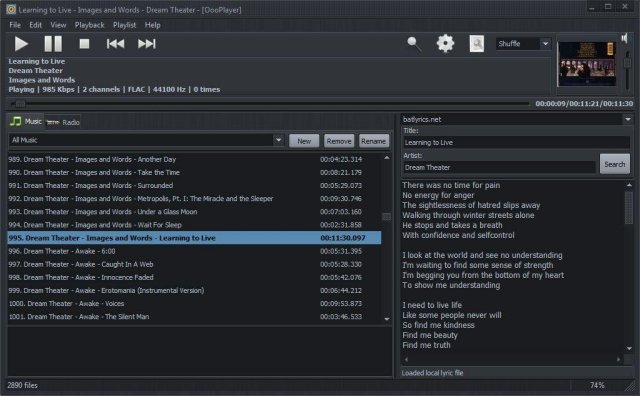
OooPlayer is a free audio player for Microsoft® Windows®. It has a clean, lightweight user interface and it is also friendly with your computer resources. It is one of the best candidates if you’re looking for an alternative to Winamp® or just looking for a simple, easy-to-use music and radio player. It’s written in Delphi and uses Bass library and its plugins from www.un4seen.com

The listed versions are clean, without no bundles/installers and it has support for most popular audio formats (see below in the features section). This player is released under the GNU General Public License version 2.0 and is available in two versions: installer and portable.

Features:

  • user-friendly and with a low impact on resource usage
  • support for most audio formats: MP3, FLAC, OGG, MPC, WMA, AC3, SPX, AAC, ALAC, APE, TTA, OFR, WV, OPUS, TAK etc.
  • support for gapless playback (uninterrupted playback of sequential/consecutive audio tracks)
  • support for M3U and M3U8 playlists
  • integrated lyric downloader (it doesn’t work with certain files such as covers)
  • save your own playlists in M3U, M3U8 or PPF format
  • built-in support for radio stations (huge list available) including details about the current radio
  • multiple options available: shuffle, repeat, search, jump, find etc.
  • available as installer and portable version.

www.fosshub.com/OooPlayer
github.com/ozok/OooPlayer

Muine ~ Gnome Music Player


Muine is an innovative music player, featuring a simple, intuitive interface. It is designed to allow users to easily construct a playlist from albums and/or single songs. Its goal is to be simply a music player, not to become a robust music management application. This doesn’t mean Muine has no features! Some feature highlights:

  • Ogg/Vorbis, FLAC, AAC and MP3 music playback support
  • Automatic album cover fetching via MusicBrainz and Amazon
  • Support for embedded album images in ID3v2 tags
  • ReplayGain support
  • Support for multiple artist and performer tags per song
  • Plugin support
  • Translations into many languages

Muine is targeted at the GNOME desktop and uses GTK+ for the interface. Most of the code is written in C#, with some additions/bindings/glue in plain C. Muine was originally written by Jorn Baayen, but now maintained mostly by others.

github.com/mickeyr/Muine
gitlab.gnome.org/Archive/muine
en.wikipedia.org/wiki/Muine
manpages.org/muine

CP-GFX ~ Guitar Effect Processor


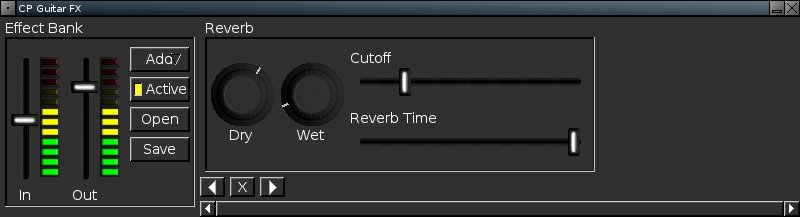
CP-GFX is simply a Cross Platform Guitar Effect Processor. The aim of the project is to create an extensible and easy to use program which is easy to port to different platforms and operating systems. Currently in development are both Linux x86 and Win32 builds.

For the Linux build the primary audio API in use is JACK, which allows CP-GFX to work along side and with other programs, such as Ardour, or any other software using JACK without any fuss or problems.

image of the CP-GFX user interface

cp-gfx.sourceforge.net
sourceforge.net/projects/cp-gfx

LAoE ~ Multilayer Java Audio Editor


LAoE means Layer-based Audio Editor, and it is a rich featured graphical audio sample-editor, based on multi-layers, floating-point samples, volume-masks, variable selection-intensity, and many plugins suitable to manipulate sound, such as filtering, retouching, resampling, graphical spectrogram editing by brushes and rectangles, sample-curve editing by freehand-pen and spline and other interpolation curves, effects like reverb, echo, compress, expand, pitch-shift, time-stretch, and much more… And it is free of charge, under GPL license!

www.oli4.ch/laoe/home
sourceforge.net/projects/laoe

GLAME ~ GNU / Linux Audio Mechanics


Welcome to the wonderful world of GLAME, short for GNU/Linux Audio Mechanics! The project aims to present you with a powerful, fast, stable and easily extensible sound editor for Linux and compatible systems. And best of all, it’s GPLed!

glame.sourceforge.net

Psycle ~ Modular Music Creation Studio


Psycle is a Music tracker (like FastTracker 2 or Impulse Tracker) combined with plugin modularity. It supports its own plugin API, the VST2 plugin standard, and a tracker style sampler playback.

https://sourceforge.net/projects/psycle

http://psycle.pastnotecut.org/portal.php
http://sourceforge.net/projects/psycle/

Sayonara ~ Lightweight Linux Player


Sayonara is a small, clear and fast audio player for Linux written in C++, supported by the Qt framework. It uses GStreamer as audio backend. Sayonara is open source and uses the GPLv3 license. One of Sayonara’s goals is intuitive and easy usability. Currently, it is only available for Linux and BSD. Although Sayonara can be considered as a lightweight player, it has a lot of features in order to organize even big music collections. In contrast to the heavyweight players, the main focus of Sayonara is performance, low CPU usage and low memory consumption. Sayonara is a great alternative to players like Rhythmbox, Clementine or Amarok. Those who miss Winamp for Linux should give Sayonara a try.

Managing your library: You can manage your library by artists, albums, genres or file paths. Sayonara contains a sophisticated tag editor helping you to keep your collection clean. You can hold multiple playlists simultaneously, save/rename/delete or export them to common playlist file formats. With the multi library feature you can manage multiple directories as stand-alone libraries and copy and move tracks from one to another. There are even more complex library plugins like Soundcloud or SomaFM support.

Directory view: Some people don’t have a perfect tagged library and are more interested in the directory structure of their libraries. Sayonara provides various features to access and edit your music in the directory view.

Plugins: In addition, there are some useful plugins helping to enhance your comfort while listening. Some interesting plugins are the equalizer, a speed/pitch control, a crossfader, bookmarks for tracks and a broadcasting function.

Webstreams and Podcasts: You can record all tracks streamed from the internet. Your saved tracks automatically tagged, of course. When listening to ordinary webstreams, a history of all played tracks can be displayed. If webstreams or podcasts contain some chapter information, Sayonara also uses this information in order to provide fast jumping within these tracks.

Screenshot0

sayonara-player.com
en.wikipedia.org/wiki/Sayonara_Player