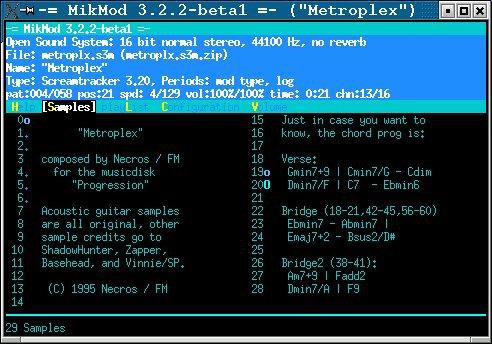
Mikmod is a module player and library supporting many formats, including mod, s3m, it, and xm. Originally a player for MS-DOS, MikMod has been ported to other platforms, such as Unix, Macintosh, BeOS, and Java(!!)

Mikmod is a module player and library supporting many formats, including mod, s3m, it, and xm. Originally a player for MS-DOS, MikMod has been ported to other platforms, such as Unix, Macintosh, BeOS, and Java(!!)

Streamripper was started sometime back in early 2000. Streamripper started as a way to separate tracks via Shoutcast’s title-streaming feature. This has now been expanded into a much more generic feature, where part of the program only tries to “hint” at where one track starts and another ends, thus allowing a mp3 decoding engine to scan for a silent mark, which is used to find an exact track separation.
Streamripper is now part of the FreeBSD standard distribution, mentioned in the Linux MP3 HOWTO, known to compile on many platforms such as Linux, Windows, FreeBSD, BeOS, OS/2. This is not surprising as portability was a constant consideration during development.
With the emergence of file sharing protocols such as Napster, Gnutella, and now Mojonation and Freenet, the average Internet user can download nearly any mp3 he wants in a matter of no time, but many times people don’t know what they want. Streamripper allows you to download an entire station of music. Many of these mp3 radio stations only play certain genres, so you can now download an entire collection of goa/trance music, an entire collection of jazz, punk rock, whatever you want.
streamripper.sourceforge.net
sourceforge.net/projects/streamripper
TiMidity++ is a software synthesizer. It can play MIDI files by converting them into PCM waveform data; give it a MIDI data along with digital instrument data files, then it synthesizes them in real-time, and plays. It can not only play sounds, but also can save the generated waveforms into hard disks as various audio file formats.
TiMidity++ is a free software, distributed under the terms of GNU general public license.
Features:
timidity.sourceforge.net
- Plays MIDI files without any external MIDI instruments at all
- Understands SMF, MOD, RCP/R36/G18/G36, MFI
- Converts MIDI files into various audio file formats: .wav, .au, .aiff, .ogg and so on
- Uses Gravis Ultrasound compatible patch files and/or SoundFonts as the voice data
- Displays information about the music that is now playing
- Various user interfaces: ncurses, gtk, Win32-GUI, and others
- Plays remote MIDI files over the network
- Plays MIDI files in archive files
- Displays sound spectrogram for the playing music
- Trace playing
sourceforge.net/projects/timidity
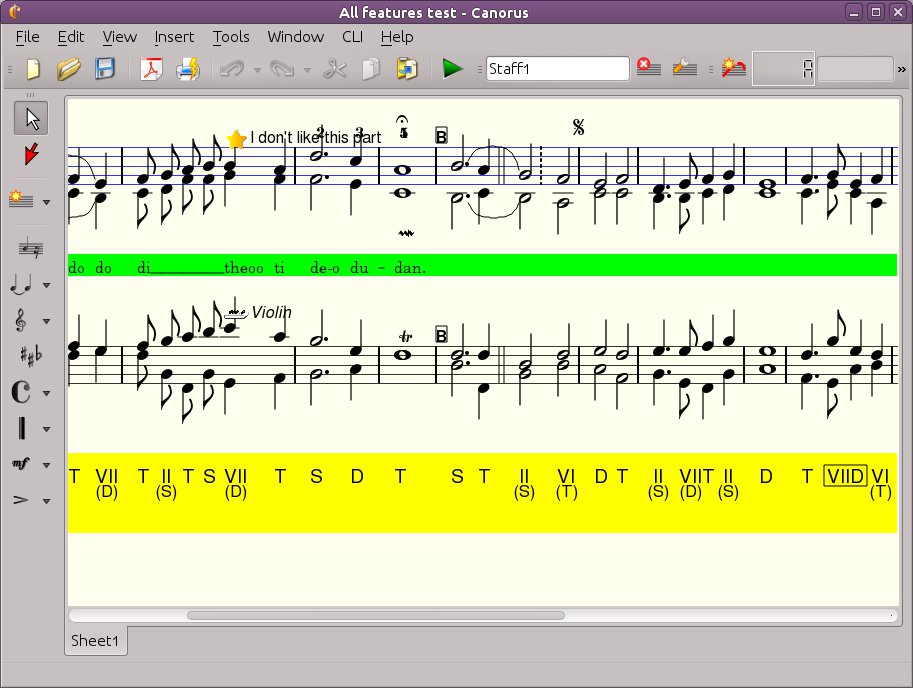
Canorus is a free cross-platform music score editor. It supports an unlimited number and length of staffs, polyphony, a MIDI playback of notes, chord markings, lyrics and import/export filters to formats like MIDI, MusicXML, ABC Music, MusiXTeX and LilyPond.

sourceforge.net/projects/canorus
github.com/canorusmusic/canorus
v2strip is a simple command-line utility that lets you remove the ID3v2 tag from an MP3 file. The ID3v2 format is nice in many ways, but it can cause problems when being parsed by MP3 players and utilities that don’t support ID3v2 tags.
David Huron created Humdrum in the 1980s, and it has been used steadily for decades. Humdrum is a set of command-line tools that facilitates musical analysis, as well as a generalized syntax for representing sequential streams of data. Because it’s a set of command-line tools, it’s program-language agnostic. Many have employed Humdrum tools in larger scripts that use PERL, Ruby, Python, Bash, LISP, and C++.
Humdrum Labs ~ wiki.ccarh.org/wiki/Humdrum_Lab_1
Humdrum music encoding tutorial ~ doc.verovio.humdrum.org/humdrum/getting_started
Humdrum Resources ~ github.com/humdrum-tools
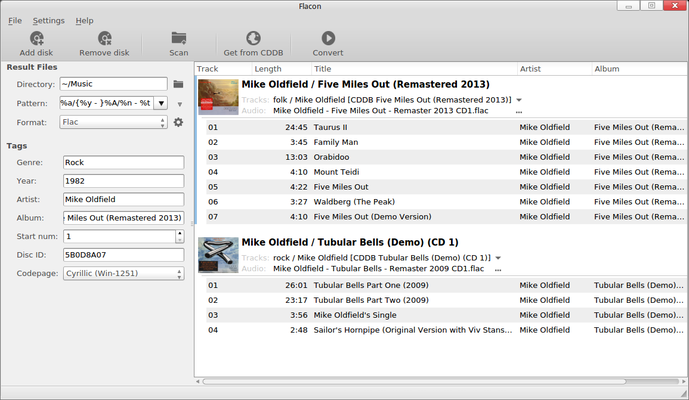
Flacon extracts individual tracks from one big audio file containing the entire album of music and saves them as separate audio files.
To do this, it uses information from the appropriate CUE file. Besides, Flacon makes it possible to conveniently revise or specify tags both for all tracks at once or for each tag separately.
- Supported input formats: WAV, FLAC, APE, WavPack, True Audio (TTA).
- Supported out formats: FLAC, WAV, WavPack, AAC, OGG or MP3.
- ReplayGain analysis (album-gain and track-gain modes).
- Multi-threaded conversion process.
- Automatic character set detection for CUE files.
- Generation of the pertrack CUE file in the output dir.

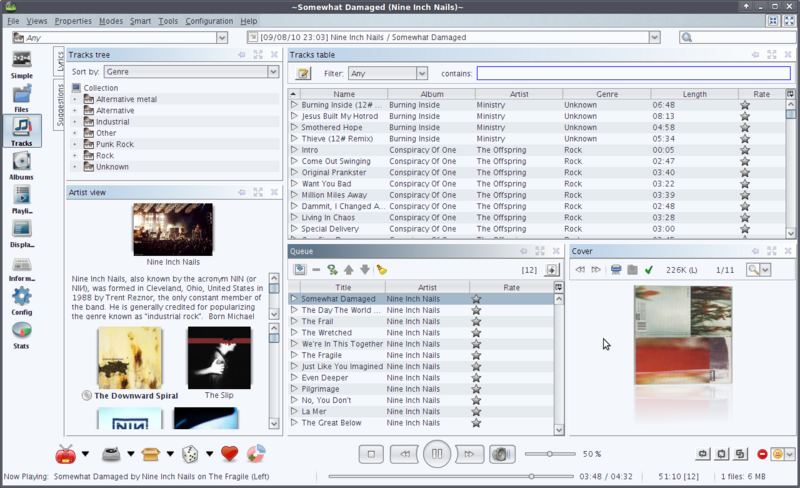
Jajuk is a Java music organizer for all platforms. The main goal of this project is to provide a fully-featured application to advanced users with large or scattered music collections.
Jajuk’s main principles are:
- Maximum features – Jajuk is made firstly for advanced users looking for powerful features;
- Maximum usability – Jajuk is designed to be intuitive, fast and provide multiple ways to perform the same operation;
- Maximum portability and desktop integration.

projectM is an OpenGL based advanced music visualization program for Linux, Mac OSX, and Windows. It is backward compatible with all the features of Milkdrop 1.x (and now 2.x), but has many new toys and enhancements.

Vsound is a Linux / Unix application which allows you to digitally record the output of another program such as RealPlayer. The recorded output can be saved to a WAV file or can be piped into another program such as an MP3 encoder…
DeaDBeeF (as in 0xDEADBEEF) is a modular audio player for GNU/Linux, *BSD, OpenSolaris, macOS, and other UNIX-like systems.
DeaDBeeF lets you play variety of audio formats, convert between them, customize the UI almost any way you want, and use many additional plugins which can extend it even more.

deadbeef.sourceforge.net
deadbeef.sourceforge.net/download
deadbeef.sourceforge.io/plugins.html
play.google.com/store/apps/details?id=org.deadbeef.android
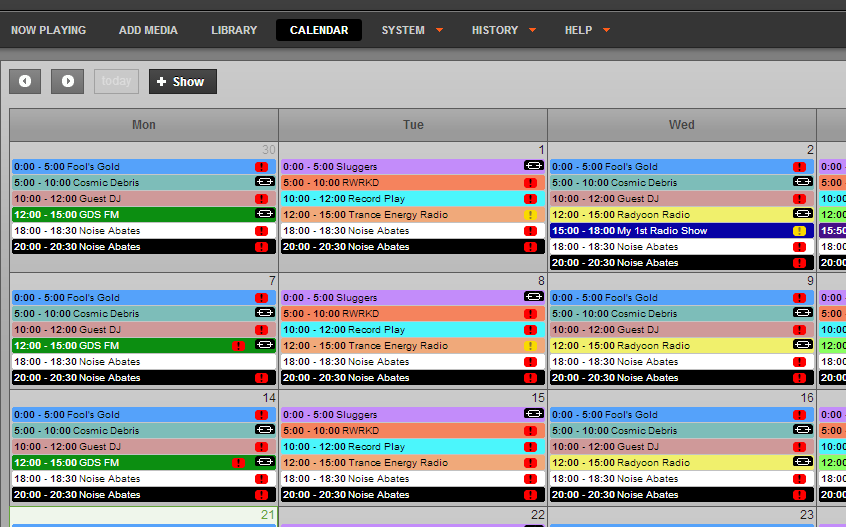
Airtime is an open source application that provides remote and
collaborative automation of a broadcast radio station.Major features:
- Web-based remote station management. Authorized personnel can add
programme material, create playlists or smart blocks, and stream in live,
all via a web interface.- Automation. Airtime has a scheduler function that enables users to
create shows with content for playback at the exact date and time specified.- Playlists, smart blocks and remote stream URLs can be used multiple times.
- Solid playout. Airtime uses the open source Liquidsoap streaming language for reliable and precise playback to multiple outputs.
- Open, extensible architecture. Stations are free to extend and alter
all parts of the program code, under the GNU AGPLv3 license.

www.sourcefabric.org/en/airtime
en.wikipedia.org/wiki/Airtime_(software)