SeekMIDI is a simple multi-channel MIDI sequencer for quick song creation.
Category Archives: Unix

Tomita ~ python-tomita Synthesizer
tomita is a command-line music and synthesizer package based on PySynth.
github.com/g4brielvs/python-tomita
Share this:

PySynth ~ Python Synthesizers & Scripts
PySynth is a suite of simple music synthesizers and helper scripts written in Python 3. It is based on a synth script I found on the Web and then modified for my purposes. The goal is not to produce many different sounds, but to have scripts that can turn ABC notation or MIDI files into a WAV file without too much tinkering.
There are nine PySynth variants now: PySynth A, the oldest variant, only needs Python itself, and sounds somewhat like a cross between a flute and organ. PySynth B is more complex in sound and needs NumPy. It is supposed to be a little closer to a piano. No competition for Pianoteq of course, but a reasonable fit for keyboard music. PySynth E is similar, but an FM-synthesized e-piano so it sounds much brighter than B (slightly DX7 e-piano-like; I used the DX7 presets in hexter as a basis). PySynth S is more comparable to a guitar, banjo, or harpsichord, depending on note length and pitch. PySynth C, D, and P are subtractive synths, reminiscent of 1970s analog synthesizer voices.
The synthesizers are all monophonic, i.e. they can only play one note at a time. (Although successive notes can overlap in PySynth B and S, but not A.) However, two or more output files can be mixed together…
github.com/g4brielvs/python-tomita
Share this:

meterec ~ Console Multitrack Recorder
meterec works as a basic multitrack tape recorder. The aim of this software is to minimise the interactions of the users with the computer and allow them to focus on their instrumental performances. For this reason meterec’s features are minimal. If you screw one take, start it over again! Rather than learning how to use a specific software to correct what you screw up, meterec forces you to learn and master your instrument. The good news is that previous takes are kept in history and if in the end, the first one was the best you could play, you can choose it in your final mix.
http://meterec.sourceforge.net/
https://sourceforge.net/projects/meterec/
Share this:

CloudTunes ~ Web Player For The Cloud
CloudTunes provides a unified interface for music stored in the cloud (YouTube, Dropbox, etc.) and integrates with Last.fm, Facebook, and Musicbrainz for metadata, discovery, and social experience. It is similar to services like Spotify, except instead of local tracks and the fixed Spotify catalog, CloudTunes uses your files stored in Dropbox and music videos on YouTube.
https://github.com/jakubroztocil/cloudtunes
Share this:

cyanrip ~ Accurate & Secure Ripper
Fully featured CD ripping program able to take out most of the tedium. Fully accurate, has advanced features most rippers don’t, yet has no bloat and is cross-platform.
Features:
- Automatic tag lookup from the MusicBrainz database
- Encoded and muxed via FFmpeg (currently supports flac, opus, mp3, tta, wavpack, alac, vorbis and aac)
- Drive offset compensation and error recovery via cd-paranoia
- Full pregap handling
- HDCD detection and decoding
- Multi-disc album ripping
- Able to encode to multiple formats in parallel
- Cover image embedding in mp3, flac, aac and opus
- Provides and automatically verifies EAC CRC32, AccurateRip V1 and V2 checksums
- Accurate ripping verification of partially damaged tracks
- Automatic drive offset finding
Share this:

QmidiCtl ~ MIDI Remote Controller
QmidiCtl is a MIDI remote controller application that sends MIDI data over the network, using UDP/IP multicast. Inspired by multimidicast and designed to be compatible with ipMIDI for Windows.
Share this:

AUDMES ~ Oscilloscope & Spectrum Analyzer
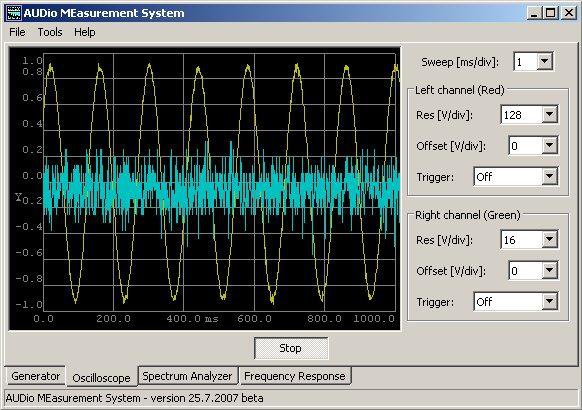
AUDio MEasurement System – multi-platfrom system for audio measurement through a PC sound card. Incorporates generator, oscilloscope, audio spectrum analyzer (FFT) and frequency sweep characteristic. Can be compiled and works under Linux, Windows and MacOS.
Features:
- Display audio spectrum (FFT)
- Show wave form
- Generate tones
- Only requires a sound card
- Uses WxWidgets
- Source code available
sourceforge.net/projects/audmes
Resources:
en.wikipedia.org/wiki/Spectrum_analyzer
en.wikipedia.org/wiki/Oscilloscope
Share this:

RuneAudio ~ Hardware Audio Player
RuneAudio is a free and open source software that turns embedded hardware into Hi-Fi music players. We want to make a cheap, low-consumption and silent mini-PC perform as an high fidelity digital source. RuneAudio features a custom-built Linux distribution (RuneOS) and a web player (RuneUI) which allows to remote control playback and setup options, from multiple devices (desktop PC, netbook, tablet, smartphone).
Features:
- Easy to install and use
- A custom built, optimized and small footprint Linux-based OS (RuneOS)
- Runs on a variety of embedded platforms
- Works with almost every model of USB DAC in commerce
- Bitperfect and gapless playback of common audio formats (FLAC, WAVE, MP3, AAC, ALAC, etc.)
- Supports native DSD playback with DSD-over-PCM
- Playback from network drives (over CIFS and NFS protocols) and USB drives (FAT32 and NTFS)
- Playback of web radio streams
- Built-in web interface (RuneUI) for playback and setup control
- Can be controlled from a lot of third party clients (desktop and mobile)
- Supports USB Audio Class 2
- Optimized to reduce SD card wearing
www.runeaudio.com
sourceforge.net/projects/runeaudio
Also see: github.com/rern/rOS
Share this:

ABC/HR Audio Comparison Tool ~ Open Source DBT
ABC/HR is an audio comparison tool that allows users to self-conduct double-blind listening tests of digital audio codecs.
https://sourceforge.net/projects/abchr/
Share this:

Bongo ~ GNU Emacs Media Player
Bongo is a flexible and usable media player for GNU Emacs. If you store your music collection locally and use structured file names, then Bongo is a great way for you to play music from within Emacs.
https://github.com/dbrock/bongo/
Share this:

BallroomDJ ~ Ballroom Audio Player
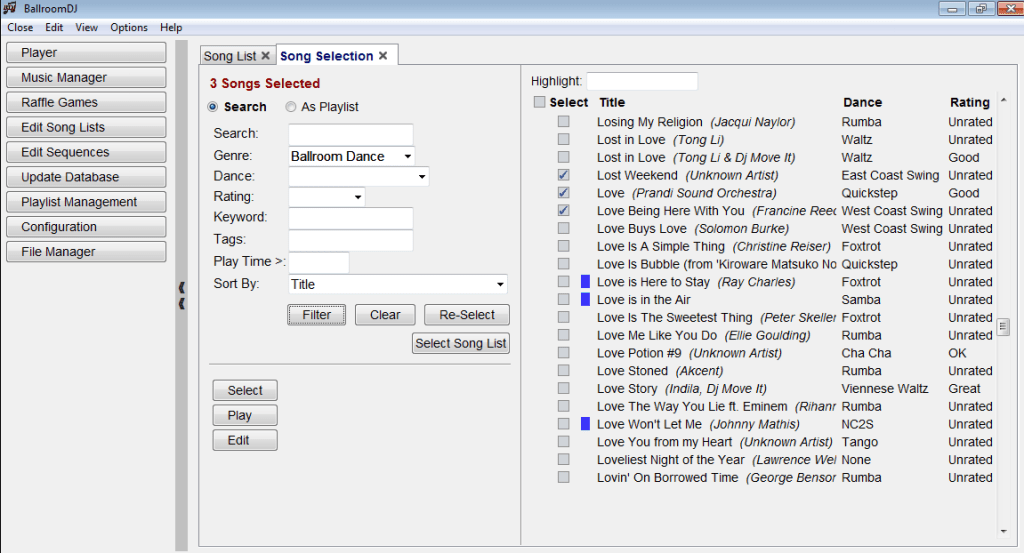
BallroomDJ is a ballroom music player. It is designed to be able to play music the entire evening without intervention. Use for your personal training, dance studio, and ballroom, dancesport, Argentine tango, country western, or west coast swing events.