
Audio DiffMaker is a freeware tool set intended to help determine the absolute difference between two audio recordings, while neglecting differences due to level difference, time synchronization, or simple linear frequency responses.
The difference recording that results is only what has changed between the two recordings. If anything – a change of component, a treatment, mechanical damping, etc. – is having any audible effect on the audio signal in a system, the difference recording will have audible content. The end result is primarily intended to be evaluated by ear.
Presented at the 125th AES convention. “Detecting Changes in Audio Signals by Digital Differencing“
www.libinst.com/Audio DiffMaker
Category Archives: Software

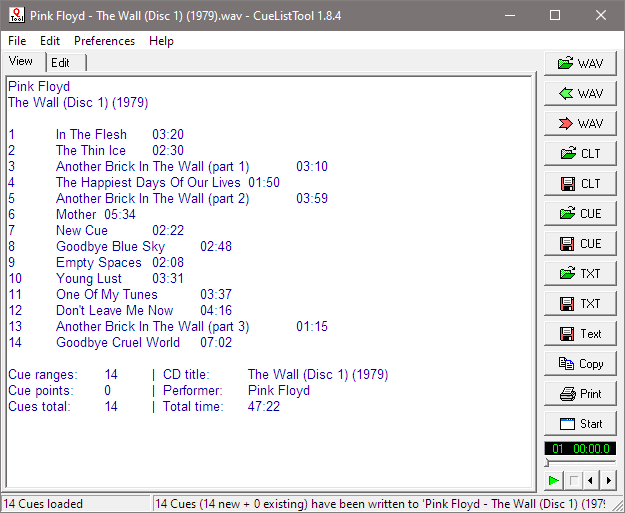
CueListTool ~ Swiss Army Knife For Cue Lists & Cue Sheets
This utility allows you, among other things, to read, edit, and write back the cue lists embedded in WAV files by audio editing programs such as Adobe Audition. Cue lists can be saved as small text files and shared with other users.
www.stefanbion.de/cuelisttool
Share this:

LCDex ~ A Linux CDEX Clone
A ripper and encoder frontend for Linux. Requires libsndfile and lame to work.
sourceforge.net/projects/lcdex
Share this:

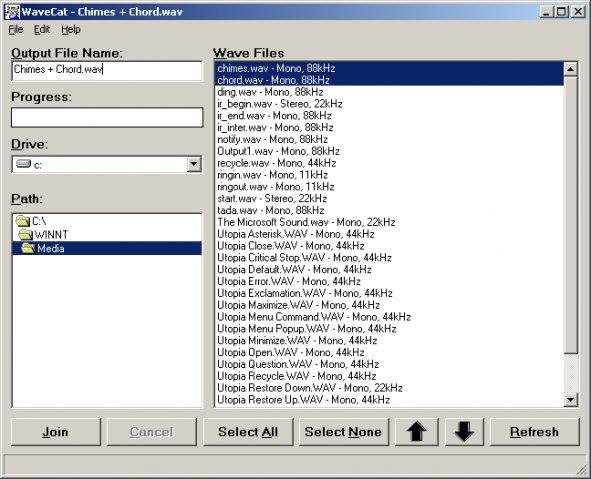
WaveCat ~ Combines Multiple WAV Files
Joins one or more WAV files together. If you rip a five CD book on tape, you’ll have a cluttered mess of about sixty audio files. WaveCat can turn your sixty files into one convenient large wav file. Suggestion: CDex –> WaveCat –> WinLame –> Single MP3 file.
Feature
sourceforge.net/projects/wavecat
- Concatenates multiple Wav files into one large file.
Share this:

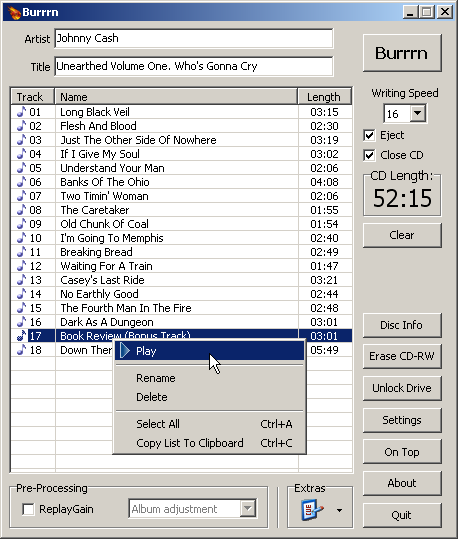
Burrrn ~ Burn Audio CDs The Easy Way!
Burrrn is a little tool for creating audio CDs with CD-Text from various audio files. Supported formats are: wav, mp3, mpc, ogg, aac, mp4, ape, flac, ofr, wv, tta, m3u, pls and fpl playlists and cue sheets. You can also burn EAC’s noncompliant image + cue sheets! Burrrn can read all types of tags from all these formats (including ape tags in mp3). Burrrn uses cdrdao.exe for burning.
www.burrrn.net
Share this:

Digital Peak Programme Meter
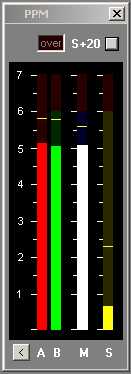
Under-reads very short peaks slightly like a traditional BBC PPM. Fallback ballistics are accurately modelled but the attack time (eg the BBC spec of 2.5dB down for a 10ms burst of 5Khz) is only approximate. Very short peaks such as 1.5ms register -4dB instead of -9dB as per spec. The fallback time from 1 to 7 is in line with BBC specifications, 2.5 to 3 seconds. You may prefer a faster fallback, especially as there are the peak markers, so the fallback time can be adjusted by means of an arbitrary value entered on the options page. A value of 2 corresponds to the BBC PPM spec. Values up to 10 speed up the decay.
Mono matrix can be set to M = (A+B) – 3dB or 6dB. Traditionally the BBC have used M3, though M6 is increasingly used. Channels can be labelled L & R or A & B. Displays Left, Right, Mono (sum) and Stereo (difference) simultaneously.
The peak markers can be set to hold the peak. Click on the window to reset.
There is also a 20dB button. This increases the gain of of the Stereo difference indication by 20dB (10 times). M, L & R are not affected.
The colour of each bar can be set to any colour from the options screen. By default all bars are green but it possible to have, for example, red and green for A and B.
For Windows XP, Vista, 7 or 8.
www.darkwooddesigns.co.uk/pc2/meters.html#Peak
Share this:

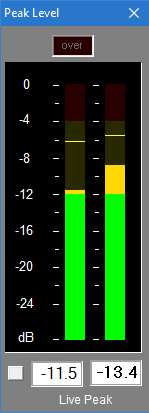
Digital Level Meter ~ 0.1 dB Resolution Readout
With 0.1dB resolution readout, ideal for accurate steady state measurements or for reading peaks however short.
For Windows XP, Vista, 7 or above. Requires WDM drivers, does not support ASIO.
The button to the left of the readout switches the digital readout to follow the maximum peak markers or the instantaneous ‘live’ peaks. In conjunction with the peak hold feature this enables transient peaks to be read accurately.
Zero is referenced to Full Scale Digital, although this can be modified with the calibration adjustment to provide some headroom as required.
Sample rate can be set to match recording if necessary.
Infinite peak hold setting if required, even across program restarts. Reset by double-clicking meter display.
If you need to run multiple meters monitoring more than one source there is a Multi-Channel Level Meter for up to 24 channels.
www.darkwooddesigns.co.uk/pc2/meters.html#Digital
Share this:

DSD2FLAC ~ Convert DSD To FLAC
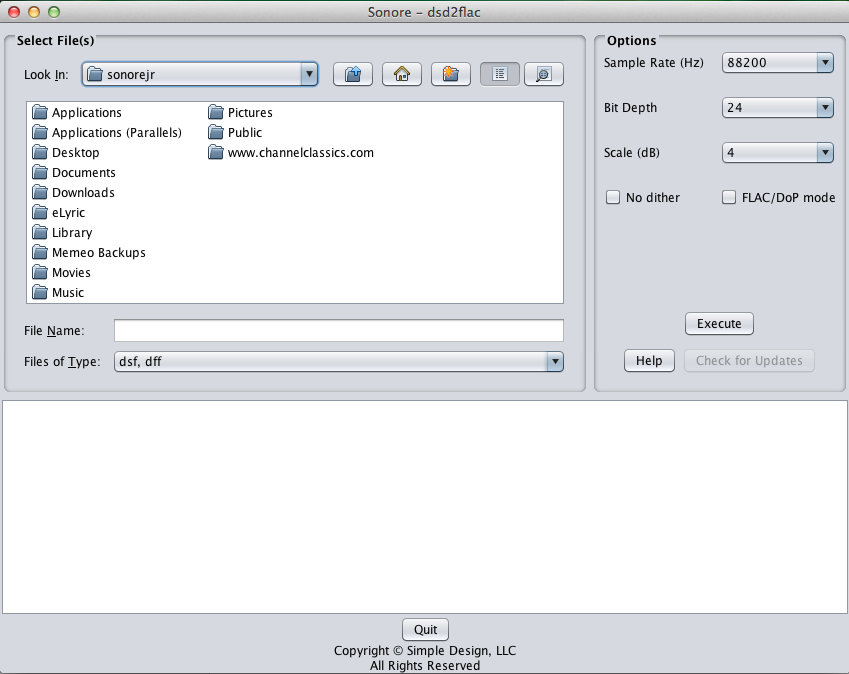
DSD2FLAC converts DSD files to FLAC
Features:
- Supports DSD input files in .dsf and .dff formats
- Supports DSD64 and DSD128 input rates
- Selectable output sample rates: 88.2KHz (default), 176.4KHz or 352.8KHz
- Selectable bit depth: 16, 20, 24 (default)
- Volume scale: -6db to +6db (+4 db default)
- Dither: on (default) or off
- Optional output mode in DoP2FLAC for use by a player that supports FLAC and a DAC that supports DoP input
- Transfers stored metadata from the original DSD file to the resulting FLAC file
- Single title conversion or entire album conversion in a given folder
This application is provided as-is without warranty or support.
www.sonore.us/dsd2flac
Development for this application is closed.
Share this:

Audiophile Linux ~ Audio Optimized Operating System
Audiophile Linux is the operating system optimized for high quality digital audio reproduction. Created by audiophiles for people who share the same dream. To have their system a bit more better. AP-Linux is easily installed, user friendly, and absolutely free. Install it like any other GNU/Linux distribution and enjoy the music playback. Audiophile Linux comes with everything you need for playing your audio and video files.
Audiophile Linux Features:
www.ap-linux.com
- System and memory optimized for quality audio
- Custom Real-Time kernel
- Latency under 5ms
- DSD support
- Lightweight window manager
- Pre installed audio and video programs
- Lightweight OS, free of unnecessary daemons and services

Share this:

DiscImageCreator ~ Disk Image Extractor
This command-line program dumps a disc (CD, GD, DVD, HD-DVD, BD, GC/Wii, XBOX, XBOX 360) and disk (Floppy, MO, USB etc.)
CD and GD, it can dump considering a drive + CD (=combined) offset.
What is the drive offset? Please look this documentThis program works on Windows PC (Windows XP or higher) and Unix based PC (Linux, macOS).
MPF can work this program with GUI.
github.com/saramibreak/DiscImageCreator
Share this:

DISTRHO Ildaeil ~ Plugin Host
DISTRHO Ildaeil is mini-plugin host working as a plugin, allowing one-to-one plugin format reusage. The idea is to load it as a plugin inside your DAW and then the other “real” plugin inside Ildaeil. This allows, for example, a VST3 host to load LV2 plugins and vice-versa.
The Ildaeil name comes from the korean 일대일, which means “one to one”.
Features:
The current formats Ildaeil can work as are:
- JACK/Standalone
- CLAP
- LV2
- VST2
- VST3
And it can load the following plugin formats:
- Internal (from Carla)
- LADSPA
- DSSI
- LV2
- VST2
- VST3
- CLAP
- JSFX
With a few extra formats through the “Load from file…” action:
- Audio files (through internal audio file player, synced to transport)
- MIDI files (through internal MIDI file player, synced to transport)
Share this:

Nekobi ~ Single Oscillator Synth
Simple single-oscillator synth based on the Roland TB-303.
github.com/DISTRHO/Nekobi
pedalboards.moddevices.com/plugins/

A softsynth recreation of a classic single-oscillator bass monosynth.
github.com/gordonjcp/nekobee

 The Audio File