LMS is an open source multi-room audio system. It was created by SlimDevices and then acquired by Logitech. Although Logitech has ended development of hardware devices, the project is still very active with lots of plugin released regularly. New hardware players can be added using PI devices and DAC boards to build high-quality multi-room systems.
I’ve created some extra plugins, especially to include new standard hardware / players to the LMS ecosystem: UPnP/DLNA (Sonos), ChromeCast and AirPlay.
Wok Loudness simulates the loudness button on old HiFi amps, which alters the frequency response curve to correspond roughly with the equal loudness characteristic of the ear at lower volumes.
The level of high and low frequencies is increased at low listening levels, to compensate for the fact that as the volume of audio decreases, the ears lower sensitivity to extreme high and low frequencies may cause these signals to fall below threshold. As a result audio material may seem to become ‘thin’ sounding at low volumes, losing bass and treble, the ‘Loudness compensation’ button (often just labelled ‘Loudness’ or ‘Loud’) is intended to rectify this situation.
The “epicVerb” reverberation device aims at both tight small room and ambience effect simulation well suited to modern drum and vocal productions up to large “epic” halls as known from high quality outboard gear. This reverb’s sound ranges from rather concrete or even edgy up to smooth, transparent and artifact free reverb tails. It is designed for maximum flexibility and usability, and to take place as a true high quality stereo main reverb.
“epicVerb” features two different reverberation modes and six different stereo early reflection models. There are some standard reverb controls like ‘TIME’, ‘DAMP’ or ’PRE-DELAY’ as well as reverb tail modulation and detailed control over very first reflection patterns as an option. It offers different reverb time handling for high and low frequencies as well as a musical sounding EQ section containing two “BootEQ” equalizers and additional high- and low-pass filtering.
Specs and requirements:
PC / VST compatible
SSE and Assembler optimized sound engine
State-of-the-art digital signal processing
Smooth reverb tail processing without any ringing or metallic sounding artifacts
Different reverb and early reflection modes for maximum flexibility
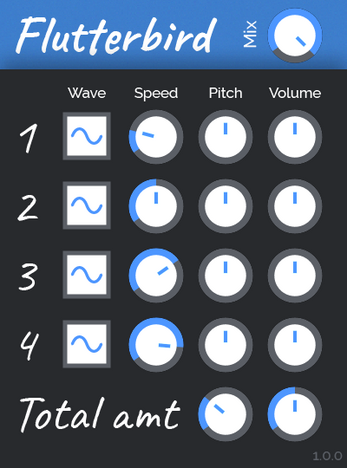
Flutterbird is a free, open-source effect plugin for adding pitch and volume fluctuation to incoming audio. It can be used for traditional wow/flutter effects as well as more chaotic, extreme modulation. Flutterbird has four separate oscillators with adjustable speeds that can be mapped to either pitch or volume.
This is the community version of Element, a modular AU / LV2 / VST / VST3 audio plugin host. Create powerful effects, racks and instruments by connecting nodes to one another. Integrates with your existing hardware via standard protocols such as MIDI.
Utility is a free, lightweight, universal general purpose all in one digital channel strip plugin offering precise controls over various aspects of an audio signal, from mid/side processing to soft clipping.
Features:
input routing with separate pans for the left and right channels, or alternatively a pre mono balance control to decide how the left and right channels are blended for conversion into mono
gain, and individual left and right channel gains, mutes
pan and phase inversion of either channel
width control, along with separate mid and side gain sliders and mutes
maximally flat minimal phase high and low pass 12db/octave filtering
optional hard and soft clipping at 0db
everything is fully automatable with sensible parameter ranges/scaling
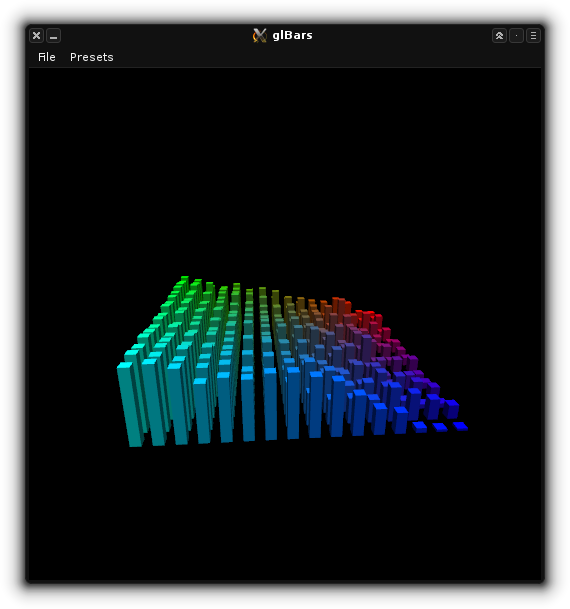
This is an OpenGL bars visualization plugin (as seen in XMMS and XBMC/Kodi). It’s adapted from the jack_glbars project by Nedko Arnaudov. glBars works as a JACK standalone and audio plugin (LV2 or VST).
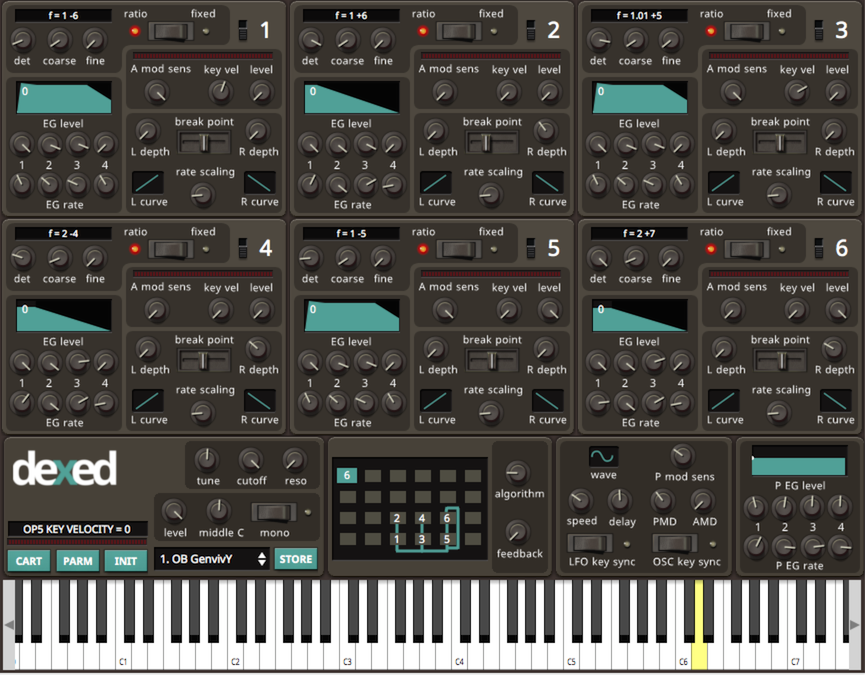
Dexed is a multi-platform, multi-format plugin synth that is closely modelled on the Yamaha DX7. Dexed is also a midi cartridge librarian / manager for the DX7.
Features:
Multi platform (OS X, Windows or Linux) and multi format. (VST, AU, LV2)
144 DAW automatable DX7 parameters available from one single panel.
Fully supports DX7 input and output Sysex messages; including controller change. This means that you can use this with a native DX7/TX7 as a patch editor and sysex manager.
Each operator has a realtime VU meter so you know which one is active.
Can load or save any DX7/TX7 sysex programs. It is also possible to save a single program into a different sysex file.