SAC ~ State-Of-The-Art Lossless Audio Compression


Sac is a state-of-the-art lossless audio compression model.

Lossless audio compression is a complex problem, because PCM data is highly non-stationary and uses high sample resolution (typically >=16bit). That’s why classic context modelling suffers from context dilution problems. Sac employs a simple OLS-NLMS predictor per frame including bias correction. Prediction residuals are encoded using a sophisticated bitplane coder including SSE and various forms of probability estimations. Meta-parameters of the predictor are optimized with DDS on by-frame basis. This results in a highly asymmetric codec design.

Technical features:

  • Input: wav file with 1-16 bit sample size, mono/stereo, pcm
  • Output: sac file including all input metadata
  • Decoded wav file is bit for bit identical to input wav file
  • MD5 of raw pcm values

github.com/slmdev/sac

Live Compositor ~ Realtime Video & Audio Mixing


Live Compositor is an engine for applying effects to videos and for combining multiple videos together. On a very basic level, it is an application which exposes an HTTP API. The API allows you to specify where to get input videos, and how to modify and compose them together. The resulting outputs can then be written to a file or streamed to a separate service.

compositor.live
compositor.live/playground
github.com/software-mansion/live-compositor

Online Multichannel Peakmeter Using AudioWorklet


hydrogenaud.io/index.php/topic,126685

foo_dr_meter ~ Foobar2000 Dynamic Range Meter


A simple Dynamic Range meter based on DR estimation formula published by https://dr.loudness-war.info/. For foobar2000 version 1.5 and newer.

foobar.hyv.fi/?view=foo_dr_meter

Binary Synth ~ Audio Synthesis From Binary


A web-synthesizer that generates sound from the binary code of any files. It can synthesize sound directly in the browser, or be a generator of MIDI messages to external devices or DAWs, turning any file into a score. All the application code is written in Javascript and along with everything you need is packed into a single .html file of about 750kb. The synthesizer doesn’t need internet, it can be downloaded and run locally on any device with a browser.

The application reads the file sequentially, and due to the high speed of reading and random deviation of reading duration, we can get quite unpredictable generation of timbre nuances, and at certain settings we can switch to granular synthesis.

github.com/MaxAlyokhin/binary-synth
bs.stranno.su

Picard Barcode Scanner ~ Scan Your Collection


Picard Barcode Scanner helps you to tag your physical releases with MusicBrainz Picard. It allows you to scan the barcode of e.g. a CD and have the corresponding metadata from MusicBrainz automatically loaded into Picard on your desktop.

This is especially useful if you have your physical music collection already digitized and want to tag the files using the correct album.

github.com/phw/PicardBarcodeScanner

scdlbot ~ Music Downloader Telegram Bot


Telegram Bot for downloading MP3 rips of tracks/sets from SoundCloud, Bandcamp, YouTube with tags and artwork.

github.com/gpchelkin/scdlbot

jfMusic ~ Tracked Music Editor


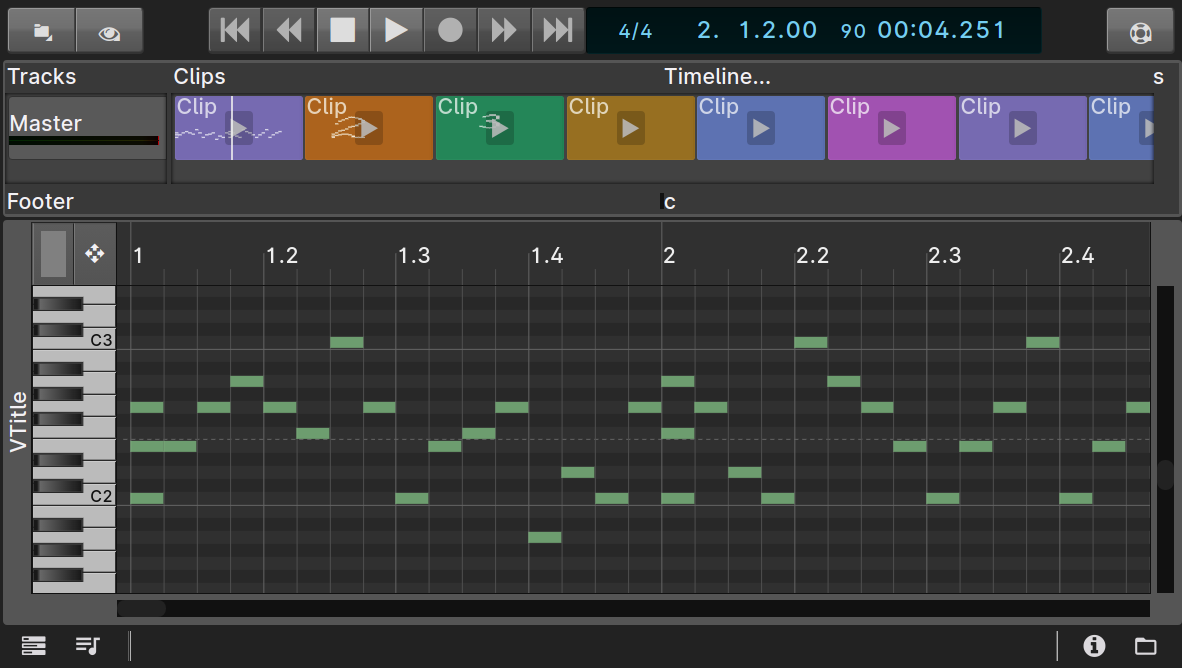
Supports WAV and DLS files.
Supports recording from MIDI devices.

sourceforge.net/projects/jfmusic

Q17 ~ QUAD 405 MOSFET Amplifier


Q17 is an amplifier based on the QUAD 405 current dumping principle.

Please refer to Q17 Project description from Tiberiu Vicol’s original design.

Q17-Turbo project (200W @ 8 Ohms):

The natural evolution of the Q17-Mini, this time with two pairs of power transistors, better thermal management with the same technical characteristics and the same sound signature.

Q17 PCB

github.com/stefaweb/Q17-Amplifier

CamillaDSP ~ IIR & FIR Engine For Crossovers & Room Correction


A tool to create audio processing pipelines for applications such as active crossovers or room correction. It is written in Rust to benefit from the safety and elegant handling of threading that this language provides. Supported platforms: Linux, macOS, Windows.

Audio data is captured from a capture device and sent to a playback device. Alsa, PulseAudio, Jack, Wasapi and CoreAudio are currently supported for both capture and playback.

The processing pipeline consists of any number of filters and mixers. Mixers are used to route audio between channels and to change the number of channels in the stream. Filters can be both IIR and FIR. IIR filters are implemented as biquads, while FIR use convolution via FFT/IFFT. A filter can be applied to any number of channels. All processing is done in chunks of a fixed number of samples. A small number of samples gives a small in-out latency while a larger number is required for long FIR filters. The full configuration is given in a YAML file.

henquist.github.io
github.com/HEnquist/camilladsp