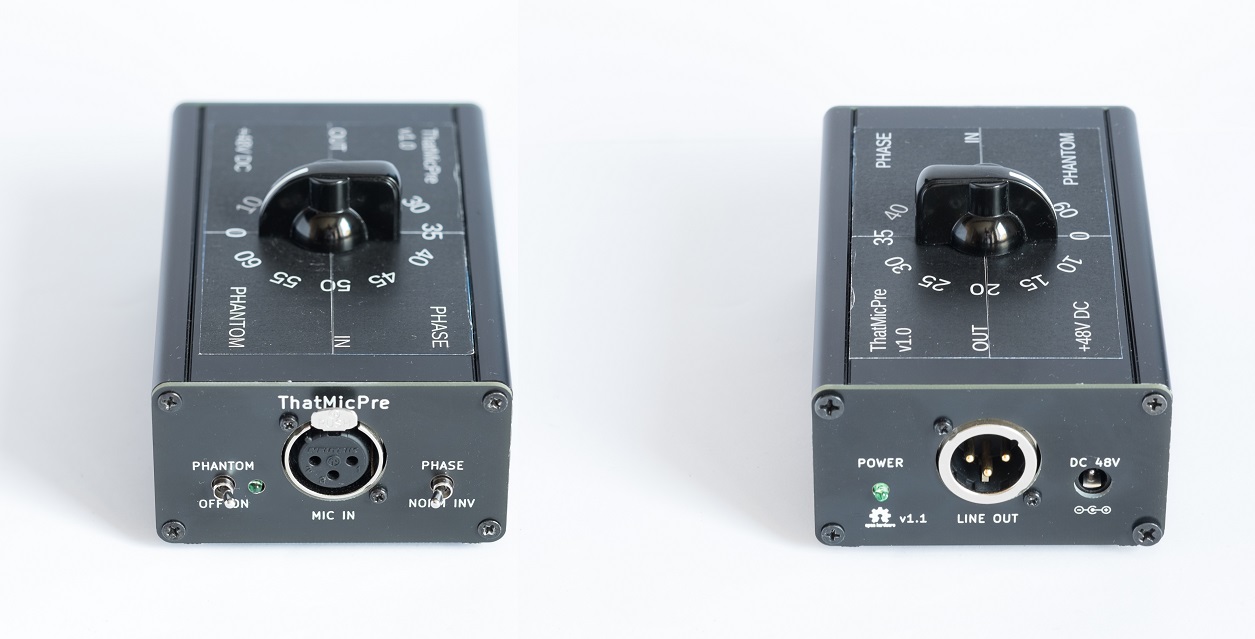
A simple, high-quality DIY microphone pre-amplifier with switched gain. The background for this project was that I needed a simple but good microphone preamp for doing acoustic measurements. I needed a switched gain to be able to reproduce the gain setting in a more predictable way than what is possible with a potmeter. I could not find any existing DIY designs, so I decided to make one.
The design is based on the excellent THAT1510 or THAT1512 preamp ICs. It is also compatible with SSM2019 or INA217. I have followed all THAT’s datasheets and app-notes to implement a robust, best-practice design.
A goal was to use simple through-hole parts that I and other DIYers usually have in our parts drawer. So there are no additional IC’s or voltage regulators for example, it just uses simple transistors, capacitors and zener diodes for supply filtering and regulation. I selected affordable switches and connectors to keep cost down. Many parts can be substituted without sacrificing performance.
There are two versions of this design, one suited for a desktop encolsure with gain switch on top, and one suited for a rack-mount enclosure with gain switch on the front.
ESP32 headless acid combo of tb303 + tb303 + tr808 like synths. Filter cutoff, reso, env mod, accent, wavefolder, overdrive within each 303, per-instrument tunings, hi-pass/lo-pass filter and bitcrusher in drums, send to reverb, delay and master compression. All MIDI driven. 44100, 16bit stereo I2S output to the external DAC or 8bit to the built-in DAC. No indication. Uses both cores of ESP32. Cheap ~$10. Consult with midi_config.h to find out and to set up MIDI continuous control messages.
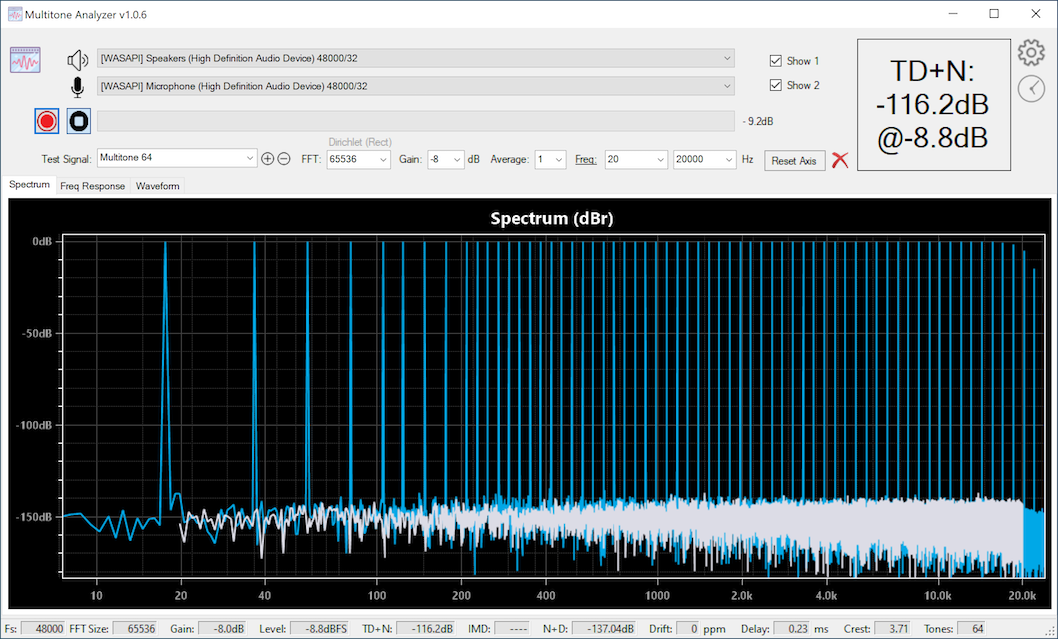
Multitone Analyzer is an app designed to explore audio electronics performance by producing quick measurements using a simple loop-back configuration. MA produces a specific set of test tones that are sent to a digital-to-analog converter (DAC) that are then passed through one or more analog components and then received by MA and analyzed. MA both, plays the signals and records them for analysis. DAC and ADC are required for this to work.
Measurements that MA can produce: TD+N, IMD, N+D, delay, clock drift, frequency response, etc.
Audio support for WASAPI, ASIO, and Direct Audio devices with sampling rates of up to 384kHz/32 bits
Test signals: arbitrarily large multi-tone signal, simple sine waves, two-tone IMD test signals, 3-tone IMD test signals, square wave, triangle wave
FFT sizes of up to 1M
For distortion measurements a range of frequencies to measure can be selected
OBPlayer is a stable and secure UNIX-based media streaming playout application that can operate as a standalone player or controlled over a network by a managing OBServer. It can be installed remotely at a transmitter site, in the studio or as multiple virtual headless processes.
OBPlayer is built with rules based intelligence to continue broadcasting no matter what happens. It functions by continually syncing with OBServer, looking for updated schedules, media, and priority broadcasts. If there is a blank spot in the schedule, it falls back to a Default Playlist. If that fails, it goes into Fallback Media Mode. If that fails, it plays from the analog input bypass. Finally, it will play a test signal as a last resort. OBPlayer will always play valid CAP (Common Alerting Protocol) Alerts at the highest priority.
OBPlayer can be run in a variety of configurations:
Headless OBPlayer (CLI Process)
LIVE Assist with Mobile HTML5 Touch Screen interface
GTK desktop application for a Digital Display and output to CATV
Standalone Emergency Alerting CAP Player supporting audio, image and video
Support For IPAWS CAP Profile Version 1.0 via Alert-Hub
OpenBroadcaster focuses on reliability, accessibility and scalability over a having a bloated range of half baked / buggy features. It has an organic AJAX interface built with Gstreamer, HTML5 and Javascript to deliver a web application in support of broadcast radio and TV automation, media asset management and dynamic community programming. One OBServer may manage one or more OBPlayer in a synchronized network configuration or have the server and playout on one device or VM. There is a robust Plugin Module Architecture with many modules extending the core server application. The server has a Documented API to enable sharing digital media assets and metadata with revocable secure keys.
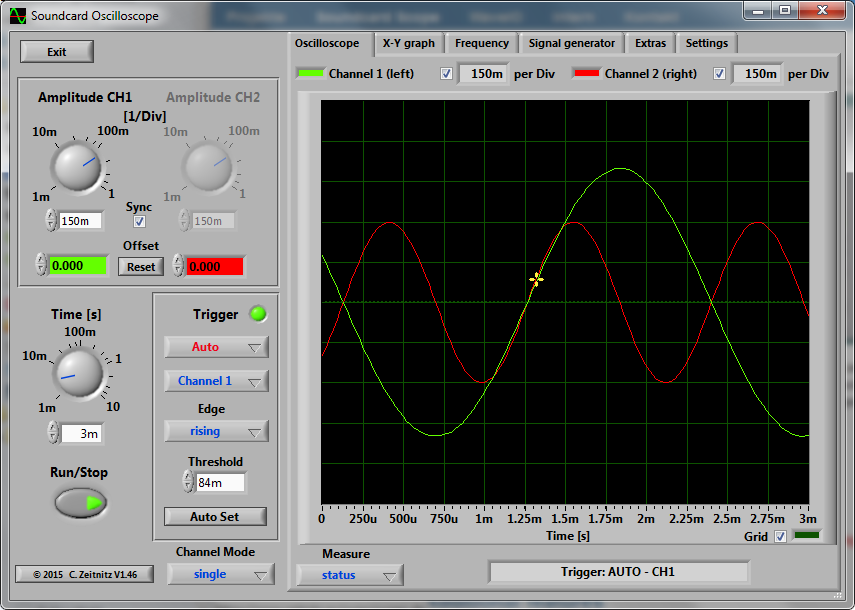
The PC based Soundcard Oscilloscope receives its data from the Soundcard with 44.1kHz and 16 Bit resolution. The data source can be selected in the Windows mixer (Microphone, Line-In or Wave). The frequency range depends on the sound card, but 20-20000Hz should be possible with all modern cards. The low frequency end is limited by the AC coupling of the line-in signal. Be aware, that most microphone inputs are only mono.
The oscilloscope contains in addition a signal generator for 2 channels for sine, square, triangular, sawtooth wave forms and different noise spectra in the frequency range from 0 to 20kHz. The signal can be defined by a mathematical formula as well. The signals are available at the speaker output of the sound card. These can be fed back to the oscillocope in order to generate Lissajous figures in the x-y mode.
Features:
Trigger modes: off, automatic, normal and single shot
Triggerlevel can be set with the mouse
The signals of the two channels can be added, subtracted and multiplied
x-y mode
Frequency analysis (Fourier spectrum)
Waterfall diagram (frequency spectrum as function of time)
Frequency filter: low-, high-, band-pass and band-stop
Cursors to measure amplitude, time and frequency in the main window
Audio Recorder to save data to a wave file
For multi soundcard system, the used card can be selected in the settings tab
This project provides an open source MacOS v10.14, v10.15, v11.6 (Mojave, Catalina, Big Sur) compatible CoreMIDI 64 bit device driver for M-Audio’s MIDISPORT range of USB MIDI interfaces. This driver supports the following devices:
MIDISPORT 1×1
MIDISPORT 2×2
MIDISPORT 4×4
MIDISPORT 8×8/S
Oxygen 8 Keyboard
Other devices which are compatible may also work, although presently, these are the only ones which have been tested.