Measures Total Harmonic Distortion (THD) in sound cards, speakers and headphones.
Applies matched filters for maximizing the signal-to-noise ratio (SNR) in the presence of additive stochastic noise.
Supports microphone calibration files.
Supports full range of sample rates from 44.056 kHz up to 384 kHz. All sample rates are supported without resampling to avoid any possible loss in accuracy.
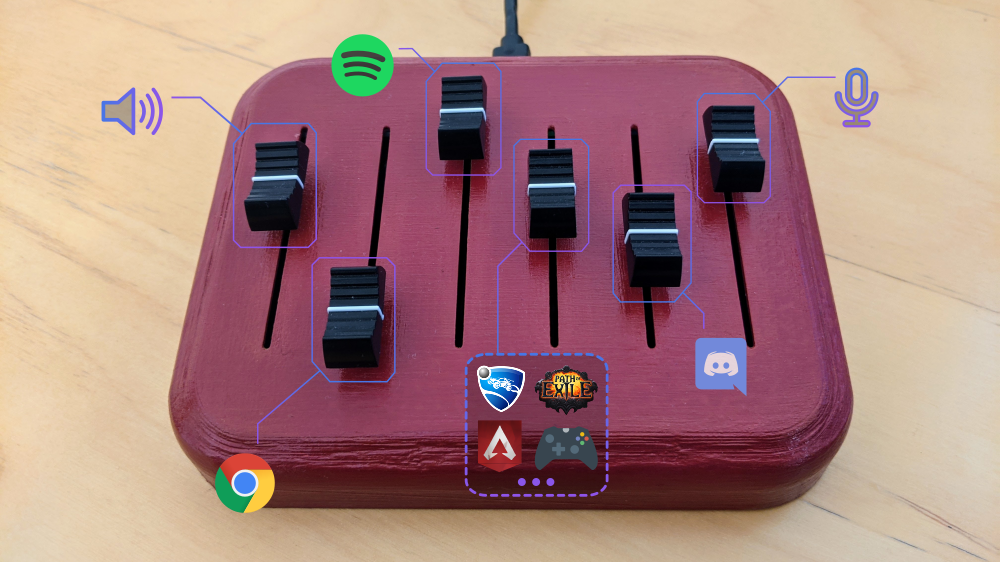
deej is an open-source hardware volume mixer for Windows and Linux PCs. It lets you use real-life sliders (like a DJ!) to seamlessly control the volumes of different apps (such as your music player, the game you’re playing and your voice chat session) without having to stop what you’re doing.
The natural evolution of the Q17-Mini, this time with two pairs of power transistors, better thermal management with the same technical characteristics and the same sound signature.
Phoniebox is a contactless jukebox for the Raspberry Pi, playing audio files, playlists, podcasts, web streams and Spotify triggered by RFID cards. All plug and play via USB, no soldering iron needed. It also features GPIO buttons control support.
The MuPiBox is an easy-to-use music player. Local music files, Spotify and streams from the Internet can be played. Operation via touchscreen is child’s play for young and old…
Features:
Music box for young and old
Touch display
easy to use (no access to the shell necessary!)
Update function
Spotify – album, playlists (premium account is required)
Local music – MP3, Flac, WAV, WMA
Generate local playlists at the touch of a button
Streams / radio via internet
Simple administration via display
Advanced administration via web interface
Easy installation (without shell access)
Automatic power off
Display timeout
Resume function
Read aloud collection/artist and album (Google TTS)
own sorting by radio play, music, playlist and radio
automatic offline / online switching depending on availability
Simple user interface
Cover ad
Add additional WiFi hotspots on the go
Construction of an individual housing (3D printing)
Tested hardware list
Slim OS (dietPi)
Few file accesses – logs etc. in RAM to protect the SD card
Stream from LMS and send audio to the build-in amplifier, the line-out jack, the spdif connector or another Bluetooth speaker. You can also use an external I2S DAC if you connect it to the general purpose 5/8 pins connector and tweak the software. Synchronization works.
Stream from a Bluetooth device and send audio to the same outputs, except of course for sending to another Bluetooth speaker … There is no guarantee of audio/video synchronization at this point
Stream from an AirPlay1 device (iPhone, iTunes …) to the same outputs, including to a Bluetooth speaker. Synchronization works.
Add your own buttons, rotary encoder and map/combine them to various functions (play, pause, volume, next …
Use IR control by adding a simple receiver compatible with 38kHz device (no pullup resistor or capacitor needed)
Add a display like this one which can be directly connected to the 6-pins header. Currently SH1106, SSD1306, SSD1322, SSD1326/7, SSD1351, ST7735 and ST7789 displays are supported.