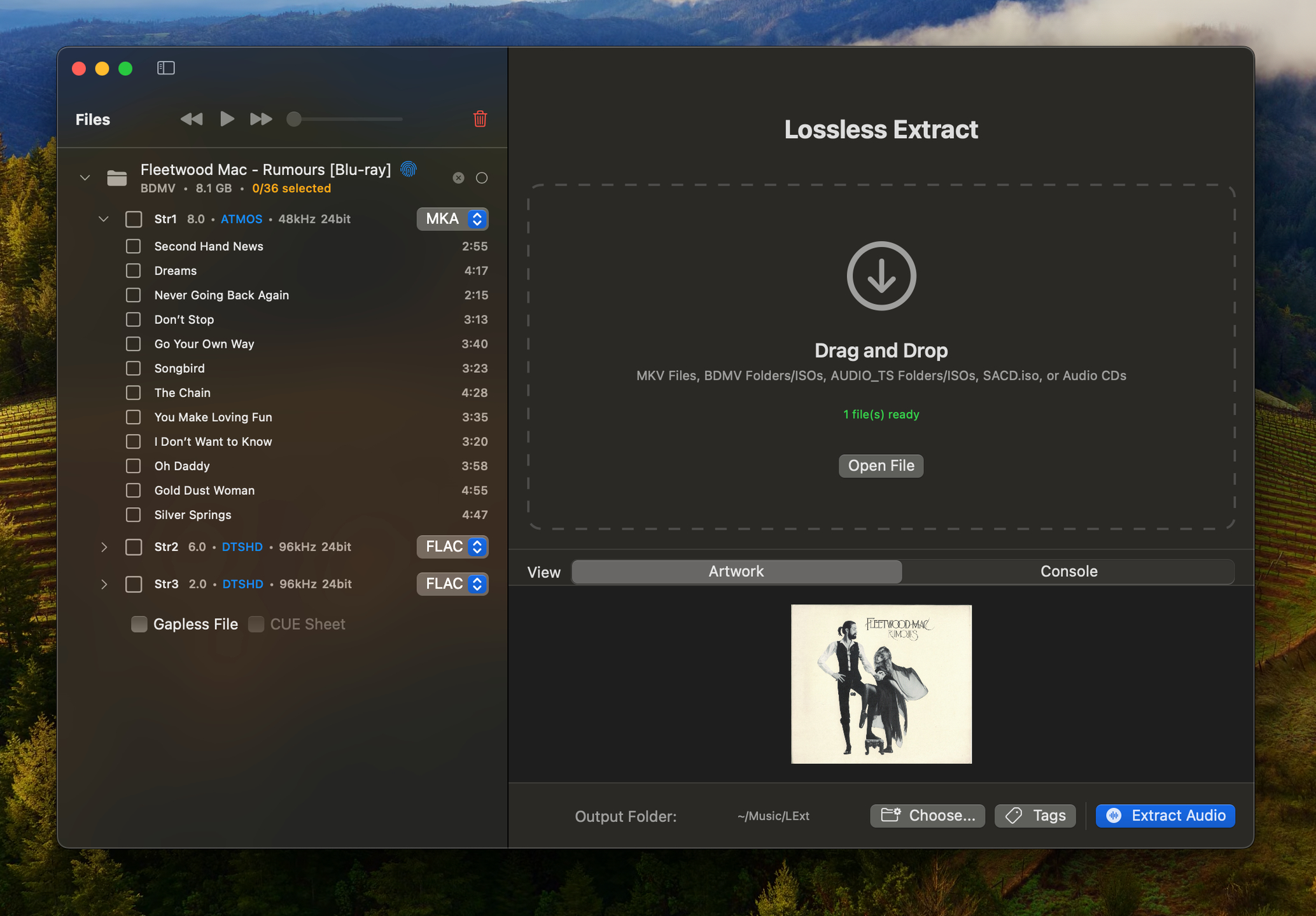
Lossless Extract for macOS and Windows is a tool for purists who demand perfect audio preservation. Designed for precision and simplicity, it effortlessly extracts high-resolution audio from Blu-ray, SACD, MKV or DVD=Audio sources. It handles Dolby TrueHD (with Atmos) and DTS-HD Master Audio preserving atmos object based meta data. Many tools decode immersive audio into PCM, which permanently destroys spatial metadata. Lossless Extract preserves the original audio stream so the immersive mix plays correctly on compatible AVRs and streaming devices.
Accepts MKV, BLU-Ray BDMV, and DVD-AUDIO ISO, AUDIO_TS folders, and SACD.isos as input files. Choose your preferred output format—FLAC , MKA, M4A, DSF, DFF, or Direct stream copy and Lossless Extract will deliver pristine, bit-for-bit copies of your original audio streams. Whether you’re archiving your home theater collection or preparing high-end audio projects, Lossless Extract ensures every detail is preserved, every time.
Cdparanoia is a Compact Disc Digital Audio (CDDA) Digital Audio Extraction (DAE) tool, commonly known on the net as a ‘ripper’. The application is built on top of the Paranoia library, which is doing the real work (the Paranoia source is included in the cdparanoia source distribution). Cdparanoia reads audio from the CDROM directly as data, with no analog step between, and writes the data to a file or pipe in WAV, AIFC or raw 16 bit linear PCM.
Cdparanoia is a bit different than most other CDDA extration tools. It contains few-to-no ‘extra’ features, concentrating only on the ripping process and knowing as much as possible about the hardware performing it. Cdparanoia will read correct, rock-solid audio data from inexpensive drives prone to misalignment, frame jitter and loss of streaming during atomic reads. Cdparanoia will also read and repair data from CDs that have been damaged in some way.
Cdparanoia is easy to use and administrate; It has no compile time configuration, happily autodetecting the CDROM, its type, its interface and other aspects of the ripping process at runtime. A single binary can serve the diverse hardware of the do-it-yourself computer laboratory from Hell.
Wax is a program for cataloging and playing a collection of music recordings. Wax is able to rip CDs and import downloads so that you can create a sound archive complete with metadata.
Wax is fundamentally different from existing music managers in two important ways. First, the fundamental unit for recordings is a “work”, not a track. A work is usually a collection of tracks. It can encapsulate whatever tracks you choose. In pop music, a work can be an album. For symphonic music, a work can be a single symphony, even when the tracks come from a CD with more than one symphony. For operas, a work can be a single opera even when the tracks come from multiple CDs. Music collectors usually think in terms of works, so a music manager that supports the concept makes operation more natural.
The other distinguishing characteristic of Wax is that genres are fundamental to the organization of a collection rather than a mere attribute of a track. Wax recognizes that the ideal way to catalog works varies by genre. For example, symphonic works can be cataloged by composer, work, conductor whereas shows can be cataloged by show, composer, lyricist. By organizing collections around genres, Wax supports an operation sequence that is natural for music lovers: first select the genre, then the work, and finally the tracks.
redumper is an advanced byte perfect disc dumper. It supports incremental dumps, advanced SCSI/C2 repair, intelligent audio CD offset detection and a lot of other features. Everything is written from scratch in C++.
The Daphile is the heart of a digital music system. Its primary focus is in storage and playback of your digital music library. It enables the best possible audio quality and future-proof flexibility by providing plug&play support for USB connected digital-to-analog converters (DAC). You can easily setup a multi-zone system just by connecting another USB DAC for each zone.
Features:
Headless music server OS
Bitperfect and gapless playback
Extensive audio format support
Native DSD playback up to DSD512
PCM resolutions up to 384kHz/24bit
High quality audio resampling including PCM to DSD conversion
Convolution filtering for DRC and equalizer
“Play from RAM” to minimize CPU load and disk activity during playback
Automatic audio device configuration with multiplayer support
CD ripping with AccurateRip™ verification, automatic metadata tagging and cover art
Supports external file servers as music source
Easy configuration and installation through the web interface
WiFi hotspot support (if compatible hardware exists)
Software update via web interface
Network-attached storage (NAS) service
Whole system included in about 200MB ISO-file
Daphile is based on the open source Squeezebox Server, Squeezelite and Linux. Since Daphile is used and configured completely via the web interface the user is not required to have any Linux skills.
Fully featured CD ripping program able to take out most of the tedium. Fully accurate, has advanced features most rippers don’t, yet has no bloat and is cross-platform.
Features:
Automatic tag lookup from the MusicBrainz database
Encoded and muxed via FFmpeg (currently supports flac, opus, mp3, tta, wavpack, alac, vorbis and aac)
Drive offset compensation and error recovery via cd-paranoia
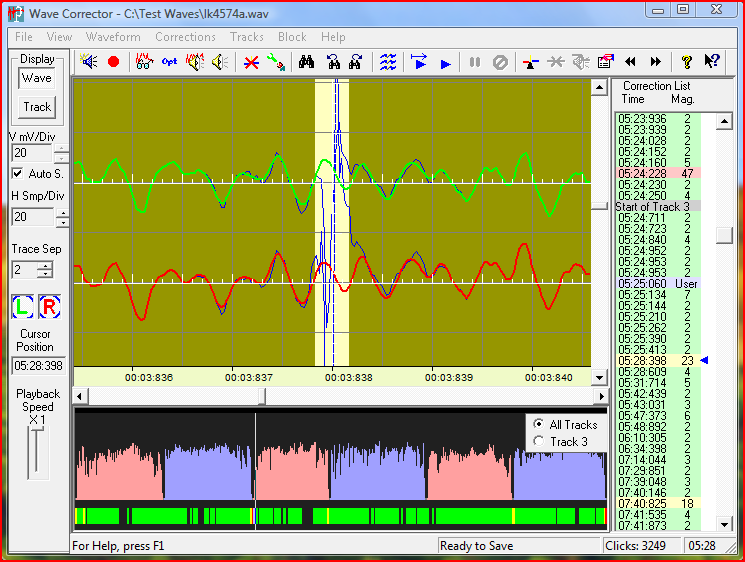
Transfer your old records and tapes to digital. Wave Corrector offers an integrated solution to record, clean-up and convert your music to digital audio formats. The program uses advanced digital processing to remove noise from old analogue recordings. Files can be transferred to CD or stored in your digital audio library. The program runs on the Microsoft Windows 2000/XP/Vista/7/8/8.1/10 platforms and on LINUX under Wine.
.ogg is a free audio format alternative. It features sound quality that is generally higher than MP3, and has no licensing fees. Ogg Drop will encode audio tracks and CD’s into .oggs. Ogg Drop is entirely free.
Ogg Drop includes a CDDB lookup of the FreeDB music database. Stick an audio CD into Ogg Drop, and it should be able to identify the songs automatically, and tag the songs for you.
Asunder is a graphical Audio CD ripper and encoder for Linux. You can use it to save tracks from an Audio CD as any of WAV, MP3, OGG, FLAC, Opus, WavPack, Musepack, AAC, and Monkey’s Audio files.





 The Audio File