
Tapedeck is an audio editor for Linux with an alternative control interface. Instead of a mouse, keyboard, and screen, it uses the DJ board Hercules DJ Control Instinct, and a set of LED graph displays (not currently implemented, simulated with terminal graphics).
github.com/vanjac/tapedeck
Category Archives: Linux

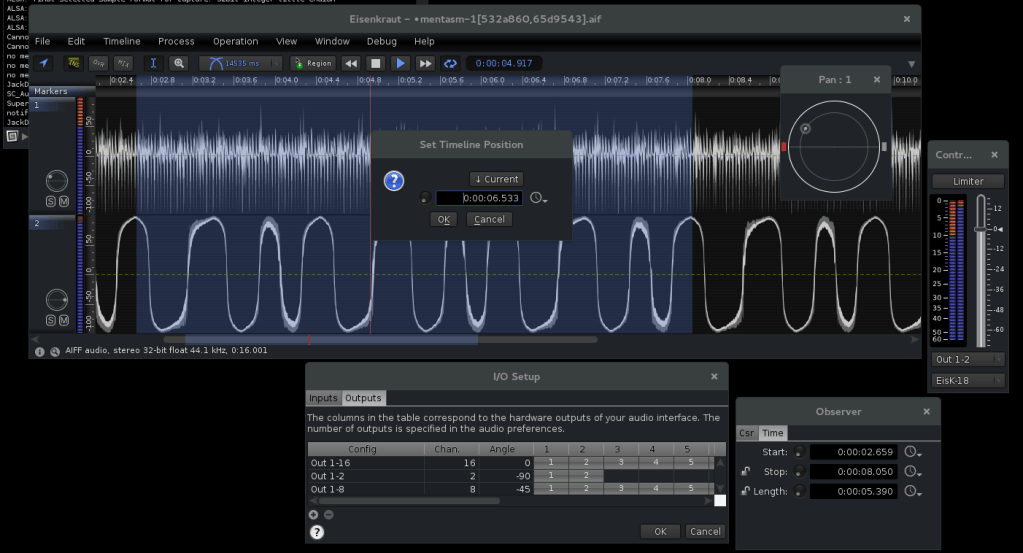
Eisenkraut ~ Multi-channel Audio Editor
The audio file editor, baptised ‘Eisenkraut’, came into existence (as a scaffold) during a project class on audio programming in Java at the SeaM in Weimar. It is distinguished by a number of traits which makes it particularly interesting in the field of computer music: There are no restrictions with regard to the number of channels in a file, and there is an OSC interface via which the functionality can be extended, for example using the SuperCollider language. Possible applications of such extensions are the transfer of marker information or the maintenance of meta data for segmented files, the algorithmic editing (cut/copy/paste) of files, or the addition of your own sound transformations or special decoders (e.g. an MS matrix).
github.com/dhfgj/Eisenkraut
github.com/Sciss/Eisenkraut
Share this:

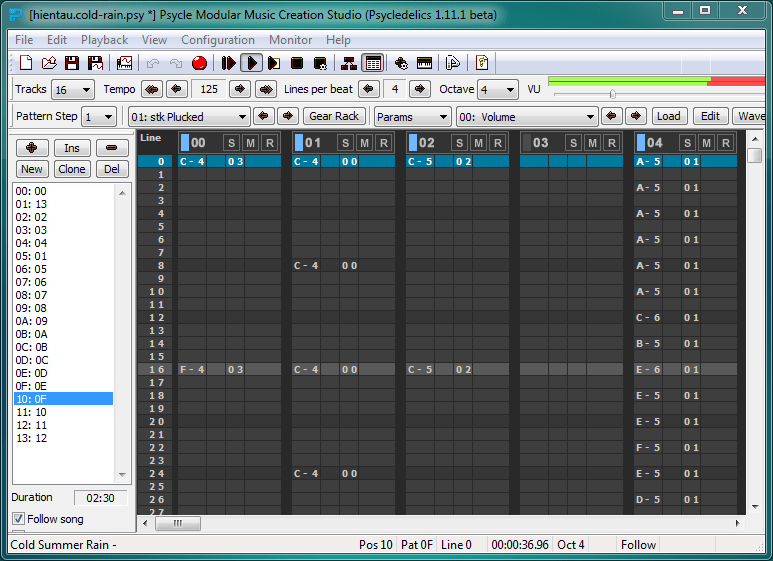
Psycle ~ Modular Music Creation Studio
Psycle is a Music tracker (like FastTracker 2 or Impulse Tracker) combined with plugin modularity. It supports its own plugin API, the VST2 plugin standard, and a tracker style sampler playback.
https://sourceforge.net/projects/psycle
http://psycle.pastnotecut.org/portal.php
http://sourceforge.net/projects/psycle/
Share this:

Mp3VoiceStamp ~ Automatic Voice Annotation
Athletes’ companion: adds synthesized voice overlay with various info and on-going timer to your audio files.
Features:
- Automatic voice volume adjustment based on music file volume
- Supports batch processing of multiple files
- Features dry-run mode for quick tests
- Highly customizable
- Minimal runtime dependencies
- Works on Linux, Mac OS and Windows
- Free
github.com/MarcinOrlowski/Mp3VoiceStamp
Share this:

AudioWorks ~ Tagging & Conversion Suite
A cross-platform, multi-format audio conversion and tagging suite for .NET and PowerShell. Formats currently supported are MP3, MP4 AAC, FLAC, Apple Lossless (ALAC), Opus, Ogg Vorbis and Wave.
This project supplants PowerShell Audio by targeting both Windows PowerShell and PowerShell Core (Windows, Linux and MacOS).
Share this:

Helio ~ Libre Music Composition

Distraction-free – Helio is an attempt to rethink a music sequencer to create a tool that feels right. It provides a lightweight UI to help you get into the zone and focus on your ideas.
Clear over clever – Visualize music in a way that doesn’t seem so smoke and mirrors. The app may serve as a learning tool you need to grow as a composer.
Cross-platform tech – Available for all major platforms, desktop and mobile. Hosts VST and AudioUnit, runs on CoreAudio, ASIO, DirectSound, ALSA, JACK and OpenSLES. Exports to MIDI, WAV and FLAC.
helio.fm
github.com/helio-fm/helio-sequencer
Share this:

Soundsync ~ Cross-platform Virtual Cables
Soundsync is a web and desktop app to manage every audio source and every audio output in your home from a single interface. Link any audio source to multiple speakers connected to any devices on your home network. Soundsync will keep the music synchronized between all of them.
Features:
- 🆓 Free to use
- 🕸️ Work with any number of connected devices, audio sources, audio outputs and every link of your choosing
- 🎶 Compatible with a lot of different audio sources (Spotify Connect with a premium account, Airplay, Hardware Audio input (line in / microphone), Linux system audio ; coming soon: Windows system audio, UPnP and more)
- 🔊 Broadcast sound to any speaker connected to a computer (Windows, MacOS, Linux, RapsberryPi), a web browser (Chrome, Firefox) or a Chromecast and soon more
- 🔗 Group speakers together to synchronize them to the same audio source
- 🎛️ Control everything from a web browser
- 🔓 Not linked to any external service, works offline, no account creation
github.com/geekuillaume/soundsync
Share this:

Sayonara ~ Lightweight Linux Player
Sayonara is a small, clear and fast audio player for Linux written in C++, supported by the Qt framework. It uses GStreamer as audio backend. Sayonara is open source and uses the GPLv3 license. One of Sayonara’s goals is intuitive and easy usability. Currently, it is only available for Linux and BSD. Although Sayonara can be considered as a lightweight player, it has a lot of features in order to organize even big music collections. In contrast to the heavyweight players, the main focus of Sayonara is performance, low CPU usage and low memory consumption. Sayonara is a great alternative to players like Rhythmbox, Clementine or Amarok. Those who miss Winamp for Linux should give Sayonara a try.
Managing your library: You can manage your library by artists, albums, genres or file paths. Sayonara contains a sophisticated tag editor helping you to keep your collection clean. You can hold multiple playlists simultaneously, save/rename/delete or export them to common playlist file formats. With the multi library feature you can manage multiple directories as stand-alone libraries and copy and move tracks from one to another. There are even more complex library plugins like Soundcloud or SomaFM support.
Directory view: Some people don’t have a perfect tagged library and are more interested in the directory structure of their libraries. Sayonara provides various features to access and edit your music in the directory view.
Plugins: In addition, there are some useful plugins helping to enhance your comfort while listening. Some interesting plugins are the equalizer, a speed/pitch control, a crossfader, bookmarks for tracks and a broadcasting function.
Webstreams and Podcasts: You can record all tracks streamed from the internet. Your saved tracks automatically tagged, of course. When listening to ordinary webstreams, a history of all played tracks can be displayed. If webstreams or podcasts contain some chapter information, Sayonara also uses this information in order to provide fast jumping within these tracks.

sayonara-player.com
en.wikipedia.org/wiki/Sayonara_Player
Share this:

SoundTracker ~ Unix Sample Tracker
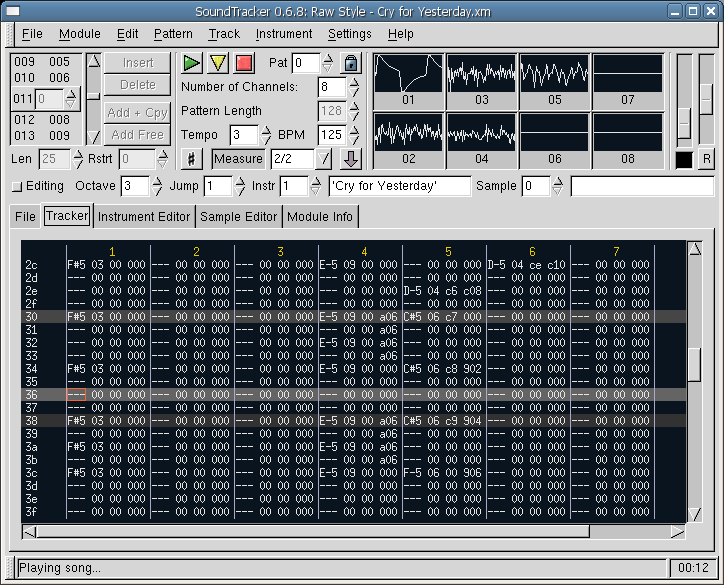
SoundTracker is a music tracking tool for Unix / X11 similar in design to the DOS program FastTracker and the Amiga legend ProTracker. Samples can be lined up on tracks and patterns which are then arranged to a song. Supported module formats are XM and MOD; the player code is the one from OpenCP. A basic sample recorder and editor is also included. SoundTracker is free (“open source”) software, licensed under the GNU GPL.
Share this:

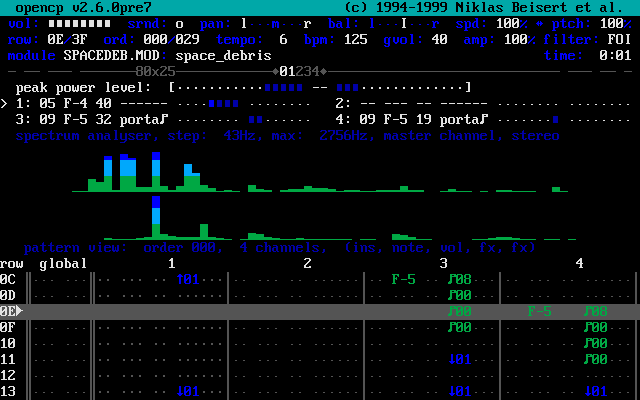
Open Cubic Player ~ Old School Audio
OPENCP is a music file player for DOS, Linux, Unix, Windows 95, ME & XP.
It’s derived from the Cubic Player 2.0 which was developed by Niklas Beisert.
Share this:

Ecasound ~ Open Source Unix DAW
Ecasound is a software package designed for multitrack audio processing. It can be used for simple tasks like audio playback, recording and format conversions, as well as for multitrack effect processing, mixing, recording and signal recycling. Ecasound supports a wide range of audio inputs, outputs and effect algorithms. Effects and audio objects can be combined in various ways, and their parameters can be controlled by operator objects like oscillators and MIDI-CCs. A versatile console mode user-interface is included in the package.
The primary platform for running Ecasound is GNU/Linux. Ecasound can also be run on many UNIX-derived systems such as FreeBSD, Mac OS X and Solaris. Limited support for Windows is available through Cygwin.
Share this:

Matchering ~ Master Via Modeling
Matchering 2.0 is a novel Containerized Web Application and Python Library for audio matching and mastering. It follows a simple idea – you take TWO audio files and feed them into Matchering:
- TARGET (the track you want to master, you want it to sound like the reference)
- REFERENCE (another track, like some kind of “wet” popular song, you want your target to sound like it)
Our algorithm matches both of these tracks and provides you the mastered TARGET track with the same RMS, FR, peak amplitude and stereo width as the REFERENCE track has.

 The Audio File