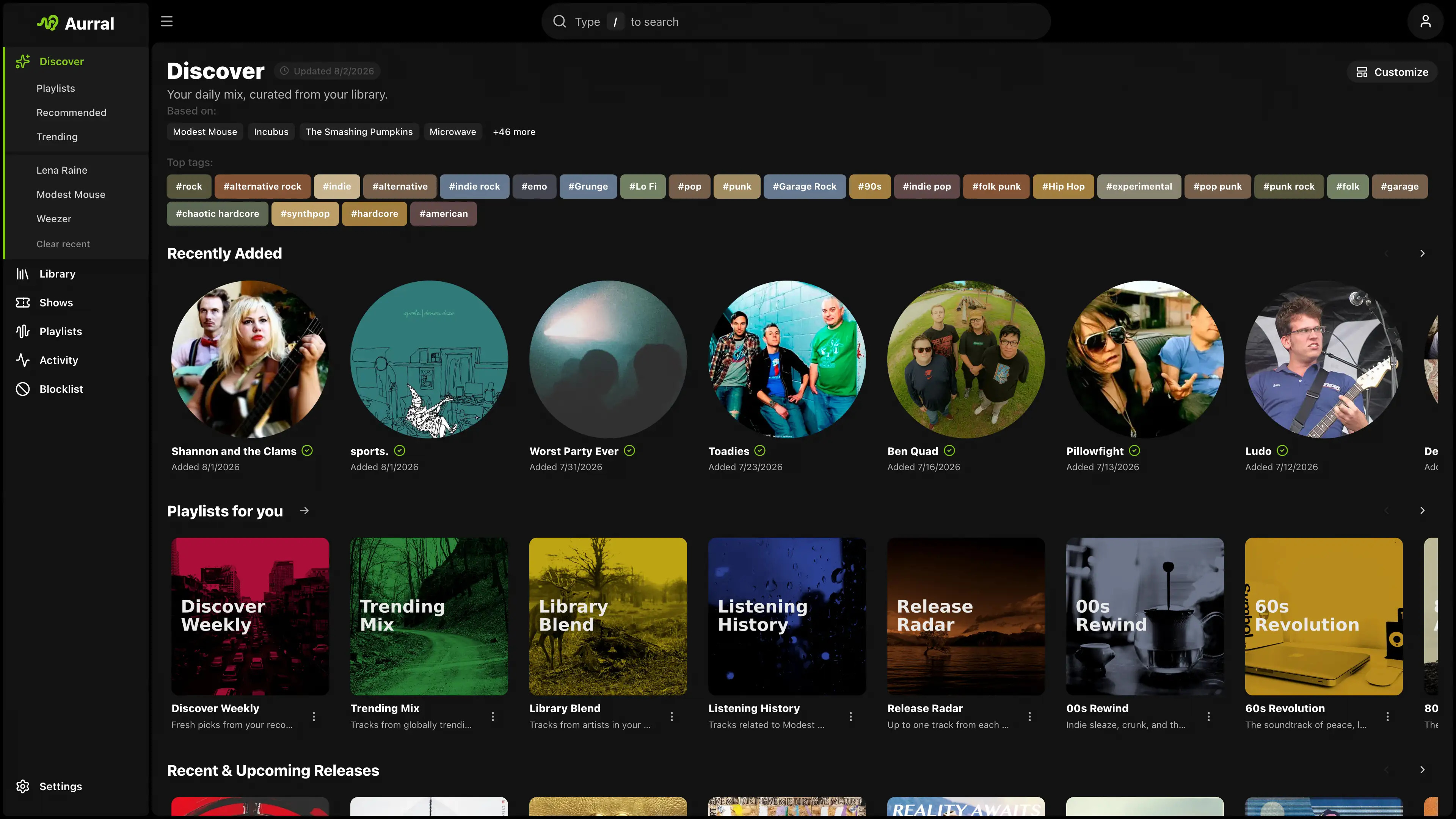
Aurral is self-hosted music discovery with its own music library. Best-in-class recommendations, rotating flows, playlist downloads, and a library that Aurral manages, with Lidarr as an optional add-on.
aurral.org
github.com/lklynet/aurral

Aurral is self-hosted music discovery with its own music library. Best-in-class recommendations, rotating flows, playlist downloads, and a library that Aurral manages, with Lidarr as an optional add-on.
aurral.org
github.com/lklynet/aurral

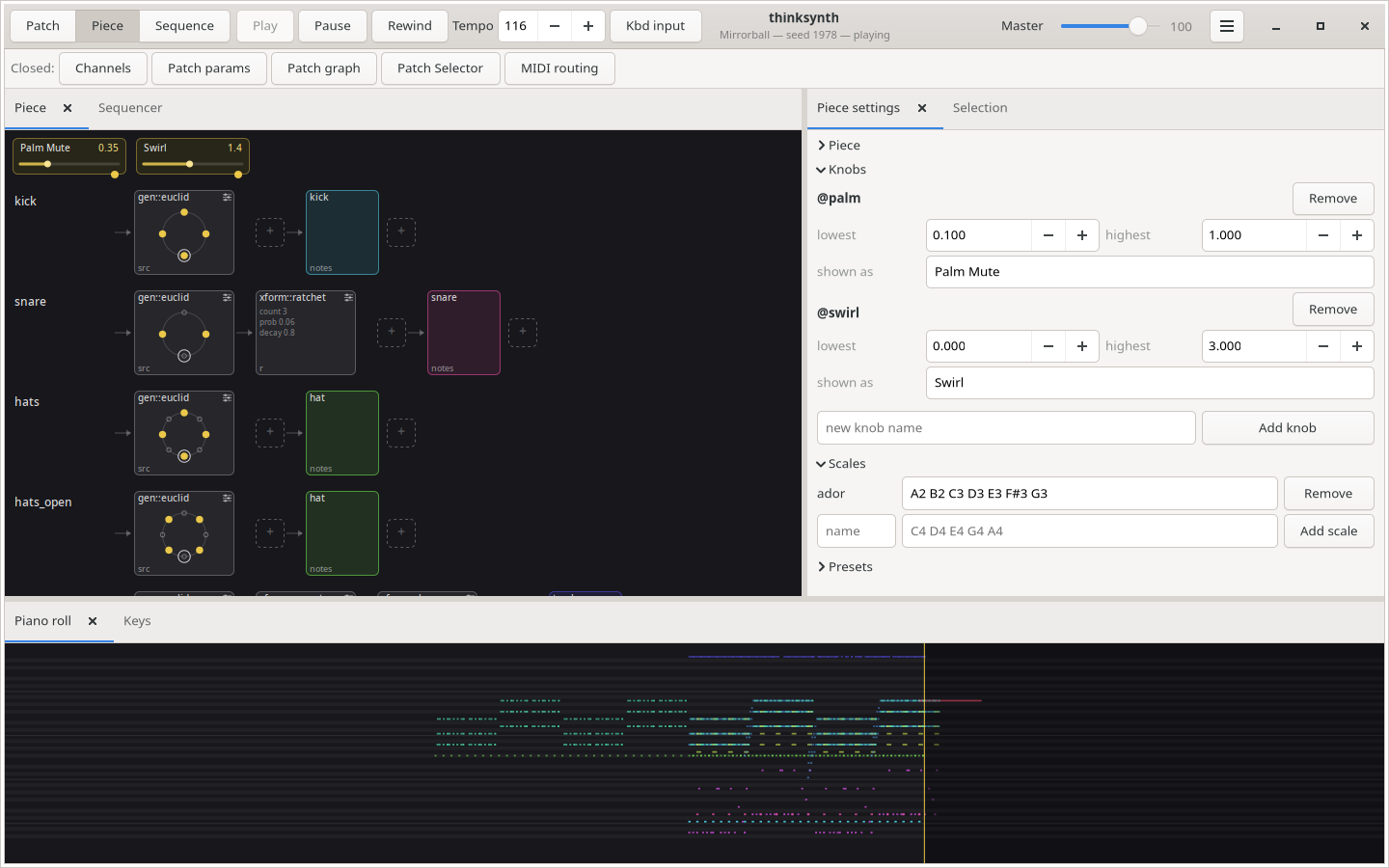
thinksynth builds sounds out of a graph of DSP nodes — oscillators, filters, envelopes, delays and arithmetic — described in a small language and rendered in real time. Patches assign those graphs to MIDI channels, so one instrument can layer several voices.
Every node is a plugin, and the set that ships covers subtractive and FM synthesis, resonators, waveshaping and a range of filters. New ones are ordinary shared libraries dropped into the plugin directory.

Play a music collection that lives on a computer at home, from anywhere. It can be your computer or a friend’s. No port forwarding, no VPN, no account and no cloud copy of your files.
peerloomllc.com/peartune
github.com/peerloomllc/peartune

Ambient sounds for focus and calm.

music streaming server / free-software subsonic server API implementation
Features:
- browsing by folder (keeping your full tree intact) see here
- browsing by tags (using taglib – supports mp3, opus, flac, ape, m4a, wav, etc.)
- on-the-fly audio transcoding and caching (requires ffmpeg) (thank you spijet)
- subsonic jukebox mode, for gapless server-side audio playback instead of streaming (thank you lxea)
- support for podcasts (thank you lxea)
- pretty fast scanning (with my library of ~50k tracks, initial scan takes about 10m, and about 6s after incrementally)
- multiple users, each with their own transcoding preferences, playlists, top tracks, top artists, etc.
- last.fm scrobbling
- listenbrainz scrobbling (thank you spezifisch, lxea)
- artist similarities and biographies from the last.fm api
- support for multi valued tags like albumartists and genres (see more)
- a web interface for configuration (set up last.fm, manage users, start scans, etc.)
- support for the album-artist tag, to not clutter your artist list with compilation album appearances
- written in go, so lightweight and suitable for a raspberry pi, etc. (see ARM images below)
- newer salt and token auth
- tested on airsonic-refix, amperfy, symfonium, dsub, jamstash, music-assistant, subsonic.el, sublime music, soundwaves, stmp, termsonic, tempus, strawberry, and ultrasonic

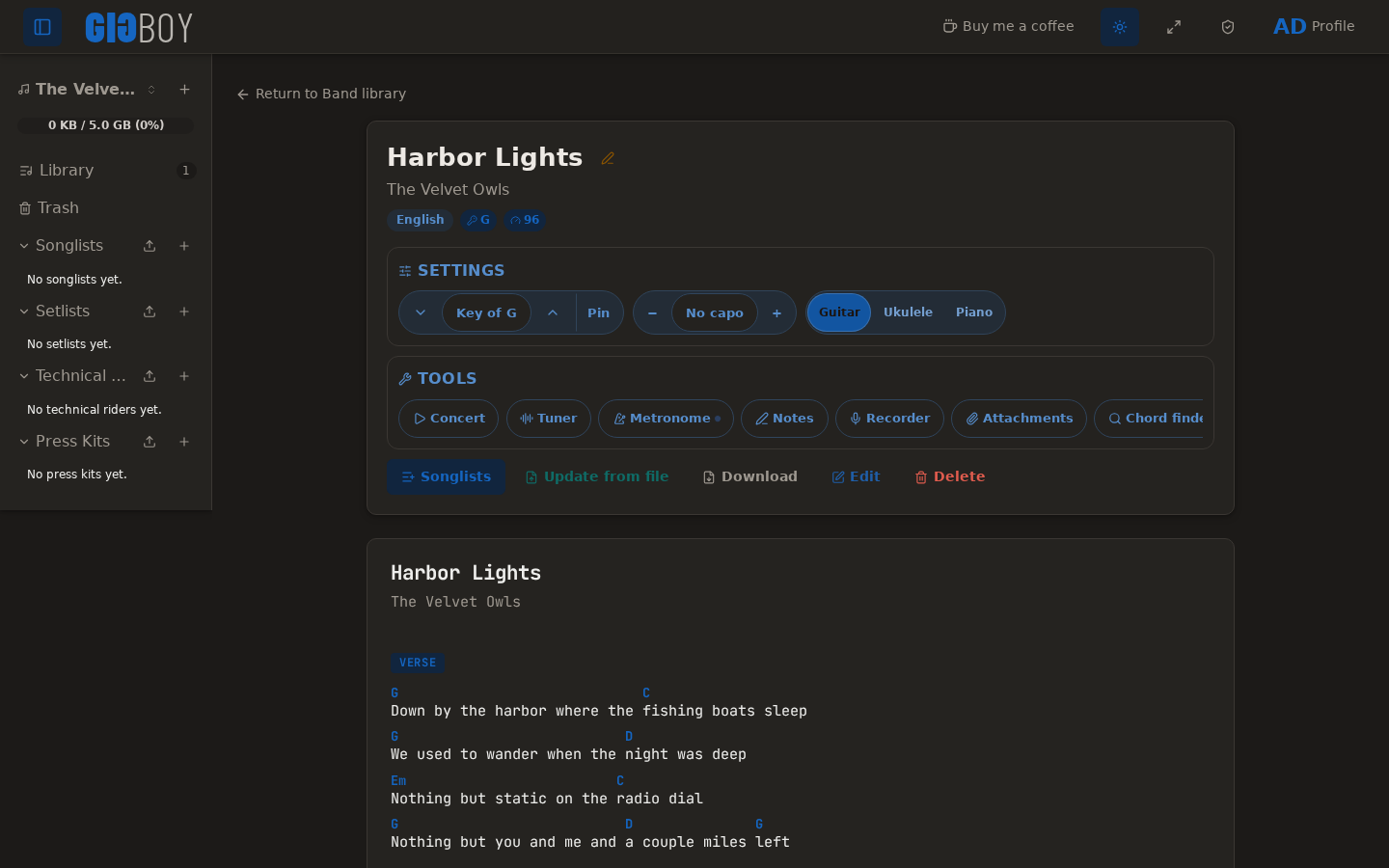
Gigboy is a web app for musicians and bands to write, organize, and rehearse songs from — built on the open ChordPro format, so nothing you write is ever locked into a proprietary format or someone else’s server. It’s self-hosted only: you run it on your own machine, NAS, or VPS with one Docker Compose command, and your band’s setlists, recordings, and press kit live in your own database, not a startup’s.
No subscriptions, no per-seat pricing, no feature paywalls — every account gets full access.
blindpassasjer.github.io/gigboy
github.com/blindpassasjer/gigboy

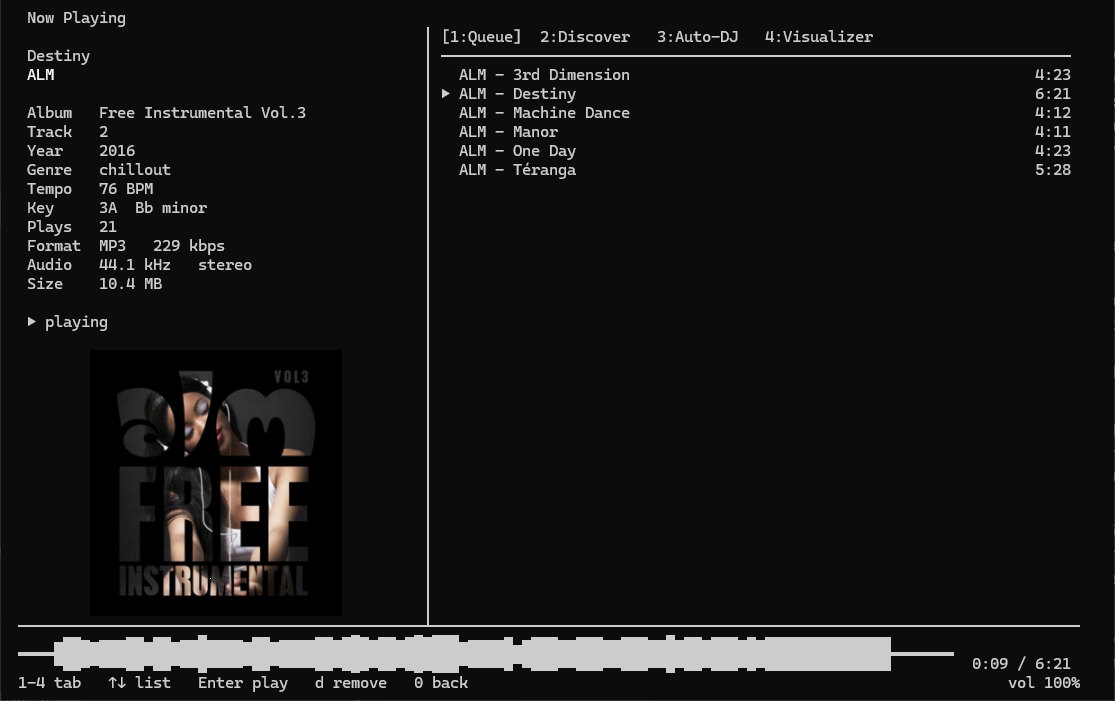
mStream is a self-hosted music server. Self-hosting means you run the server software on a computer you own. mStream is lightweight and can be run on old hardware and boards like the Raspberry Pi.
Why host your own?
- Own your music. No ads, and nothing gets removed from your library.
- Quality. Stream FLAC and lossless files uncompressed.
- Privacy. Streaming services log your listening habits. Your server never snitches on you.
- Good for artists. Buy music directly and the money goes to them.
mstream.io
github.com/IrosTheBeggar/mStream

A modern mp3gain / aacgain replacement written in Rust. A native GUI application (mp3rgui) is available for users who prefer a graphical interface.
mp3rgain adjusts MP3 and AAC volume without re-encoding by modifying the global_gain field in each frame. This preserves audio quality while achieving permanent volume changes.
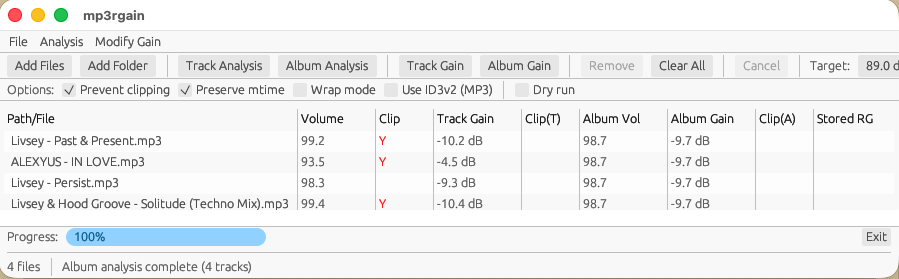
github.com/M-Igashi/mp3rgain
crates.io/crates/mp3rgain
hydrogenaudio.org/index.php/topic,129648.0
github.com/dgilman/aacgain
mp3gain.sourceforge.net

A lightweight HTML5 web music player with FLAC support that runs in a Docker container. This project provides a clean, minimalist interface for playing FLAC audio files with metadata extraction.
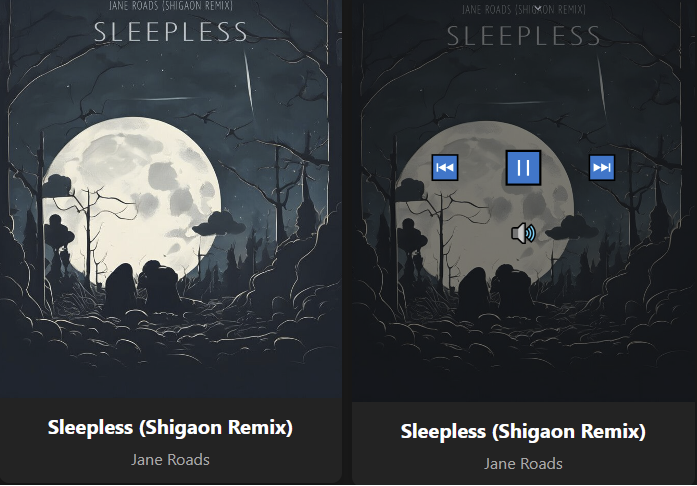

Swing Music is a fast and beautiful, self-hosted music player for your local audio files. Like a cooler Spotify … but bring your own music. Just run the app and enjoy your music library in a web browser.
Features:
- Daily Mixes – curated everyday based on your listening activity
- Metadata normalization – a clean and consistent library
- Album versioning – normalized albums and association with version labels (eg. Deluxe, Remaster, etc)
- Related artist and albums
- Folder view – Browse your music library by folders
- Playlist management
- Beautiful browser based UI
- Silence detection – Combine cross-fade with silence detection to create a seamless listening experience
- Collections – Group albums and artists based on your preferences
- Statistics – Get insights into your listening activity
- Lyrics view
- Android client
- Last.fm scrobbling
- Multi-user support
- Cross-platform – Windows, Linux, MacOS (coming soon), arm64, x86
- Blazingly fast
- Pure awesomeness
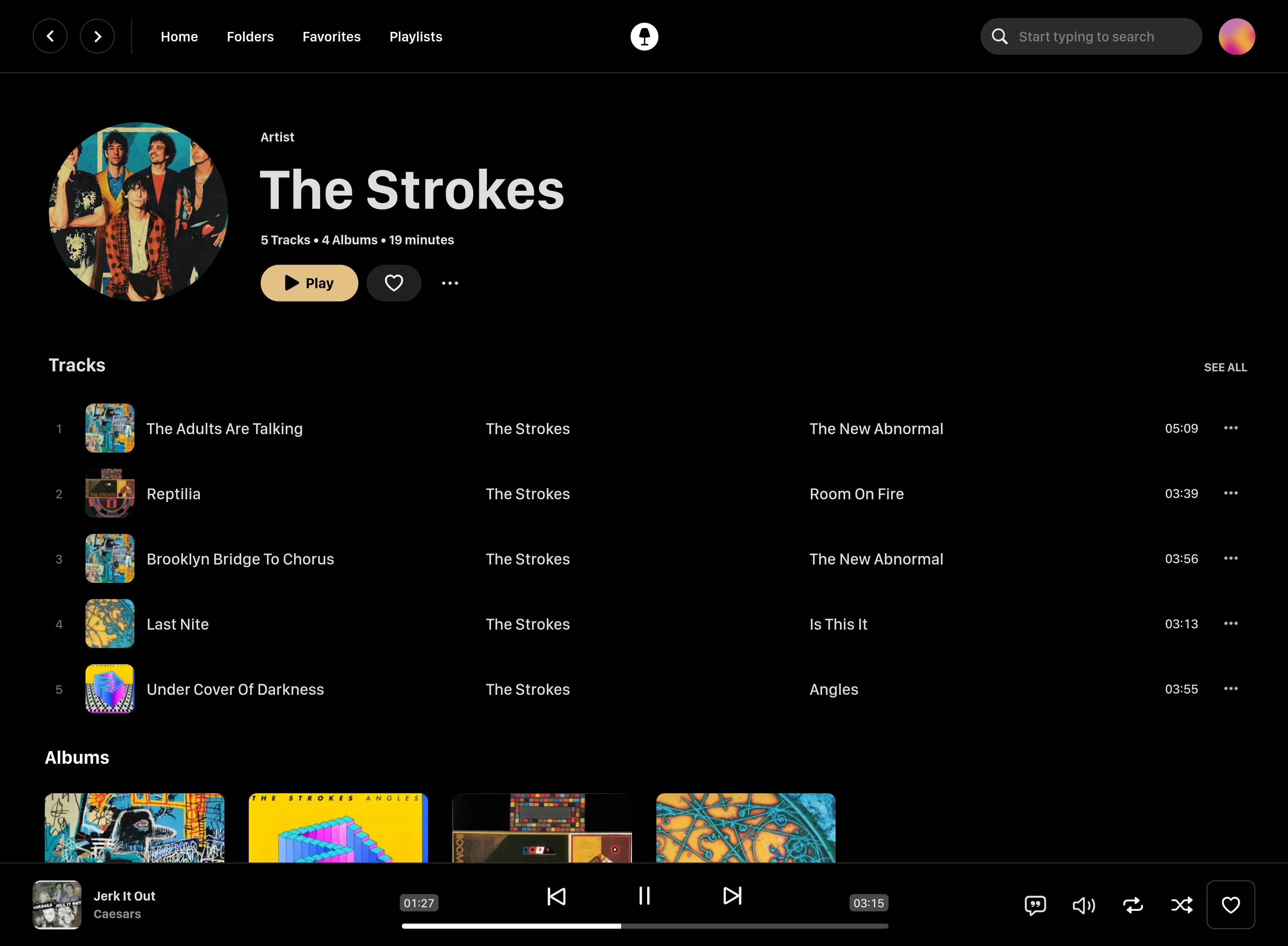
github.com/swingmx/swingmusic
github.com/swingmx/android
github.com/swingmx/webclient
sourceforge.net/projects/swing-music.mirror

Navidrome is a piece of software that allows you to listen to your own digital music in the same way you would with services like Spotify, Apple Music and others. It also allows you to easily share your music and playlists with your friends and family
How it works?
After a simple installation, Navidrome indexes all digital music stored in your hard drive and makes it available through a nice web player and also by using any Subsonic-API compatible mobile client. Your music becomes searchable and you can create playlists, rate and “favourite” your loved tracks, albums and artists
www.navidrome.org
github.com/navidrome/navidrome
www.reddit.com/r/navidrome/
twitter.com/navidrome
Foobar2000 Component:
foo_opensubsonic

DawDreamer is an audio-processing Python framework supporting core DAW features and beyond:
- Composing graphs of multi-channel audio processors
- Audio playback
- VST instruments and effects (with UI editing and state loading/saving)
- FAUST effects and polyphonic instruments
- Time-stretching and looping, optionally according to Ableton Live warp markers
- Pitch-warping
- Parameter automation at audio-rate and at pulses-per-quarter-note
- Parameter automation saving in absolute audio-rate time
- MIDI playback in absolute time and PPQN time
- MIDI file export in absolute time
- Rendering and saving multiple processors simultaneously
- Support for the Faust Box and Signal APIs
- Transpiling Faust code to JAX/Flax and other target languages (C++, Rust, Wasm, etc.)
- Machine learning experiments with QDax
- Multiprocessing support
- Full support on macOS, Windows, Linux, Google Colab, and Ubuntu Dockerfile
DawDreamer’s foundation is JUCE, with a user-friendly Python interface thanks to pybind11. DawDreamer evolved from an earlier VSTi audio “renderer”, RenderMan.
github.com/DBraun/DawDreamer


