mstream ~ Self-hosted Music Server


mStream is a self-hosted music server. Self-hosting means you run the server software on a computer you own. mStream is lightweight and can be run on old hardware and boards like the Raspberry Pi.

Why host your own?

  • Own your music. No ads, and nothing gets removed from your library.
  • Quality. Stream FLAC and lossless files uncompressed.
  • Privacy. Streaming services log your listening habits. Your server never snitches on you.
  • Good for artists. Buy music directly and the money goes to them.
mstream interface

mstream.io
github.com/IrosTheBeggar/mStream

mp3rgain ~ Lossless MP3/AAC Volume Adjustment


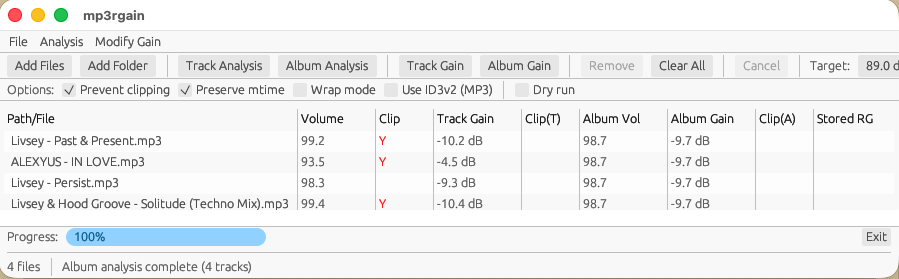
A modern mp3gain / aacgain replacement written in Rust. A native GUI application (mp3rgui) is available for users who prefer a graphical interface.

mp3rgain adjusts MP3 and AAC volume without re-encoding by modifying the global_gain field in each frame. This preserves audio quality while achieving permanent volume changes.

github.com/M-Igashi/mp3rgain
crates.io/crates/mp3rgain
hydrogenaudio.org/index.php/topic,129648.0

References:

github.com/dgilman/aacgain
mp3gain.sourceforge.net

Shairport Sync ~ Unix AirPlay Player


Shairport Sync is an AirPlay audio player – it plays audio streamed from iTunes, iOS, Apple TV and macOS devices and AirPlay sources such as Quicktime Player and ForkedDaapd, among others.

Audio played by a Shairport Sync-powered device stays synchronised with the source and hence with similar devices playing the same source. In this way, synchronised multi-room audio is possible for players that support it, such as iTunes and the macOS Music app.

Shairport Sync runs on Linux, FreeBSD and OpenBSD. It does not support AirPlay video or photo streaming.

github.com/mikebrady/shairport-sync
github.com/mikebrady/shairport-sync/wiki

Dynamic Audio Normalizer ~ Advanced Normalization


Dynamic Audio Normalizer is a library for advanced audio normalization purposes. It applies a certain amount of gain to the input audio in order to bring its peak magnitude to a target level (e.g. 0 dBFS). However, in contrast to more “simple” normalization algorithms, the Dynamic Audio Normalizer dynamically re-adjusts the gain factor to the input audio. This allows for applying extra gain to the “quiet” sections of the audio while avoiding distortions or clipping the “loud” sections. In other words: The Dynamic Audio Normalizer will “even out” the volume of quiet and loud sections, in the sense that the volume of each section is brought to the same target level. Note, however, that the Dynamic Audio Normalizer achieves this goal without applying “dynamic range compression”. It will retain 100% of the dynamic range within each “local” region of the audio file.

The Dynamic Audio Normalizer is available as a small standalone command-line utility and also as an effect in the SoX audio processor as well as in the FFmpeg audio/video converter. Furthermore, it can be integrated into your favourite DAW (digital audio workstation), as a VST plug-in, or into your favourite media player, as a Winamp plug-in. Last but not least, the “core” library can be integrated into custom applications easily, thanks to a straightforward API (application programming interface). The “native” API is written in C++, but language bindings for C99 Microsoft.NET,  Java,  Python and Pascal are provided.

muldersoft.com/#dyauno
github.com/lordmulder/DynamicAudioNormalizer