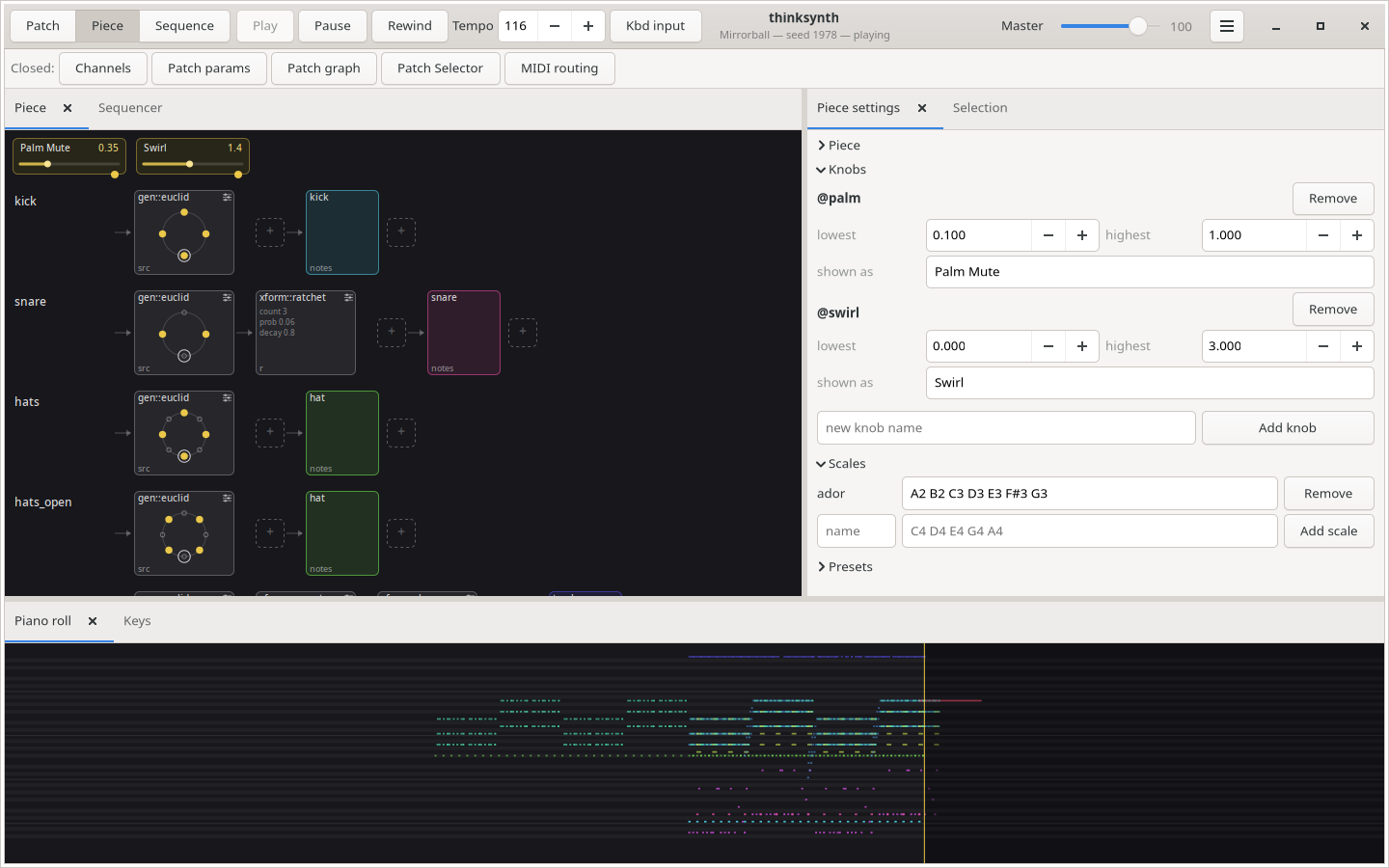
thinksynth builds sounds out of a graph of DSP nodes — oscillators, filters, envelopes, delays and arithmetic — described in a small language and rendered in real time. Patches assign those graphs to MIDI channels, so one instrument can layer several voices.
Every node is a plugin, and the set that ships covers subtractive and FM synthesis, resonators, waveshaping and a range of filters. New ones are ordinary shared libraries dropped into the plugin directory.
Tonbandfetzen is a collection of command-line tools that allow you to compose music based on audio fragments generated from plain text input. It contains:
A featureful SID-music creation tool (tracker) for the Commodore 64. It includes many advanced effects and tools like keyboard-tracking, tempo-programs/funktempo, gateoff-table-pointers, filter-shift, SID-export, executable-export, MIDI/XM conversion and MIDI-input hardware, etc., etc.
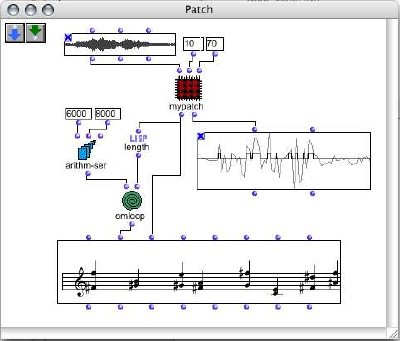
OpenMusic (OM) is a visual programming language based on Common Lisp. Visual programs are created by assembling and connecting icons representing functions and data structures. Most programming and operations are performed by dragging an icon from a particular place and dropping it to an other place. Built-in visual control structures (e.g. loops) are provided, that interface with Lisp ones. Existing CommonLisp/CLOS code can easily be used in OM, and new code can be developed in a visual way.
OM may be used as a general purpose functional/object/visual programming language. At a more specialized level, a set of provided classes and libraries make it a very convenient environment for music composition. Above the OpenMusic kernel, live the OpenMusic Projects. A project is a specialized set of classes and methods written in Lisp, accessible and visualisable in the OM environment. Various classes implementing musical data / behaviour are provided. They are associated with graphical editors and may be extended by the user to meet specific needs. Different representations of a musical process are handled, among which common notation, midi piano-roll, sound signal. High level in-time organisation of the music material is proposed through the concept of “maquette”.
OM-SoX is a library for multichannel audio manipulation and functional batch processing for OpenMusic, a visual programming environment based on CommonLisp / CLOS.
This is a web version of the Roland TR-909 drum-machine with painfully hand-made generated html, svg & css and a proper web-audio-api sound engine. It emulates the exact same cumbersome user experience of the original machine.
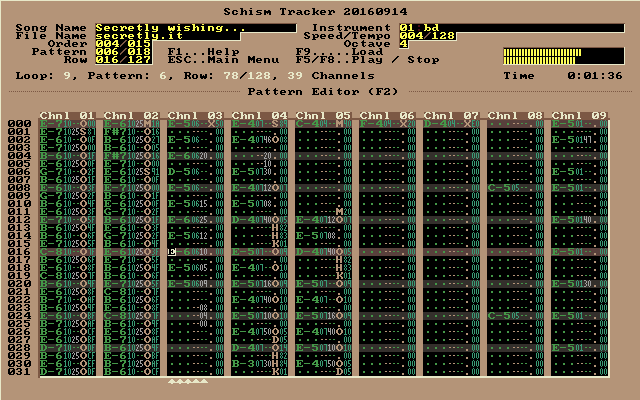
Schism Tracker is a free and open-source reimplementation of Impulse Tracker, a program used to create high quality music without the requirements of specialized, expensive equipment, and with a unique “finger feel” that is difficult to replicate in part. The player is based on a highly modified version of the ModPlug engine, with a number of bugfixes and changes to improve IT playback.
Where Impulse Tracker was limited to i386-based systems running MS-DOS, Schism Tracker runs on almost any platform that SDL supports, and has been successfully built for Windows, Mac OS X, Linux, FreeBSD, OpenBSD, AmigaOS, BeOS, and even Wii. Schism will most likely build on any architecture supported by GCC4 (e.g. alpha, m68k, arm, etc.) but it will probably not be as well-optimized on many systems.
Incudine is used to design software synthesizers or sound plugins from scratch, exploiting the expressive power of Common Lisp, without the constraints of using pre-built unit generators. It is also a compositional tool that produces high quality sounds, controllable at the sample level, while defining and redefining the digital signal processors and the musical structures on-the-fly.