SOF ~ DSP Firmware Infrastructure & SDK


Sound Open Firmware (SOF) is an open source audio Digital Signal Processing (DSP) firmware infrastructure and SDK. SOF provides infrastructure, real-time control pieces, and audio drivers as a community project. The project is governed by the Sound Open Firmware Technical Steering Committee (TSC) that includes prominent and active developers from the community. SOF is developed in public and hosted on the GitHub platform.

The firmware and SDK are intended for developers who are interested in audio or signal processing on modern DSPs. SOF provides a framework where audio developers can create, test, and tune the following:

  • Audio processing pipelines and topologies.
  • Audio processing components.
  • DSP infrastructure and drivers.
  • Host OS infrastructure and drivers.

sofproject.org
thesofproject.github.io
github.com/thesofproject/sof
Youtube: Sound Open Firmware – Liam Girdwood, Intel

Cavern ~ Object-based Audio Engine & CODEC


Cavern is a fully adaptive object-based audio rendering engine and (up)mixer without limitations for home, cinema, and stage use. Audio transcoding and self-calibration libraries built on the Cavern engine are also available. This repository also features a Unity plugin and a standalone converter called Cavernize.

Cavern goes beyond fixed-channel audio systems by rendering any number of audio “objects” in three-dimensional space, tailored to the listener’s speaker arrangement or headphone output. It is also supported by a standalone conversion tool, Cavernize, which allows users to convert spatial mixes into conventional channel-based PCM formats while maintaining positional accuracy.

Key Features and Capabilities:

Object-Based Rendering
Cavern supports an unrestricted number of audio objects and output channels. This allows precise spatial placement and movement of sounds in 3D space, independent of specific channel layouts.

Codec and Container Support
The engine and its companion tools support a wide range of codecs and containers, including those commonly used for immersive audio delivery. Traditional formats such as WAV and common multimedia containers are also supported.

Calibration and Room Correction
Cavern includes tools for self-calibration and room equalization. These can flatten frequency response, compensate for acoustic irregularities, and help unify tonal characteristics across speakers.

Headphone Virtualization
Through HRTF-based processing, Cavern enables spatial rendering over stereo headphones. This simulates direction, distance, and spatial cues to reproduce the effect of multichannel speaker setups in a binaural listening environment.

Real-Time Up-Mixing
Legacy stereo or multichannel content can be up-mixed into fully rendered 3D scenes. This provides an immersive experience even when the source was not originally produced as object-based audio.

Integration with Game Engines
Cavern offers integration with Unity, enabling developers to incorporate real-time positional audio into games, simulations, and interactive media.


Use Cases

Home Cinema and Media Playback
Cavern can render object-based audio tracks for users who do not have commercial hardware processors. It allows accurate spatial playback through both speakers and headphones.

Headphone-Focused Listening
The binaural virtualization system benefits users who rely on headphones for movies, music, gaming, or general media consumption.

Game and VR Development
Developers can use Cavern inside Unity to produce dynamic, spatially accurate audio scenes in interactive applications.

Archiving and Conversion
Cavernize converts object-based audio into standard PCM or channel-based formats, preserving positional intent while enabling playback on conventional systems.

Speaker Optimization
Its calibration tools provide a software-based approach to room correction and multi-speaker alignment without requiring dedicated hardware processors.


Limitations and Considerations

  • Some supporting utilities are not fully open-source and may be distributed under separate licensing terms.
  • Spatial rendering benefits depend on input quality; poor-quality stereo sources will not yield true immersive results.
  • Speaker hardware, room acoustics, and HRTF compatibility affect the perceived accuracy of spatialization.
  • Integrating Cavern into custom software projects requires familiarity with its API and spatial-audio concepts.

Why Cavern Matters

Cavern stands out by making advanced spatial-audio technology accessible without requiring specialized hardware or proprietary processors. By combining open-source rendering, a flexible object-based architecture, codec support, calibration tools, and developer integration, it provides a versatile platform for enthusiasts, researchers, and media creators.

For users interested in experimenting with immersive audio workflows, whether for home cinema, headphone listening, archiving, or game development, Cavern offers a free, comprehensive and adaptable approach.


References:

  • VoidXH / Cavern – GitHub repository
  • Cavern documentation website
  • Cavern package listing on NuGet

cavern.sbence.hu/cavern
github.com/VoidXH/Cavern
github.com/VoidXH/HRTF
cavern.sbence.hu/cavern/doc
cavern.sbence.hu/cavern/downloads
www.nuget.org/packages/Cavern
en.wikipedia.org/wiki/Digital_room_correction#Cavern_QuickEQ

flacopyus ~ FLAC To Opus Library Transcription


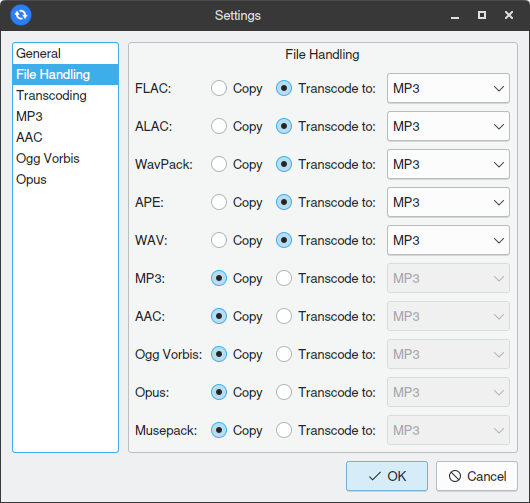
Flacopyus is a CLI tool that mirrors your lossless FLAC library to a portable Opus collection. It performs rsync-like batch mirroring with incremental encoding/copying to save time. It preserves metadata and is idempotent, so repeated runs safely keep the destination in sync.

pypi.org/project/flacopyus/
github.com/curegit/flacopyus

DiscoDOS ~ Discogs Command Line


github.com/JOJ0/discodos
discodos.readthedocs.io/en/latest/index
www.discogs.com/forum/thread/1112957

Music ~ Android Intent Player


A music player, made simple yet customizable for Android.

Music is designed to integrate seamlessly with other apps and system functions through intent filters, enabling users to play audio files directly from various external sources.

It aims to provide a responsive and user-friendly experience while leveraging Android’s powerful intent-filters.

github.com/feivegian/music

Schism Tracker ~ Create High Quality Music


Schism Tracker is a free and open-source reimplementation of Impulse Tracker, a program used to create high quality music without the requirements of specialized, expensive equipment, and with a unique “finger feel” that is difficult to replicate in part. The player is based on a highly modified version of the ModPlug engine, with a number of bugfixes and changes to improve IT playback.

Where Impulse Tracker was limited to i386-based systems running MS-DOS, Schism Tracker runs on almost any platform that SDL supports, and has been successfully built for Windows, Mac OS X, Linux, FreeBSD, OpenBSD, AmigaOS, BeOS, and even Wii. Schism will most likely build on any architecture supported by GCC4 (e.g. alpha, m68k, arm, etc.) but it will probably not be as well-optimized on many systems.

schismtracker.org
github.com/schismtracker
Schism Tracker Tutorial on YouTube
en.wikipedia.org/wiki/Impulse_Tracker

Music Radar ~ Linux Music Recognition


Music Radar is a music recognition application for the Linux Desktop.

Features:

  • Can identify song’s title, artist, albums, albumArt etc.
  • Record from Microphone or sound coming from other applications on your system.
  • Saves history of what you have searched.
  • Allows playing preview of identified song, Search it on Youtube, Open it directly in Spotify etc.
  • Dark theme support.

github.com/keshavbhatt/music-radar

Cavasik ~ CAVA Based Audio Visualizer


This is an audio visualizer based on CAVA with extended capabilities.

Features:

  • Change background and foreground colors through a DBus interface!
  • Five normal drawing modes!
  • Two circle drawing modes!
  • Three mirror drawing modes!
  • Four drawing directions!
  • Customizable LibAdwaita interface!
  • Set a single color or up to a 10 color linear gradient for background and foreground!
  • Select different foreground colors for the mirrored images in mirror mode!
  • Set up a color animation that changes the colors gradually in a loop!
  • Configure smoothingnoise reduction and a few other CAVA settings!

github.com/TheWisker/Cavasik
flathub.org/apps/io.github.TheWisker.Cavasik

MPZ ~ Music Player For Big Local Collections


Directory tree is your music library

Features 3 columns UI: directory tree (aka library), playlists and tracks from selected playlist. Middle-click on folder or track in the directory view and it will become a playlist an its content will be loaded into tracks view. Create multiple playlists from folders in your library and switch between them quickly. Similar to “Album list” in Foobar2000.

mpz-player.org
github.com/olegantonyan/mpz

Wax ~ Catalog & Play Recordings


Wax is a program for cataloging and playing a collection of music recordings. Wax is able to rip CDs and import downloads so that you can create a sound archive complete with metadata.

Wax is fundamentally different from existing music managers in two important ways. First, the fundamental unit for recordings is a “work”, not a track. A work is usually a collection of tracks. It can encapsulate whatever tracks you choose. In pop music, a work can be an album. For symphonic music, a work can be a single symphony, even when the tracks come from a CD with more than one symphony. For operas, a work can be a single opera even when the tracks come from multiple CDs. Music collectors usually think in terms of works, so a music manager that supports the concept makes operation more natural.

The other distinguishing characteristic of Wax is that genres are fundamental to the organization of a collection rather than a mere attribute of a track. Wax recognizes that the ideal way to catalog works varies by genre. For example, symphonic works can be cataloged by composer, work, conductor whereas shows can be cataloged by show, composer, lyricist. By organizing collections around genres, Wax supports an operation sequence that is natural for music lovers: first select the genre, then the work, and finally the tracks.

github.com/jeffbarish/wax
github.com/jeffbarish/wax-install

Cardinal ~ Virtual Modular Synthesizer Plugin


A fully free and self-contained modular synthesizer based on the popular VCV Rack. Available in AudioUnit/CLAP/LV2/VST2/VST3 plugin formats and as a standalone app for FreeBSD, Linux, macOS, Windows and the Web.

cardinal.kx.studio
github.com/DISTRHO/Cardinal

Cavalier ~ Visualize Audio With CAVA


  • 11 drawing modes!
  • Set any single color, a gradient or an image for background and foreground.
  • Configure smoothing, noise reduction and a few other CAVA settings.

github.com/NickvisionApps/Cavalier
Cava ~ Cross-platform Audio Visualizer