shntool ~ WAVE Processing & Reporting Utility


shntool is a multi-purpose WAVE data processing and reporting utility. File formats are abstracted from its core, so it can process any file that contains WAVE data, compressed or not – provided there exists a format module to handle that particular file type.

shntool has native support for .wav files. If you want it to work with other lossless audio formats, you must have the appropriate helper program installed. The “Helper programs” section below contains links to helper programs for each format that shntool supports.

shnutils.freeshell.org/shntool
github.com/bayun/shntool

Splitting A Single Album File Into Tracks


Convert an album from a single media file with a .cue file to individual tracks instead.

Option 1: foobar2000 (easy, very reliable)

If you already use foobar2000, this is usually the best choice.

Steps

  1. Open foobar2000
  2. Drag either the .cue file or the .flac file into foobar
    • If the CUE is correct, you’ll see the album broken into tracks.
  3. Select all the tracks
  4. Right-click → Convert → …
  5. Choose:
    • Output format: FLAC
    • Processing: none needed
  6. Click Destination
    • Output path: your album folder
    • File name pattern (example): %tracknumber% - %title%
  7. Convert

Result

  • Individual FLAC tracks
  • No quality loss (bit-perfect split)
  • Metadata pulled from the CUE

💡 Note: If the cue has gaps or pre-emphasis flags, foobar2000 handles them correctly.


Option 2: CUETools (best for archival accuracy)

If you care about log verification, AccurateRip, or preserving exact offsets, this is the gold standard.

Steps

  1. Download CUETools
  2. Open it and load the .cue file
  3. Set:
    • Action: Encode
    • Audio Output: FLAC
    • Mode: Tracks
  4. Start

Result

  • Sample-accurate track splits
  • Excellent for archival rips
  • Strong metadata handling

This is especially good if the album originated from a CD rip.


Option 3: FLAC + shntool (command line, Linux-friendly)

If you’re on Linux, shntool works well.

Example

shnsplit -f album.cue -o flac album.flac

Then tag the files:

cuetag album.cue *.flac

Result

  • Clean, lossless splits
  • Metadata from CUE applied
  • More manual, but very transparent

Option 4: MusicBrainz Picard (semi-automatic)

Useful if:

  • The CUE has weak or missing metadata
  • You want MusicBrainz tags

Workflow:

  • Load the CUE
  • Let Picard identify the release
  • Use Tools → Split files

Not as precise as foobar or CUETools for offsets, but fine for most albums.

caudec ~ Multiprocess Audio Converter


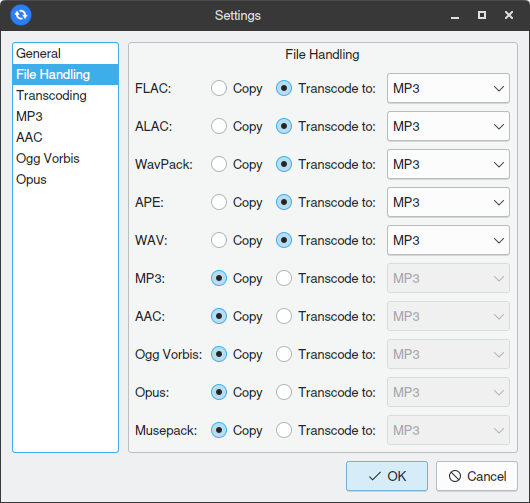
caudec is a command-line utility that transcodes (converts) audio files from one format (codec) to another, among other things.

It leverages multi-core CPUs and runs multiple processes concurrently (one per file and per codec, and more than one thread per codec when it supports it). The objective is to hog the CPU as much and as long as possible. One strategy is to sort input files by size, so that the largest files potentially get more threads towards the end of the job.

Features:

  • Supported input formats / codecs: WAV, AIFF, CAF, FLAC, WavPack, Monkey’s Audio, ALAC.
  • Supported output formats / codecs: all of the above, as well as LossyWAV / LossyFLAC, MP3, AAC (.m4a), Ogg Vorbis, Opus.
  • Supported platforms: macOS, Linux.
  • Transcoding to several different codecs at once is possible. In that case, decoding of input files is done only once.
  • Metadata is preserved (as much as possible) from one codec to another.
  • Artwork can be embedded into each file, and / or copied to the output directory. It can be done selectively (e.g. embed and / or copy one image for lossless files, and another image for lossy files).
  • Audio can be resampled (e.g. 48kHz to 44.1kHz) and downmixed (e.g. 6 channels to stereo). A profile can be provided to set a maximum value for the number of channels, bit depth and sampling rate. When a profile is provided, the source will only be altered after decoding and before encoding, if some metric of the source is above the given profile.
  • Multiprocess ReplayGain scanner for FLAC, WavPack, MP3, Ogg Vorbis, Opus.
  • Ability to hard link lossy files to a different directory when encoding to WavPack Hybrid. The point is to have two libraries that takes the storage of just one, with a lossy collection that has its own root directory and that’s easy to drag and drop to a device such as a smartphone or a Digital Audio Player (DAP).
  • Ability to touch files and album directories using metadata to reflect the music’s release date and duration (see example below).

github.com/gcocatre/caudec

ZuseMe ~ Last.fm Client


ZuseMe allows you to scrobble songs to Last.fm from players like Groove Music, Media Player (Windows 11) and more.

github.com/dumbie/ZuseMe

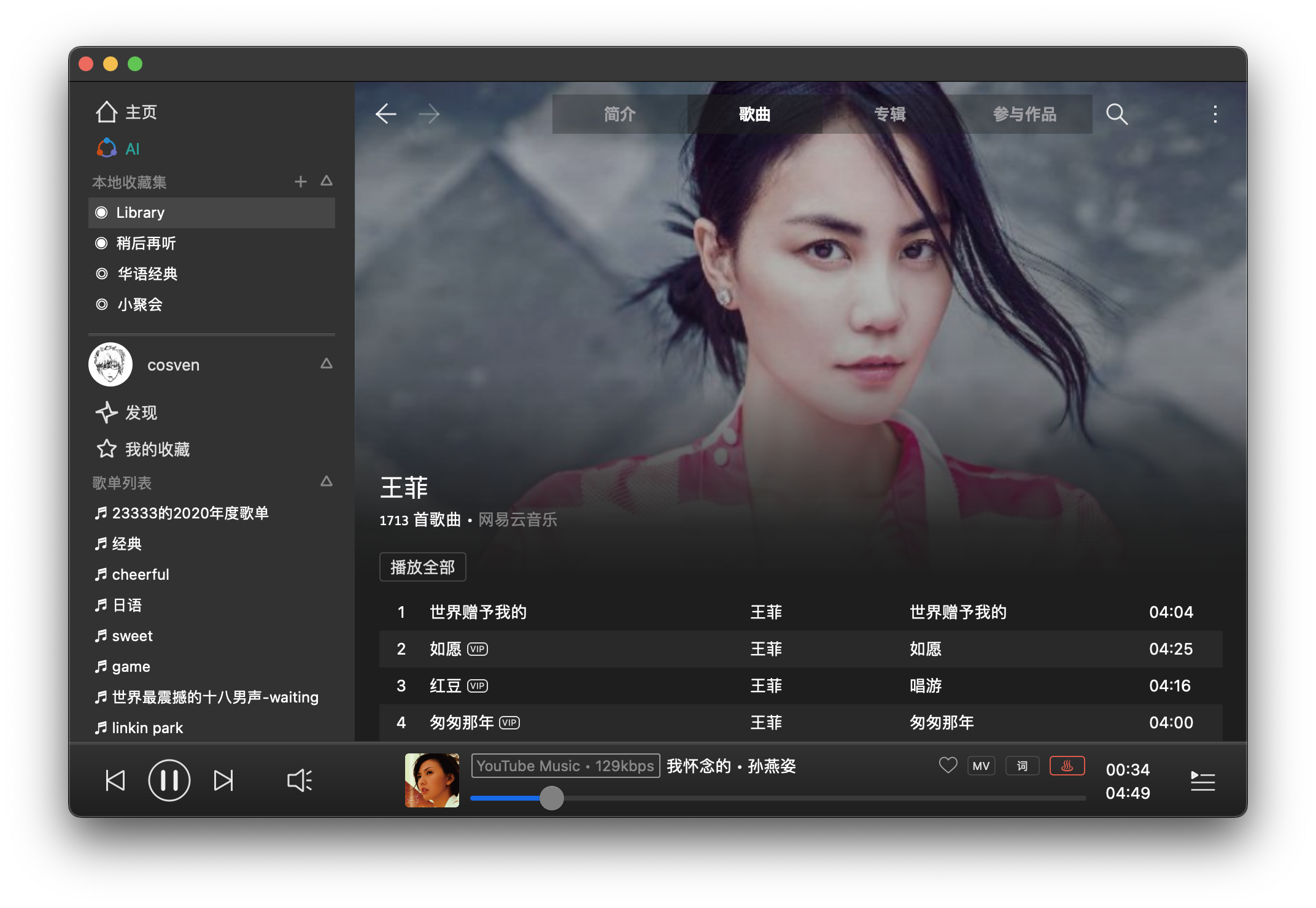
Harmonoid ~ Play & Manage Music Library


Plays & manages your music library. Looks beautiful & juicy.

Features:

  • Fluid animations & beautiful design, everywhere you navigate
  • It’ll find lyrics or give your own .LRC files
  • Closely paired to work together. Windows & Linux
  • Experience the consistent Material Design
  • Music library management based on metadata tags
  • Capable of indexing 30+ files/second & saves cache for future app start-ups
  • Very strictly follows Material Design guidelines for UI & animations
  • Taskbar & System Media Transport Controls for Windows
  • Small installer (≈ 35 MB) & low RAM usage (≈ 150 MB)
  • Discord RPC integration with album art support & “Find”/”Listen” buttons

harmonoid.com
github.com/harmonoid
sourceforge.net/projects/harmonoid.mirror
itsfoss.com/harmonoid

Zenamp ~ Player With Visualizations & Games


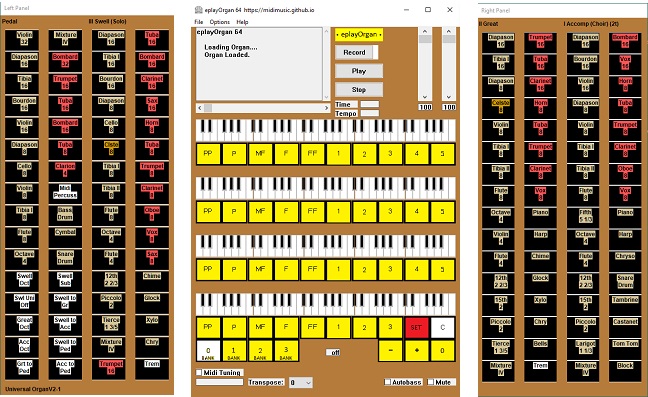
Multi-format audio player with MIDI, minigames, playlists & many visualizations

Lightweight GTK3 audio player supporting MIDI, WAV, MP3, OGG, FLAC, AIFF, and Opus formats. Features OPL3 FM synthesis for authentic MIDI playback, drag-and-drop playlist queue, real-time spectrum visualization, 10-band equalizer, and M3U playlist support. Built with SDL2 audio backend for cross-platform compatibility across Linux and Windows. Includes intuitive controls with keyboard shortcuts, 5-second seek buttons, and efficient format conversion. Perfect for musicians and audio enthusiasts needing reliable playback of both modern and legacy audio formats. Multi-threaded architecture ensures smooth performance. MIT License.

Features:

  • Music Player
  • Queue Support
  • Playlist Support
  • Visualizations
  • Minigames

sourceforge.net/projects/midiplayer
apps.microsoft.com/detail/9p7ddq785vq2

Foobar2000 ~ Album & Artist Artwork


Foobar2000 displays artwork in a panel which can be added and configured to suit your preferences. The artwork panel displays the image file associated with an audio track. If the standard options are insufficient, Foobar’s image handling can be extended via additional components.

To add an artwork panel to the default user interface (DUI), Enable Layout Editing Mode from the menu View > Layout. Add the Album Art Viewer from the Selection Information section.

Context Menu (Right Mouse Button On Artwork Panel)
Selecting the Album Art Viewer on the Add New UI Element menu

Album Art Viewer (built-in)

Sources:

  • Embedded tags (front, back, disc, artist, etc.)
  • External image files (folder.jpg, cover.png, etc.)

Notes:

  • Supports multiple artwork types.
  • Very stable, but basic (no advanced layout or scripting).
  • Artist art is only shown if tagged or present as files.
Foobar2000 Artwork Display Context Submenu

Context Menu

Display Components (Artwork panels)

foo_ui_columns (Columns UI)

Displays: Album & artist art
Sources: Embedded tags and external files

Notes:

  • Legacy but still widely used.
  • Artwork panels are static (no scripting).
  • No longer actively developed, but stable.

Resources:

CLAMPS ~ Common Lisp Aided Music Production System


Clamps, short for “Common Lisp Aided Music Production System”, is a software system for realtime and non-realtime music production written in Common Lisp. It enables a seamless workflow between high-level structures to define musical processes all the way down to low level DSP definitions for sound creation including browser based interfaces for interactive work and control useable for live performances. In that respect it combines features of systems like OpenMusic, SuperCollider or the Pure Data/Max family of software.

codeberg.org/ormf/clamps
codeberg.org/ormf/clamps-install
github.com/arclanguage/Clamp

Namida ~ Android Media Player


A Beautiful and Feature-rich Android Music & Video Player with Youtube Support, Built in Flutter.

Namida Interface

github.com/namidaco/namida

Rusty Pipes ~ Virtual Pipe Organ


Rusty Pipes is a digital organ instrument compatible with GrandOrgue sample sets. It features both graphical and text-based user interface, can be controlled via MIDI and play back MIDI files. Rusty Pipes can stream samples from disk instead of load them into RAM, though a RAM precache mode similar to GrandOrgue and Hauptwerk is available too.

rusty-pipes.com
github.com/dividebysandwich/rusty-pipes
en.wikipedia.org/wiki/GrandOrgue

OpenMusic ~ Music Composition Language


OpenMusic (OM) is a visual programming language based on Common Lisp. Visual programs are created by assembling and connecting icons representing functions and data structures. Most programming and operations are performed by dragging an icon from a particular place and dropping it to an other place. Built-in visual control structures (e.g. loops) are provided, that interface with Lisp ones. Existing CommonLisp/CLOS code can easily be used in OM, and new code can be developed in a visual way.

OM may be used as a general purpose functional/object/visual programming language. At a more specialized level, a set of provided classes and libraries make it a very convenient environment for music composition. Above the OpenMusic kernel, live the OpenMusic Projects. A project is a specialized set of classes and methods written in Lisp, accessible and visualisable in the OM environment. Various classes implementing musical data / behaviour are provided. They are associated with graphical editors and may be extended by the user to meet specific needs. Different representations of a musical process are handled, among which common notation, midi piano-roll, sound signal. High level in-time organisation of the music material is proposed through the concept of “maquette”.

openmusic interface

openmusic-project.github.io
openmusic-project.github.io/openmusic
github.com/openmusic-project
en.wikipedia.org/wiki/OpenMusic

OM-SoX

OM-SoX is a library for multichannel audio manipulation and functional batch processing for OpenMusic, a visual programming environment based on CommonLisp / CLOS.

sourceforge.net/projects/omsox

Partiels ~ Audio Analysis Application


Partiels is an audio analysis application that allows you to explore the content and characteristics of sounds.

Features:

Partiels allows analysis of one or several audio files using Vamp plug-ins loading data files, visualizingeditingorganizing, and exporting the results as images or text files that can be used in other applications such as Max, Pure Data, Open Music, etc.

  • Windows, Mac & Linux support
  • Multiformat support
  • Multichannel support
  • Multiaudiofile support
  • Analyzing audio with Vamp plug-ins
  • Visualizing results as spectrogram, lines, and markers
  • Textual and graphical editing of results 
  • Organizing and ordering analyses in groups
  • Exporting results to PNG, JPEG, CSV, LAB, JSON, CUE, REAPER & SDIF formats
  • Loading results from CSV, LAB, JSON, CUE & SDIF formats
  • Batch processing
  • Command line interface to analyze, export, and convert results
  • Consolidating documents for sharing

Alongside Partiels, a wide range of analyses based on audio engines developed at IRCAM and outside are ported to Vamp plug-ins. These plug-ins allow you to perform FFT, LPC, transient, fundamental, formant, tempo, TTS and many other analyses. You can also find a large number of analysis plug-ins on the Vamp plug-ins website.

github.com/Ircam-Partiels
www.vamp-plugins.org