
A reusable Win32 text input control for foobar2000 title-format expressions, built as footilla.lib. Ships a Footilla-maintained copy of the Scintilla editing engine used by SciTE, with Footilla’s own title-format container lexer, completion catalog and call tips. The engine’s object files are included in the library: no Scintilla DLL, Lexilla DLL, SciTE executable, WTL runtime or foobar2000 SDK is required.
Tag Archives: development

acidcat ~ Audio File Forensics
A pure-Python inspector, editor, and forensic tool for audio files and synth/DAW presets: read the metadata, decode the format structure byte by byte, flag anomalies, repair broken containers, and identify how a file was made.
Reads BPM, key, duration, tags, and format info from WAV, AIFF, MP3, FLAC, OGG, Opus, M4A, MIDI, and Serum presets. Also structurally decodes Bitwig (.bwpreset/.bwclip), Native Instruments (Massive/Absynth/Kontakt/NKS/KORE), Vital, NCW, SoundFont (SF2/SF3), tracker modules (MOD/XM/IT), MP4, VST FXP, ReCycle RX2, and RMID containers via
inspect. Beyond reading:repairandvalidatefix and check container structure (stale sizes, offset tables, counts, pad bytes) without touching a byte of audio, andauditgives a forensic verdict (structure, integrity, hidden data, and the writing tool). One pure-Python dependency (mutagen); the nativeinspectwalkers need nothing. Optional librosa analysis for BPM/key detection and ML feature extraction.Also ships per-library SQLite indexes (
acidcat index) tracked in a small global registry, plus an MCP server (acidcat-mcp) so an LLM can query your whole collection across libraries by bpm, key, tags, or full-text.
github.com/hed0rah/acidcat
github.com/hed0rah/acidcat-playground
www.databurn.org
Share this:

SDIF ~ Sound Description Interchange Format
The Sound Description Interchange Format (SDIF) is an established standard for the interchange of sound descriptions and analysis data. This project provides libraries, SDIF (in C) and Easdif (in C++), tools, and wrappers to read and write SDIF files.
sourceforge.net/projects/sdif
cnmat.berkeley.edu/library/sdif
en.wikipedia.org/wiki/SDIF
groups.google.com/g/sdif-forum
Share this:

RxFFmpeg ~ Android Development Framewok
RxFFmpeg is a high-performance multimedia processing framework built on top of FFmpeg and optimized specifically for Android environments, enabling developers to perform complex audio and video editing operations programmatically. It integrates widely used encoding libraries such as x264, mp3lame, and fdk-aac, allowing it to support a broad range of media formats and transformations. The framework provides a wrapper around FFmpeg commands, making it easier to execute advanced media operations without directly handling low-level command syntax. It supports both synchronous and asynchronous execution, enabling developers to manage long-running media tasks efficiently within mobile applications. The system also includes features like hardware acceleration through MediaCodec, significantly improving performance on supported devices. Its design focuses on flexibility, allowing users to perform tasks such as transcoding, clipping, filtering, and compositing media with minimal overhead.
Features:
- Callback system for tracking execution progress
- Execution of FFmpeg commands through a simplified interface
- Support for synchronous and asynchronous media processing
- Hardware acceleration using MediaCodec
- Wide range of video and audio editing capabilities
- Integration with multiple encoding libraries
github-com.translate.goog/microshow/RxFFmpeg
sourceforge.net/projects/rxffmpeg.mirror
Share this:

GNU Radio ~ Software Radio Ecosystem
GNU Radio is a free & open-source software development toolkit that provides signal processing blocks to implement software radios. It can be used with readily-available low-cost external RF hardware to create software-defined radios, or without hardware in a simulation-like environment. It is widely used in research, industry, academia, government, and hobbyist environments to support both wireless communications research and real-world radio systems.
wiki.gnuradio.org/index.php?title=What_Is_GNU_Radio
GNU Radio is a free software development toolkit that provides signal processing blocks to implement software-defined radios and signal processing systems. It can be used with external radio frequency (RF) hardware to create software-defined radios, or without hardware in a simulation-like environment. It is widely used in hobbyist, academic, and commercial environments to support both wireless communications research and real-world radio systems.
en.wikipedia.org/wiki/GNU_Radio
Share this:

Cmajor ~ Audio Programming Language
The programming language for writing fast, portable audio software.
You’ve heard of C, C++, C#, objective-C… well, Cmajor is a C-family language designed specifically for writing DSP signal processing code.
Our goal is to improve on the current status-quo for audio development in quite a few ways:
- To match (and often beat) the performance of traditional C/C++
- To make the same code portable across diverse processor architectures (CPU, DSP, GPU, TPU etc)
- To offer enough power and flexibility to satisfy professional audio tech industry users
- To speed-up commercial product cycles by enabling sound-designers to be more independent from the instrument platforms
- To attract students and beginners by being vastly easier to learn than C/C++
If you’re keen to learn the nitty-gritty of the language itself, the language guide offers a deep dive. To see some examples of the code, try the examples folder.
Share this:

Incudine ~ Lisp Music & DSP Programming
Incudine is used to design software synthesizers or sound plugins from scratch, exploiting the expressive power of Common Lisp, without the constraints of using pre-built unit generators. It is also a compositional tool that produces high quality sounds, controllable at the sample level, while defining and redefining the digital signal processors and the musical structures on-the-fly.
incudine.sourceforge.net
sourceforge.net/projects/incudine
github.com/topics/incudine
github.com/titola/incudine
github.com/azimut/incudine-cepl
www.cliki.net/Incudine
Share this:

Resonance Audio ~ Spatial Audio SDK
Resonance Audio is a multi-platform spatial audio SDK, delivering high fidelity at scale. This powerful spatial audio technology is critical to realistic experiences for AR, VR, gaming, and video. Resonance Audio simulates how sound waves interact with human ears and their environment.
resonance-audio.github.io/resonance-audio/discover/overview
github.com/resonance-audio
www.blog.google/products/google-vr/resonance-audio-multi-platform-spatial-audio-scale/
Share this:

Cabbage ~ Audio Instrument Development
Cabbage is a software for prototyping and developing audio instruments with the Csound audio synthesis language. Instrument development and prototyping is carried out with the main Cabbage IDE. Users write and compile Csound code in a code editor. If one wishes one can also create a graphical frontend, although this is no longer a requirement for Cabbage. Any Csound file can be run with Cabbage, regardless of whether or not it has a graphical interface. Cabbage is designed for realtime processing in mind. It is possible to use Cabbage to run Csound in the more traditional score-driven way, but your success may vary.
Cabbage is a ‘host’ application. It treats each and every Csound instrument as a unique audio plugin, which gets added to a digital audio graph (DAG) once it is compiled. The graph can be opened and edited at any point during a performance. If one wishes to use one of their Csound instruments in another audio plugin host, such as Reaper, Live, Bitwig, Ardour, QTractor, etc, they can export the instrument through the ‘Export instrument’ option.
Share this:

FluidSynth ~ A SoundFont Synthesizer
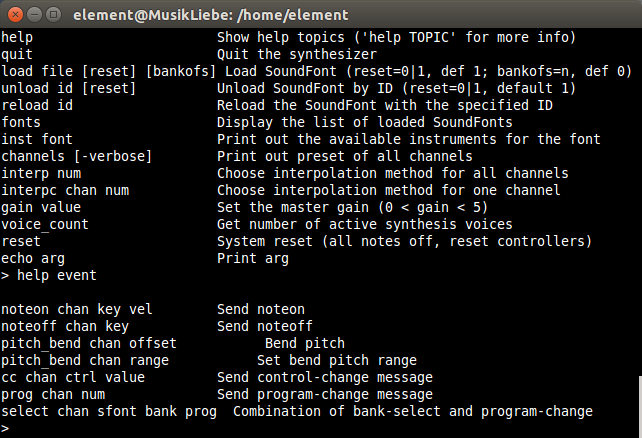
FluidSynth is a real-time software synthesizer based on the SoundFont 2 specifications and has reached widespread distribution. FluidSynth itself does not have a graphical user interface, but due to its powerful API several applications utilize it and it has even found its way onto embedded systems and is used in some mobile apps.
Features:
- Cross platform support (Linux, macOS and Windows to name a few)
- SoundFont 2 support
- SoundFont 3 support (vorbis-compressed SF2)
- Realtime effect control using SoundFont 2.01 modulators
- Playback of MIDI files
- Shared library which can be used in other programs
- Built in command line shell
QSynth ~ FluidSynth GUI Front-end
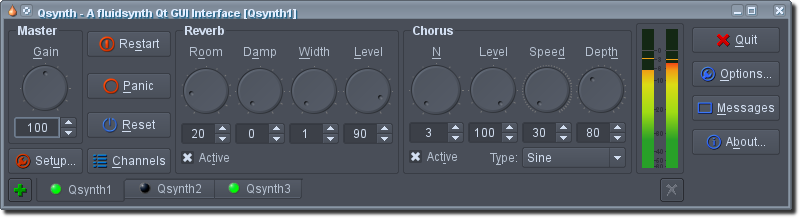
QSynth is a fluidsynth GUI front-end application written in C++ around the Qt framework using Qt Designer.
FluidPatcher ~ GUI & Automation
FluidPatcher is a performance-oriented interface for FluidSynth built using wxpython to create a simple GUI that allows live editing, selecting, and playing of patches. A patch is a collection of settings such as soundfont presets for each MIDI channel, control-change/sysex messages to send when the patch is selected, and midi router or effects settings. Groups of patches are stored in banks, which are saved as human-readable and -editable YAML files. This allows a musician to easily create complex combinations of synthesizer settings ahead of time and switch between them on the fly during a performance.
Features:
- Live playing: Play on your MIDI controller and hear the results
- Customization: Create your own combinations of instruments/effects
- Extendability: Use the included libraries to design your own implementations/software
sourceforge.net/projects/fluidpatcher
Share this:

Bfxr ~ Sound Effects For Computer Games
Bfxr is an elaboration of the glorious Sfxr, the program of choice for many people looking to make sound effects for computer games.
Bfxr has moved in the direction of increased complexity and range of expression. All the buttons that you know and love are here, but there are some new things as well:
- 5 new waveforms : triangle, breaker, tan, whistle, and pink noise.
- 3 new filters : compression, harmonics, and bitcrusher.
- Ability to lock parameters during mutation/randomization.
- Expanded pitch-jumping abilities – good for arpeggiation effects.
- Visualisation
- Mixer
- Keeps your sounds and mixes in persistent lists.
- Can reverse synths
- Ability to link directly to sounds
You have full rights to all sounds made with bfxr, and are free to use them for any purposes, commercial or otherwise.
Share this:

eSpeak ~ Open Source Speech Synthesizer
eSpeak is a compact open source Linux and Windows speech synthesizer for English and other languages. eSpeak uses a “formant synthesis” method. This allows many languages to be provided in a small size. The speech is clear, and can be used at high speeds, but is not as natural or smooth as larger synthesizers which are based on human speech recordings.
eSpeak is available as:
- A command line program (Linux and Windows) to speak text from a file or from stdin.
- A shared library version for use by other programs. (On Windows this is a DLL).
- A SAPI5 version for Windows, so it can be used with screen-readers and other programs that support the Windows SAPI5 interface.
- eSpeak has been ported to other platforms, including Android, Mac OSX and Solaris.


