
A typical stereo records are being made to listen by speakers. That is a sound engineer makes the stereo mix to the adaptation of sound for listening of one channel by both ears. Therefore, you will be tired during a long time headphone listening more by a super-stereo effect than by a poor design of headphones. What’s missing in headphones is the sound going from each channel to the opposite ear, arriving a short time later for the extra distance traveled, and with a bit of high frequency roll-off for the shadowing effect of the head. And the time delay to the far ear is somewhat longer at low frequencies than at high frequencies. The Bauer stereophonic-to-binaural DSP (bs2b) is designed to improve headphone listening of stereo audio records…
Tag Archives: DSP

freeDSP ~ DIY Audio DSP Project
The freeDSP is an open-source digital signal processor family for the do-it-yourself community. The applications range from active loudspeaker concepts (digital crossovers, bass enhancement, …) and room equalization over advanced musical effect processors to car audio signal processing.

Share this:

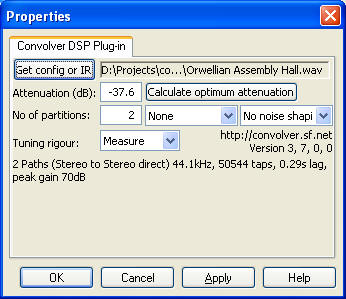
Convolver ~ A Convolution Plugin
Convolver is an open source, high performance Windows application for applying finite impulse response (FIR) filters to multi-channel digital audio in the form of
- a real time DSP audio plug-in (DMO) for Windows Media Player. The install package also contains
- two DirectX / DirectShow filter versions — ConvolverWrapper or the equivalent ConvolverFilter — for Adobe Audition and real time applications such as Zoom Player Pro, TheaterTek 2.2, Windows Media Player Classic, J.River Media Center (when used with the DirectX host plug-in), or Console. See the setup walkthrough for ZoomPlayer after reading this page for further details. In many cases the DMO will also work.
- a VST plug-in version (convolverVST). Finally, there are a number of
- command line applications for testing performance, and convolving files offline, for example. convolverPipe can filter SlimServer playback.
Convolver will take a set of FIR filter files (sound files) and convolve them with sound paths mixed from the input channels, mixing the results into a set of specified output channels.
convolver.sourceforge.net
Download
Documentation


