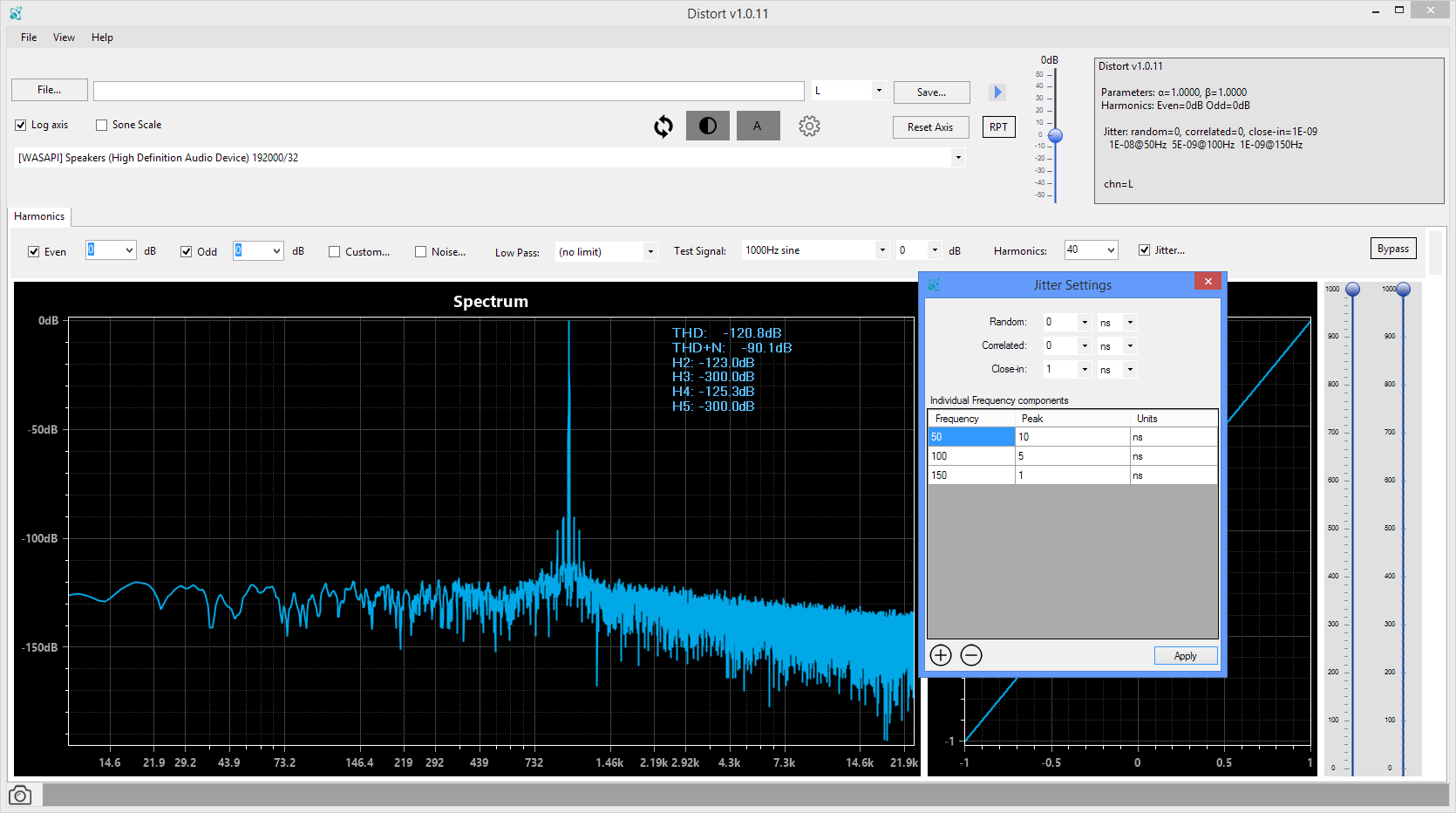
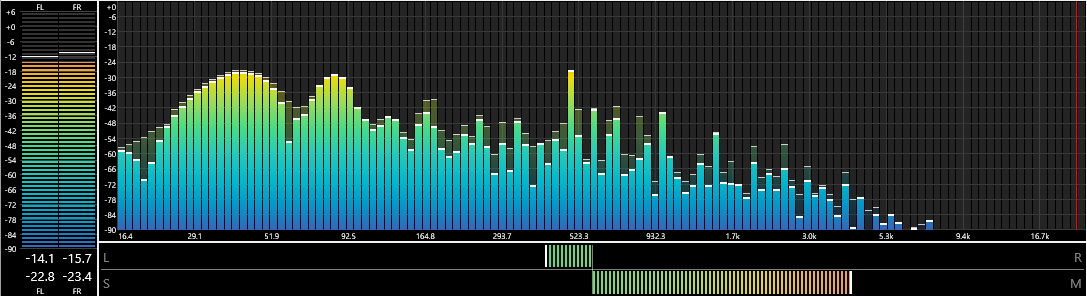
Measures Total Harmonic Distortion (THD) in sound cards, speakers and headphones.
Applies matched filters for maximizing the signal-to-noise ratio (SNR) in the presence of additive stochastic noise.
Supports microphone calibration files.
Supports full range of sample rates from 44.056 kHz up to 384 kHz. All sample rates are supported without resampling to avoid any possible loss in accuracy.
SSE is a powerful and versatile software environment designed for soundscape visualisation and quantification. It provides a robust platform for processing audio files, generating useful metrics, and presenting data through intuitive visualisation interfaces. Catering to bioacousticians and data scientists alike,
SSE encompasses an extensive range of tools and capabilities to fulfil diverse user requirements.
Audio DiffMaker is a freeware tool set intended to help determine the absolute difference between two audio recordings, while neglecting differences due to level difference, time synchronization, or simple linear frequency responses.
The difference recording that results is only what has changed between the two recordings. If anything – a change of component, a treatment, mechanical damping, etc. – is having any audible effect on the audio signal in a system, the difference recording will have audible content. The end result is primarily intended to be evaluated by ear.
Presented at the 125th AES convention. “Detecting Changes in Audio Signals by Digital Differencing“
Axone.jar is a utility allowing you to view all the information available in an MP3 file. This is not to be misunderstood: all the possible information. In the tag version 2 (ID3V2), the information is subdivided into frames and there are many more frames declared than frames actually displayed by MP3 players. Well Axone.jar knows how to display them all, without exceptions and whatever the version!
Very classic frames such as title, album, artist, year, genre, track and comment.
Other frames displayed by only some MP3 players.
the image(s).
the composer.
the text of the song.
volume control (itunes)
The frames that are hidden from you (not necessarily with bad intentions).
Undeclared frames, not understood and therefore clearly hidden from all MP3 players.
The other frames usually not used.
Other data
The Lyrics and TAG+ tags, which are completely obsolete, may remain forgotten in certain files. If they are present, Axone.jar displays them.
When the software reads an MP3 file to display the current tag, it does a summary check of the audio data. It gives you the classic information on bitrate, sampling frequency, duration, etc.; but also if it finds excess or erroneous data. Excess data can be a sign of corrupted audio data, or of data intentionally hidden if the file was purchased on a merchant site (or if you did P2P). At this level, it is important to understand that the audio decoder is robust in the sense that data that is incomprehensible to it is simply skipped. It is therefore very easy to hide data between audio data, without risking disturbing MP3 players.
This application can be used to find artifacts in audio files generated by signal processors. It analyses the signal variance across the audio duration, then generates a graph of the results.
The following types of audio can analysed: * Music * Sine Tones * Noise (White, Pink, etc)
If the audio recording is split across multiple files, they can be loaded into this application collectively and will be treated as a single stream. Multiple batches can also be loaded, in order to process multiple recordings in one continuous operation. The scanners can only process audio files up to 2.5GB, but the file splitter function can be used to break up large files into smaller ones.