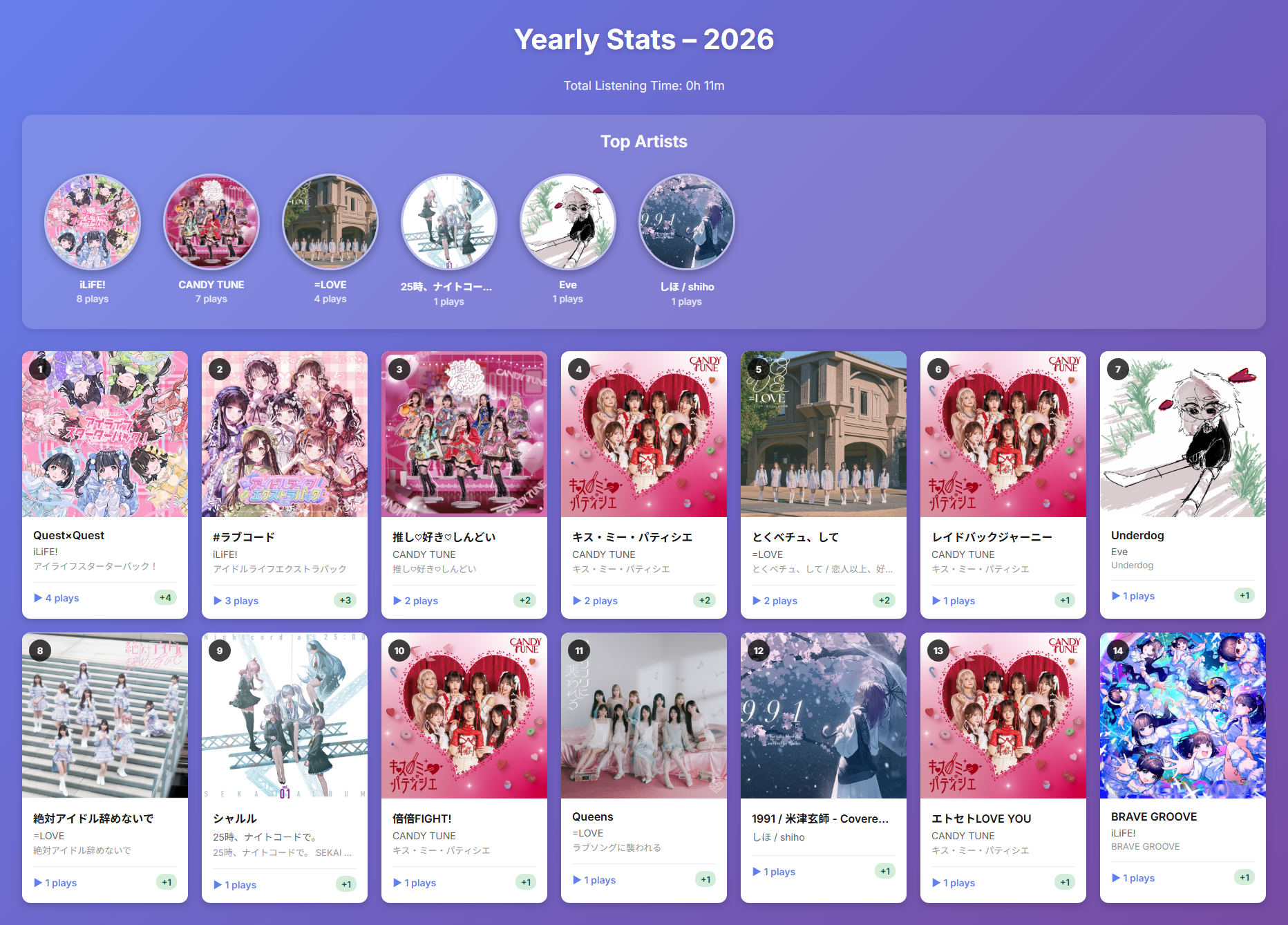
Because what’s the point in listening to music if you can’t let others know? Use our generator to create astonishing album and artist collages based on your Last.fm charts!
eyeD3 is a Python tool for working with audio files, specifically MP3 files containing ID3 metadata (i.e. song info).
It provides a command-line tool (eyeD3) and a Python library (import eyed3) that can be used to write your own applications or plugins that are callable from the command-line tool.
Before ID3v2 came around, Lyrics3 and Lyrics3v2 had their uses (extending the 30-char limit, placing synced lyrics), but nowadays they are a nuisance for most of us. Plus, we have the lyrics frames USLT and SYLT in ID3v2.
Lyrics3 tags come between the audio data and an ID3v1/ID3v1.1 tag at the end of the file (sometimes without the following ID3v1 tag, even if that is mandatory according to Lyrics3 specs). Current ffmpeg and some players and tools still have bugs and try to interpret Lyrics3 tags as audio data, resulting in obscure errors. Unfortunately, there are almost no tools out there to remove Lyrics3 tags—most programs ignore them, but write them back if changing tags. When removing ID3v1 tags from a file, this can result in the illegal situation mentioned above (having a Lyrics3 tag without a following ID3v1 tag)..
This code has been tested with thousands of files but I can give no guarantees. If you destroy your whole music collection, it’s not my fault. Please have a backup!
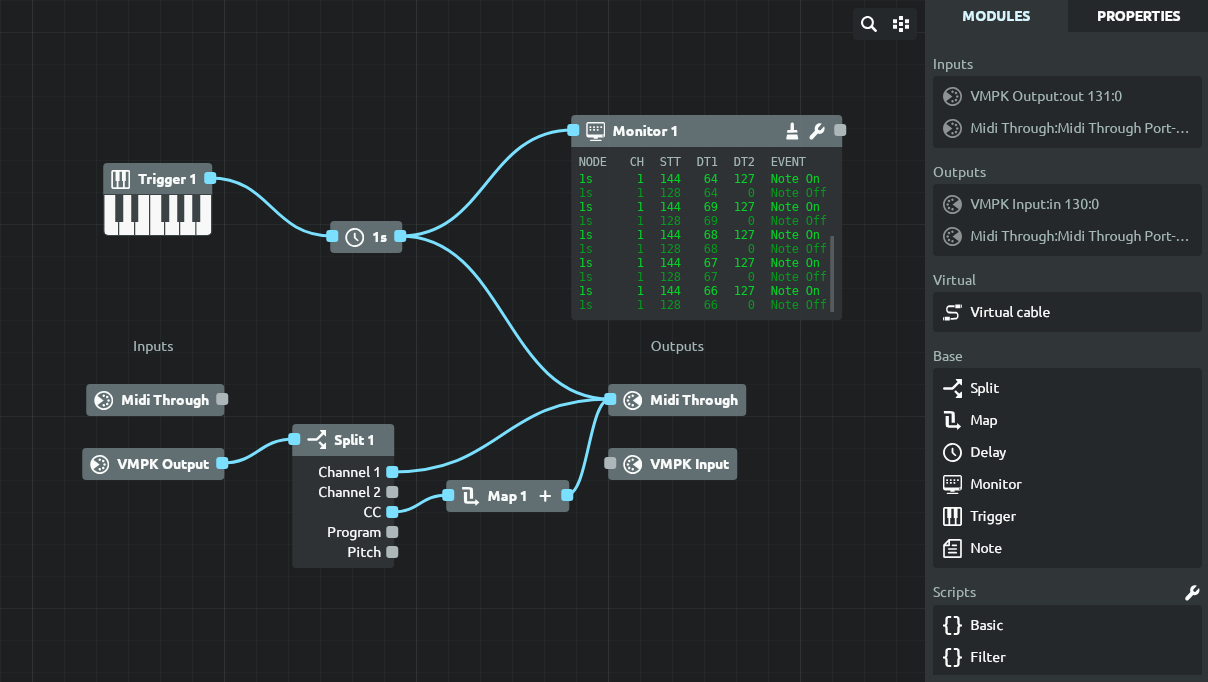
The VB-Audio Matrix is an audio framework to connect everything together, channel by channel: Several ASIO devices, several Windows devices, several audio Applications and DAW, several Computers.
Now with the VB-Audio Matrix, all audio streams can be managed, routed and mixed together, from your USB MIC to any ASIO devices, from your ASIO device to any audio applications, to or from Voicemeeter to Discord, Zoom or Ableton Live, to or from all other computer thanks to VBAN streaming features… All connections will be possible channel by channel.
Unlike a lot of people, I strangely like to have my individual non-mixed tracks located in one flat folder and any mixes (such as Ministry Of Sound mix albums, etc…) go into another folder sorted by Albums in separate folders. I also embed all of my MP3s with the album art from the album it is from so they are fully portable across a multi-tude of systems.
Therefore, I want my original system kept as is for me, but software like Windows Media Center annoyingly requires you to have it structured in the ‘Album Artist -> Album’ directory structure with the album art stored as ‘Folder.jpg’.
I will not be ranting about how rubbish that required structure is on a technical level; I have got over that now :). But instead, I wrote a PERL script that runs on my Linux NAS that does the following:
Only runs on Linux – if anyone wants to code link support in for Windows / NTFS partitions, please go ahead and mail back the changes.
Scans a directory (–mp3dir) (recursion is optional using –recursive) for MP3s / M3U playlists and creates softlinks pointing back to the original files under the ‘Album Artist\Album’ folder structure within –linksdir.
The embedded album art is then checked across the album being processed to ensure it is the same – if not, a Warning is output leaving you to fix it. The embedded album art is created as ‘Folder.jpg’ for Windows Media Center.
If you want it to delete soft links for tracks / directories that no longer exist in –linksdir (i.e. if you have moved / renamed the original file), you can use –delnonexists.
On the off chance you want the –linksdir within the directory structure of –mp3dir, you can use –excludemp3dir to ensure the –linksdir isn’t double scanned.
For the first run, I strongly recommend not using the –createlinks switch so you can view any errors you may get.
You need to have the library MP3::Tag installed for this to run – you can get this from CPAN.
tone is a cross platform audio tagger and metadata editor to dump and modify metadata for a wide variety of formats, including mp3, m4b, flac and more. It has no dependencies and can be downloaded as single binary for Windows, macOS, Linux and other common platforms.
The code is written in pure C# and utilizes the awesome atldotnet library to provide full support for a wide variety of audio and metadata formats.
Features:
The main purpose of tone is to tag m4b audio books for myself. It is planned as a successor to [m4b-tool].
dump metadata of audio files
different metadata formats (e.g. chptfmtnative, ffmetadata, etc.)
file information (bitrate, channels, duration, etc.)
support for filterable json output (similar to jq)
extensive list of supported tags (default fields like album or *artist as well as custom fields, covers, chapters, etc.)
tag audio files with different kinds of metadata
different file formats (e.g. mp3, m4b, and flac)
extensive list of supported tags (default fields like album or *artist as well as custom fields, covers, chapters, etc.)
filename to tags via --path-pattern (see below)
custom javascript taggers via --script and --script-tagger-parameter
I wrote this because I wanted a command line tool that could add album art to (and save from) mp3 files, compute replaygain and save them as ID3 tags (readable by Winamp, etc).
Features:
Write (all) Text, URL and Picture frame tags, with description.
Compute replay-gain values and set them as ID3v2.3 tags.
Apply and Undo volume gain (as mp3gain).
Extract pictures from mp3 files.
Inspect ID3 v1.1, v2.3, and v2.4 tags.
Inspect detailed info on mp3 files, including lametag data.
Tksolfege is an ear training program for learning to recognize chords, intervals, perform rhythm dictation, solfege dictation and singing solfege sequences. The program requires Tcl/Tk 8.4, however the Windows executable has Tcl/Tk builtin.
Features:
The program contains ear training exercises for the identification of chords, musical intervals, key signatures, musical scales, and cadences.
Do you miss the days of filling up your computer’s hard drive with MP3 files, burning CDs with your favorite party mixes, the glam and grunge fashion styles, waiting every week for the latest episodes of Friends and Sex And The City (sorry, no binging on streaming episodes), and all that came with the 90s? Do you wish the WordPress core blocks offered you more styles to match your interests? Then look no further because this plugin transforms a bland audio block into a llama-riffic Winamp-styled audio block!