Incudine is used to design software synthesizers or sound plugins from scratch, exploiting the expressive power of Common Lisp, without the constraints of using pre-built unit generators. It is also a compositional tool that produces high quality sounds, controllable at the sample level, while defining and redefining the digital signal processors and the musical structures on-the-fly.
ESP32 headless acid combo of tb303 + tb303 + tr808 like synths. Filter cutoff, reso, env mod, accent, wavefolder, overdrive within each 303, per-instrument tunings, hi-pass/lo-pass filter and bitcrusher in drums, send to reverb, delay and master compression. All MIDI driven. 44100, 16bit stereo I2S output to the external DAC or 8bit to the built-in DAC. No indication. Uses both cores of ESP32. Cheap ~$10. Consult with midi_config.h to find out and to set up MIDI continuous control messages.
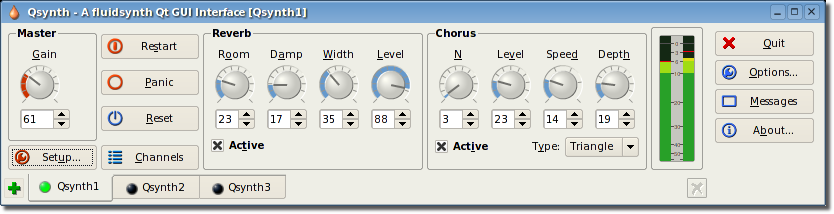
Qsynth is a fluidsynth GUI front-end application written in C++ around the Qt framework using Qt Designer. Eventually it may evolve into a softsynth management application allowing the user to control and manage a variety of command line softsynth but for the moment it wraps the excellent FluidSynth. FluidSynth is a command line software synthesiser based on the Soundfont specification.
Efflux is an application that allows users to create music inside their browser. Efflux is a tracker and follows conventions familiar to those who have used anything from Ultimate Soundtracker to Renoise. All sounds are oscillator (or wave table) based and can be routed through an effects signal path, making Efflux a modular synthesis environment, where the synths are driven by the tracker.
SuperCollider is a platform for audio synthesis and algorithmic composition, used by musicians, artists, and researchers working with sound. It consists of:
scsynth, a real-time audio server with hundreds of unit generators (“UGens”) for audio analysis, synthesis, and processing
supernova, an alternative server to scsynth with support for parallel DSP on multi-core processors
sclang, an interpreted programming language that controls the servers
scide, an editing environment for sclang with an integrated help system
sclang comes with its own package manager, called Quarks. scsynth and supernova both support third-party plugins via C and C++ APIs.
This software integrates a small specialized synthesizer and vocal processor. It can be used to learn Byzantine Church singing. You can play from the keyboard, mouse or touch screen. MIDI input is also available. Voice functions include: pitch highlighting, synthesizer control by voice, pitch correction and voice-to-ison conversion.
On the screen there are labels with symbols of Byzantine notes. There is a metronome. The program is oriented on the Chrysanthos tuning of the diatonic scale: 9/8 – 12/11 – 88/81. The octave is divided into 17 (or 19) non-equal parts, it allows you to get all the Byzantine modes.
Features:
No installation required
Metronome
Different channels for melos and isokratima
MIDI input
17 (or 19) non-equal steps per octave: same tuning for all scales
Voice functions: highlight key, synthesizer control by voice, pitch correction, voice-to-ison conversion
Record audio
Training mode
Cross-platform: may be compiled on any platform, supported by Qt 4.x or 5.x
It forgets history, To not repeat it. It doesn’t hide analog music hardware, In digital music software. You had pulse, sine, triangle and sawtooth, And went forth and made electronic music. Now there is just the Bezier curve. Go make your pulse, sine, triangle and sawtooths. Or this, this, this and this. TOPLAP Nick thinks this is nothing new, His old men did it in the 60s, Punching numbers into cards. Now you edit waveforms with a GUI, And watch the sound change before your ears. Has it got ADSR? It’s got DADSARSADS. Filters? No because Additive not Subtractive. Modulation? Bezier on Carrier and Modulator. Wolf that Chowning. Notes? Yes + Infinite microtones in between. Input? MIDI Keyboard. Computer keyboard.