Satunes is an mp3 player on Android. Use it to listen your music from your audio files stored in your Android phone (Android Lollipop 5.1.1 and later).
This entire project is under GNU/GPL v3 and it’s applied on all versions of this project (even the code pushed from the very first commit.)
Fully accessible cross-browser HTML5 media player.
Features:
Supports both audio and video.
Supports either a single audio track or an entire playlist.
Includes a full set of player controls that are keyboard-accessible, properly labeled for screen reader users, and controllable by speech recognition users.
Includes customizable keyboard shortcuts that enable the player to be operated from anywhere on the web page (unless there are multiple instances of the player on a given page; then the player must have focus for keyboard shortcuts to work).
Features high contrast, scalable controls that remain visible in Windows High Contrast mode, plus an easy-to-see focus indicator so keyboard users can easily tell which control currently has focus.
Supports closed captions and subtitles in Web Video Timed Text (WebVTT) format, the standard format recommended by the HTML5 specification.
Supports chapters, also using WebVTT. Chapters are specific landing points in the video, allowing video content to have structure and be more easily navigated.
Supports text-based audio description, also using WebVTT. At designated times, the description text is read aloud by browsers, or by screen readers for browsers that don’t support the Web Speech API. Users can optionally set their player to pause when audio description starts in order to avoid conflicts between the description and program audio.
Supports audio description as a separate video. When two videos are available (one with description and one without), both can be delivered together using the same player and users can toggle between the versions.
Supports adjustable playback rate. Users who need to slow down the video in order to better process and understand its content can do so; and users who need to speed up the video in order to maintain better focus can do so.
Includes an interactive transcript feature, built from the WebVTT chapter, caption and description files as the page is loaded. Users can click anywhere in the transcript to start playing the video (or audio) at that point. Keyboard users can also choose to keyboard-enable the transcript, so they can tab through its content one caption at a time and press enter to play the media at the desired point.
Features automatic text highlighting within the transcript as the media plays. This feature is enabled by default but can be turned off if users find it distracting.
Supports YouTube and Vimeo videos.
Provides users with the ability to customize the display of captions and subtitles. Users can control the font style, size, and color of caption text; plus background color and transparency; all from the Preferences dialog. They can also choose to position captions below the video instead of the default position (an semi-transparent overlay).
Supports fallback content if the media cannot be played (see section on Fallback for details).
Includes extensive customization options. Many of the features described above are controlled by user preferences. This is based on the belief that every user has different needs and there are no one-size-fits-all solutions. This is the heart of universal design.
The plugin is very unique in the sense that it gives you full control over all aspects of the modelled circuit. All values of all the capacitors, resistors etc. can be tuned by the user.
This is a free plugin. It comes in all the usual plugin formats (VST/VST3/AU/AAX), for 32 and 64 bit hosts, and for Mac Intel & Silicon.
SSE is a powerful and versatile software environment designed for soundscape visualisation and quantification. It provides a robust platform for processing audio files, generating useful metrics, and presenting data through intuitive visualisation interfaces. Catering to bioacousticians and data scientists alike,
SSE encompasses an extensive range of tools and capabilities to fulfil diverse user requirements.
FluentFlyout is a simple and modern audio flyout for Windows, built with Fluent 2 Design principles. The UI seemingly blends in with Windows 10/11, providing you an uninterrupted, clean, and native-like experience when controlling your media.
FluentFlyout features smooth animations, blends with your system’s color themes, includes multiple layout positions and a suite of personalization settings while providing media controls and information in a nice and modern looking popup flyout.
Features:
Native Windows-like design
Uses Fluent 2 components
Utilises Windows Mica blur
Supports Light and Dark mode
Matches your device color theme
Smooth animations
Customizable flyout positions
Includes Repeat All, Repeat One and Shuffle
Listens to both volume and media inputs
Sits unobtrusively in system tray
Audio flyout: Displays Cover, Title, Artist and media controls
“Up Next” flyout: shows what’s next when a song ends
Lock Keys flyout: displays the status of lock keys at a glance
This application uses state-of-the-art source separation models to remove vocals from audio files. UVR’s core developers trained all of the models provided in this package (except for the Demucs v3 and v4 4-stem models).
The programming language for writing fast, portable audio software.
You’ve heard of C, C++, C#, objective-C… well, Cmajor is a C-family language designed specifically for writing DSP signal processing code.
Our goal is to improve on the current status-quo for audio development in quite a few ways:
To match (and often beat) the performance of traditional C/C++
To make the same code portable across diverse processor architectures (CPU, DSP, GPU, TPU etc)
To offer enough power and flexibility to satisfy professional audio tech industry users
To speed-up commercial product cycles by enabling sound-designers to be more independent from the instrument platforms
To attract students and beginners by being vastly easier to learn than C/C++
If you’re keen to learn the nitty-gritty of the language itself, the language guide offers a deep dive. To see some examples of the code, try the examples folder.
Sac is a state-of-the-art lossless audio compression model.
Lossless audio compression is a complex problem, because PCM data is highly non-stationary and uses high sample resolution (typically >=16bit). That’s why classic context modelling suffers from context dilution problems. Sac employs a simple OLS-NLMS predictor per frame including bias correction. Prediction residuals are encoded using a sophisticated bitplane coder including SSE and various forms of probability estimations. Meta-parameters of the predictor are optimized with DDS on by-frame basis. This results in a highly asymmetric codec design.
Technical features:
Input: wav file with 1-16 bit sample size, mono/stereo, pcm
Output: sac file including all input metadata
Decoded wav file is bit for bit identical to input wav file
Live Compositor is an engine for applying effects to videos and for combining multiple videos together. On a very basic level, it is an application which exposes an HTTP API. The API allows you to specify where to get input videos, and how to modify and compose them together. The resulting outputs can then be written to a file or streamed to a separate service.
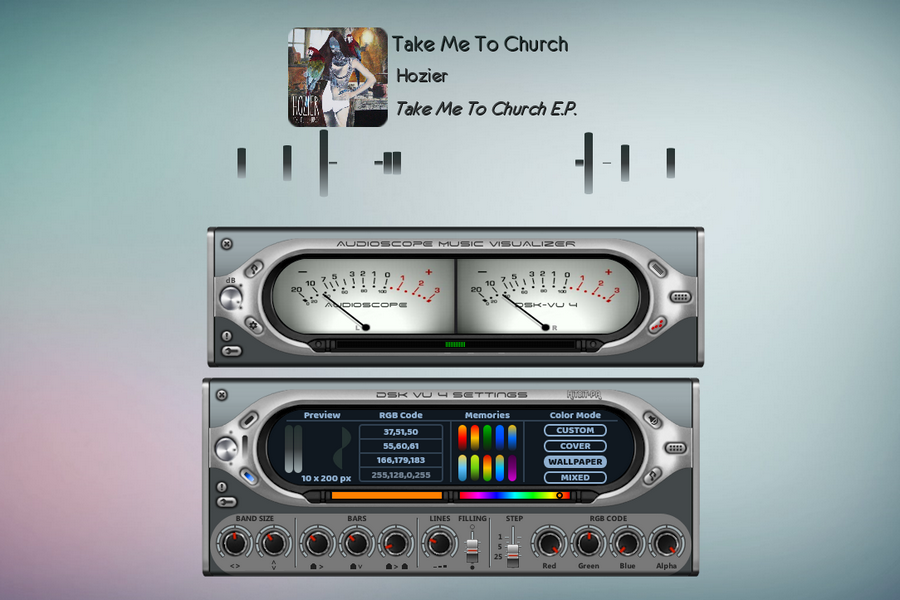
Realistic vintage Hi-Fi audio LED VU level meter, which shows relative loudness in decibels of the ambient sound, music or your voice. It features fall time selection, alternative VFD or Neon segments and calibration.
This Digital Media Renderer Analyser is a test application that evaluates the capabilities of a selected UPnP / DLNA Digital Media Renderer and recommends the optimum server settings for it to run with JRiver Media Center.
Optional Test Files
In addition to the tool, you can also download an optional set of sample test files here – warning download size 100 MByte
Database of Renderer Test Reports
You can download the database collection of the test results of all renderers so far tested here. Note if you want to add your renderer to this collection please email me the report.
This tool removes every kind of trash from your mp3-files. It searches for valid mp3 audiodata-frames and removes everything else. This has the big advantage that it will also remove tags which are in the middle of the file (as is the case with joined tracks) as well as broken frames (half-downloads) and malicious tags (Tag-buffer-overflow bug in WinAMP and Windows XP). Use this tool to cleanup your mp3 files before you add your own tag. No more double tags, or annoying ‘Lyrics’ data containing group names or misspelled song names.