PySynth is a suite of simple music synthesizers and helper scripts written in Python 3. It is based on a synth script I found on the Web and then modified for my purposes. The goal is not to produce many different sounds, but to have scripts that can turn ABC notation or MIDI files into a WAV file without too much tinkering.
There are nine PySynth variants now: PySynth A, the oldest variant, only needs Python itself, and sounds somewhat like a cross between a flute and organ. PySynth B is more complex in sound and needs NumPy. It is supposed to be a little closer to a piano. No competition for Pianoteq of course, but a reasonable fit for keyboard music. PySynth E is similar, but an FM-synthesized e-piano so it sounds much brighter than B (slightly DX7 e-piano-like; I used the DX7 presets in hexter as a basis). PySynth S is more comparable to a guitar, banjo, or harpsichord, depending on note length and pitch. PySynth C, D, and P are subtractive synths, reminiscent of 1970s analog synthesizer voices.
The synthesizers are all monophonic, i.e. they can only play one note at a time. (Although successive notes can overlap in PySynth B and S, but not A.) However, two or more output files can be mixed together…
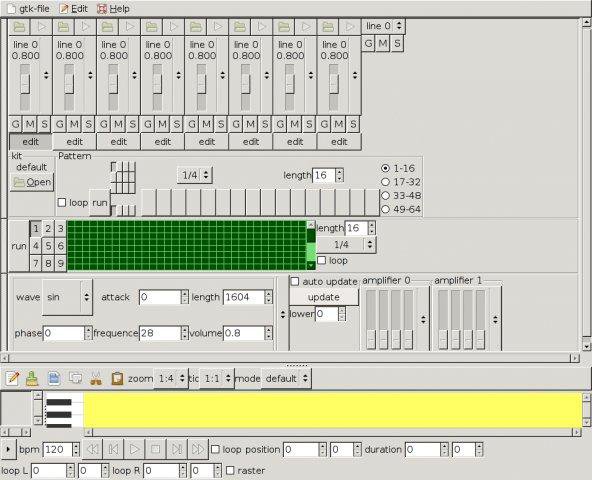
Polymeter is a MIDI sequencer for music that’s in multiple prime meters (1, 2, 3, 5, 7, 11, etc.) simultaneously. Each track has its own loop length, and when the lengths differ, the tracks “slip” (or shift phase) relative to each other. The resulting interference pattern is sufficiently intricate that variations similar to the embellishments of a live performer can be generated algorithmically.
Features:
Multitrack step sequencer for polymeter
Each track has its own loop length
Any number of tracks, of any length
Full clipboard support (copy/cut/paste)
Unlimited undo and redo for all edits
Multiple tracks can be edited at once
Optionally shows current position within each track
Drag reordering of tracks
Exports a MIDI file
Join adjacent steps to make tied notes
Velocity editing
Controller tracks
Recording of live arrangement
Editing of arrangement on timeline
Inter-track modulation of mute, note, velocity, duration, position, and more
Live performance view with full screen mode
Recursive modulation (modulation of modulation) for mute and position
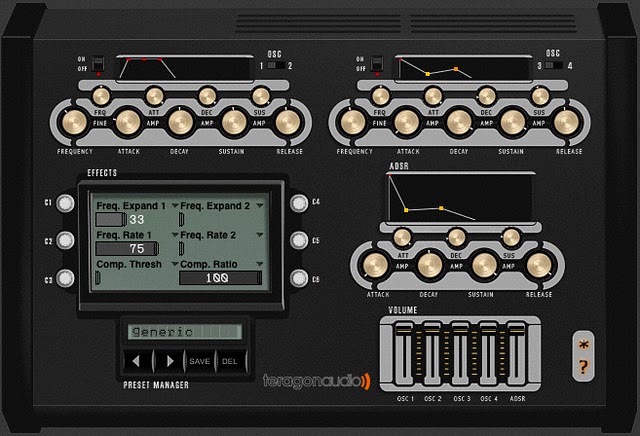
KickMaker is a synthesizer designed specifically to create good kick drum sounds. It uses four independent oscillators and a wide range of effects, allowing one to create perfectly customized beats.
Dexed is a multi-platform, multi-format plugin synth that is closely modelled on the Yamaha DX7. Dexed is also a midi cartridge librarian / manager for the DX7.
Features:
Multi platform (OS X, Windows or Linux) and multi format. (VST, AU, LV2)
144 DAW automatable DX7 parameters available from one single panel.
Fully supports DX7 input and output Sysex messages; including controller change. This means that you can use this with a native DX7/TX7 as a patch editor and sysex manager.
Each operator has a realtime VU meter so you know which one is active.
Can load or save any DX7/TX7 sysex programs. It is also possible to save a single program into a different sysex file.
caotica2 is a “noise design application”, featuring audio synthesis and effects. The goal of this experimentally designed application is to generate new sounds and noises, and also to alter wave files using simple and complex mathematical effects. The results may sound “noisy” and chaotic and, actually, they are, although rather predictable when getting used to the application. caotica2 is a source of “rough sound material” for the use of experimental composers.
Argotlunar is a tool for creating surreal transformations of audio streams. Specifically, it is a real-time delay-line granulator. It disintegrates an audio stream into short samples (grains). Each grain can have random settings of amplitude, panning, duration, delay, pitch, glissando, filter and envelope. The output of all grains is mixed together into a stream which can be fed back into the main input.
Time-related parameters can be synced to the host tempo, for rhythmic and pulsing textures. Pitch-related parameters can be quantized for harmonic and melodic effects. Feedback can create chaotic, densely layered, and distorted sounds.
Most of the parameters can be correlated. Examples:
Filter cut-off correlated with pitch: Higher filter cut-off for grains with higher pitch, and vice versa.
Grain duration correlated with panning: Grains with shorter duration panned to the centre of the stereo field, and grains with longer duration panned wide in the stereo field.
Andes is a standalone software synthesiser, or plugin, in early stages of development. The core of Andes is an original oscillator which uses a pseudo-3D version of Perlin Noise to produce distinctively digital sound.