
DawDreamer is an audio-processing Python framework supporting core DAW features and beyond:
- Composing graphs of multi-channel audio processors
- Audio playback
- VST instruments and effects (with UI editing and state loading/saving)
- FAUST effects and polyphonic instruments
- Time-stretching and looping, optionally according to Ableton Live warp markers
- Pitch-warping
- Parameter automation at audio-rate and at pulses-per-quarter-note
- Parameter automation saving in absolute audio-rate time
- MIDI playback in absolute time and PPQN time
- MIDI file export in absolute time
- Rendering and saving multiple processors simultaneously
- Support for the Faust Box and Signal APIs
- Transpiling Faust code to JAX/Flax and other target languages (C++, Rust, Wasm, etc.)
- Machine learning experiments with QDax
- Multiprocessing support
- Full support on macOS, Windows, Linux, Google Colab, and Ubuntu Dockerfile
DawDreamer’s foundation is JUCE, with a user-friendly Python interface thanks to pybind11. DawDreamer evolved from an earlier VSTi audio “renderer”, RenderMan.
github.com/DBraun/DawDreamer
Yearly Archives: 2023

ThatMicPre ~ DIY Mic Preamp With Switched Gain
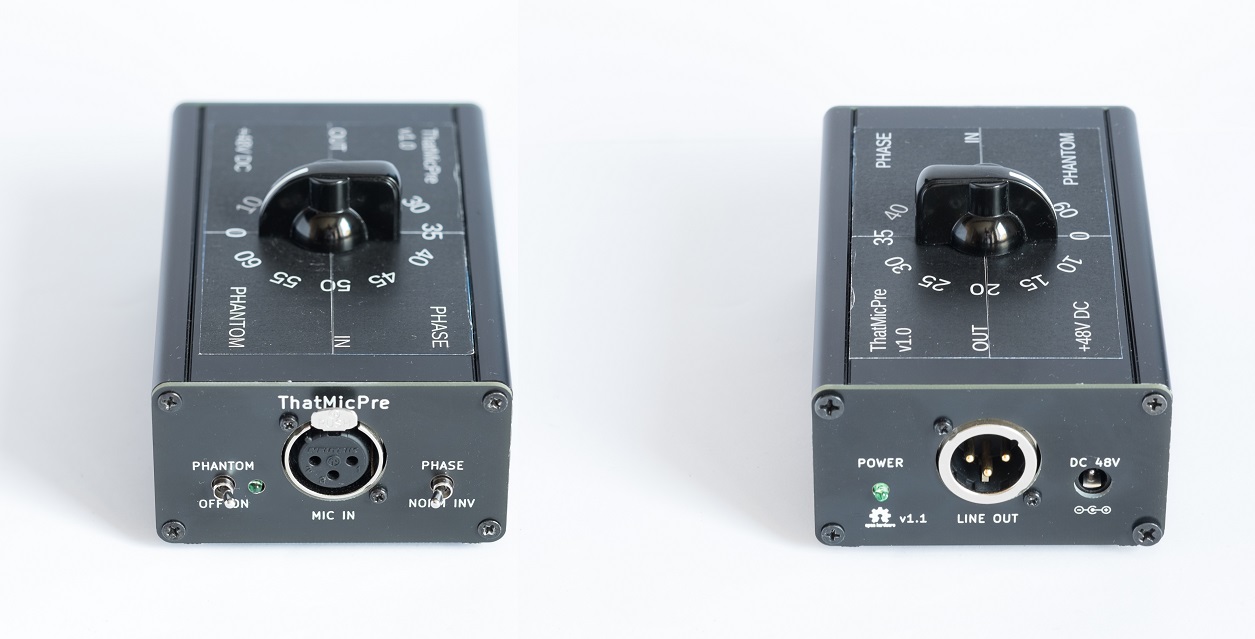
A simple, high-quality DIY microphone pre-amplifier with switched gain. The background for this project was that I needed a simple but good microphone preamp for doing acoustic measurements. I needed a switched gain to be able to reproduce the gain setting in a more predictable way than what is possible with a potmeter. I could not find any existing DIY designs, so I decided to make one.
The design is based on the excellent THAT1510 or THAT1512 preamp ICs. It is also compatible with SSM2019 or INA217. I have followed all THAT’s datasheets and app-notes to implement a robust, best-practice design.
A goal was to use simple through-hole parts that I and other DIYers usually have in our parts drawer. So there are no additional IC’s or voltage regulators for example, it just uses simple transistors, capacitors and zener diodes for supply filtering and regulation. I selected affordable switches and connectors to keep cost down. Many parts can be substituted without sacrificing performance.
There are two versions of this design, one suited for a desktop encolsure with gain switch on top, and one suited for a rack-mount enclosure with gain switch on the front.
github.com/ojg/thatmicpre
Share this:

Maloja ~ Linux Local Scrobble Database
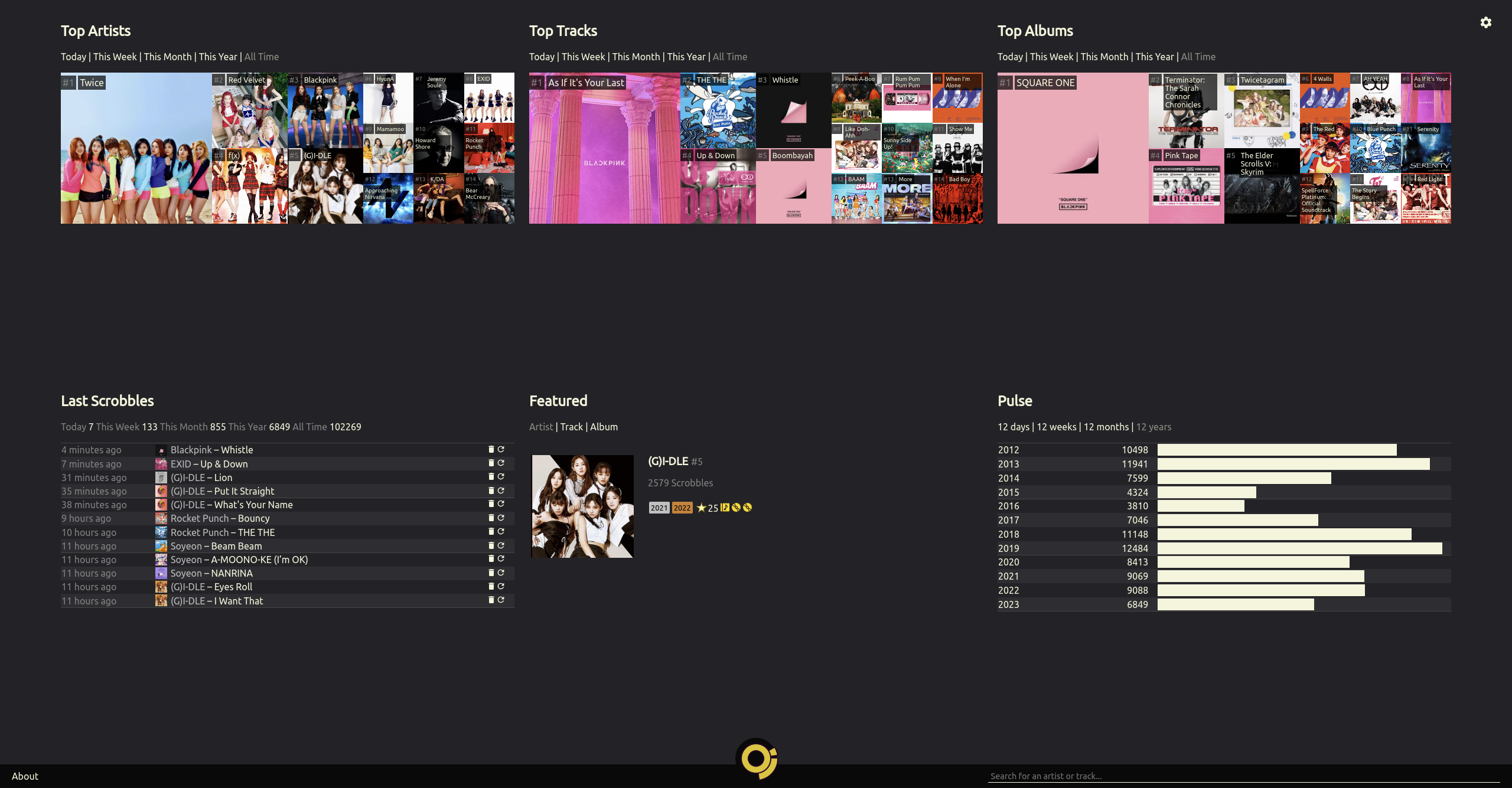
Simple self-hosted music scrobble database to create personal listening statistics.
github.com/krateng/maloja
maloja.krateng.ch
Share this:

foo_musicbrainz ~ Foobar2000 MusicBrainz Tagger
Allows tagging files using data from MusicBrainz.
Features:
www.foobar2000.org/components/view/foo_musicbrainz
- Fetches data by automatically calculated MusicBrainz Disc ID, existing Artist/Album or MusicBrainz Album ID tags
- Uses the latest version of MusicBrainz web service, which corresponds to the NGS data model
- Supports many different tags, including artist, album, date, tracknumber/totaltracks, discnumber/totaldiscs, label, catalog number, barcode etc.
- Supports MusicBrainz-specific tags: Artist ID, Album ID, Release Group ID, Disc ID, Track ID, album type, album status
- Missing TOCs can be submitted to MusicBrainz from the context menu.
Share this:

Free Foobar2000 Default User Interface Theme ~ Animus
Share this:

LosslessSwitcher ~ Mac Sample Rate Utility
LosslessSwitcher switches your current audio device’s sample rate to match the currently playing lossless song on your Apple Music app, automatically.
Let’s say if the next song that you are playing, is a Hi-Res Lossless track with a sample rate of 192kHz, LosslessSwitcher will switch your device to that sample rate as soon as possible.
The opposite happens, when the next track happens to have a lower sample rate.
github.com/vincentneo/LosslessSwitcher
Share this:

foo_listenbrainz2 ~ Foobar2000 & ListenBrainz
ListenBrainz 2
A foobar2000 component to submit the music you listened to to ListenBrainz or another ListenBrainz compatible scrobble server (for example Maloja).
This component was originally written by marc2k3. This repository is an attempt to preserve the source code of this excellent component and hopefully to revive the development.
github.com/phw/foo_listenbrainz2
What is ListenBrainz? ListenBrainz keeps track of music you listen to and provides you with insights into your listening habits. For details see:
listenbrainz.org
References:
en.wikipedia.org/wiki/ListenBrainz
Share this:

musicScraper ~ Scrape RYM & Metallum
CLI tool for scraping information from musical website (Rateyourmusic, Metal Archives), with nice album ASCII art.
Features:
github.com/mBaratta96/musicScraper
- Search for your favorite artists on Metallum and RateYourMusic (so far)
- Show discography and album tracklist
- Show album credits
- Show user reviews.
- RYM: Login and rate an album.
- Metallum: Check similar artists
Share this:

piCorePlayer ~ Raspberry Pi Audio System
Free software that plays local music as well as online music streaming services on a Raspberry Pi.
www.picoreplayer.org
Share this:

AcidBox ~ DIY Hardware Synthesizer
ESP32 headless acid combo of tb303 + tb303 + tr808 like synths. Filter cutoff, reso, env mod, accent, wavefolder, overdrive within each 303, per-instrument tunings, hi-pass/lo-pass filter and bitcrusher in drums, send to reverb, delay and master compression. All MIDI driven. 44100, 16bit stereo I2S output to the external DAC or 8bit to the built-in DAC. No indication. Uses both cores of ESP32. Cheap ~$10. Consult with midi_config.h to find out and to set up MIDI continuous control messages.
github.com/copych/AcidBox
Share this:

Align ~ DRC Speaker Alignment Utility
In 5 clicks, DRC for (almost) dummies
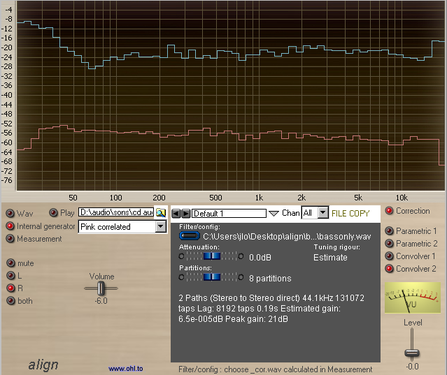
Simple, fast and effective software to measure and calculate the amplitude and phase correction and “align” speakers. This software also allows you to measure speakers to adjust them and/or to find the best placement in the room.
Note: DRC stands for Digital Room Correction
www.ohl.to/about-audio/audio-softwares/align
www.ohl.to/about-audio/audio-softwares/align2
Share this:

MusicIP ~ Analyse Songs & Generate Playlists
MusicIP is much more than a conventional Playlist Generator. MusicIP is a clever piece of software written in the 2000s that analyses and fingerprints your local music library to try to understand the makeup of each music track. So instead of endlessly scrolling through your library, trying to find something to listen to, you can simply select a track (the seed track) then based on MusicIPs understanding of your library, generate a playlist of tracks that blend together. This is far more than a genre based mix, as it will select tracks that are similar in composition.
www.spicefly.com/article.php?page=what-is-musicip

 The Audio File