Clamps, short for “Common Lisp Aided Music Production System”, is a software system for realtime and non-realtime music production written in Common Lisp. It enables a seamless workflow between high-level structures to define musical processes all the way down to low level DSP definitions for sound creation including browser based interfaces for interactive work and control useable for live performances. In that respect it combines features of systems like OpenMusic, SuperCollider or the Pure Data/Max family of software.
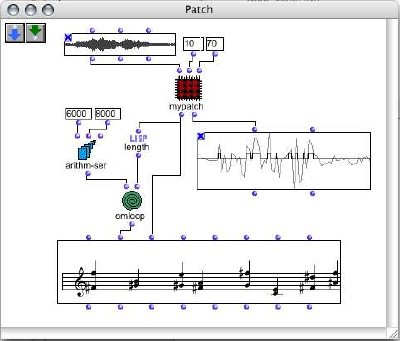
OpenMusic (OM) is a visual programming language based on Common Lisp. Visual programs are created by assembling and connecting icons representing functions and data structures. Most programming and operations are performed by dragging an icon from a particular place and dropping it to an other place. Built-in visual control structures (e.g. loops) are provided, that interface with Lisp ones. Existing CommonLisp/CLOS code can easily be used in OM, and new code can be developed in a visual way.
OM may be used as a general purpose functional/object/visual programming language. At a more specialized level, a set of provided classes and libraries make it a very convenient environment for music composition. Above the OpenMusic kernel, live the OpenMusic Projects. A project is a specialized set of classes and methods written in Lisp, accessible and visualisable in the OM environment. Various classes implementing musical data / behaviour are provided. They are associated with graphical editors and may be extended by the user to meet specific needs. Different representations of a musical process are handled, among which common notation, midi piano-roll, sound signal. High level in-time organisation of the music material is proposed through the concept of “maquette”.
OM-SoX is a library for multichannel audio manipulation and functional batch processing for OpenMusic, a visual programming environment based on CommonLisp / CLOS.
Incudine is used to design software synthesizers or sound plugins from scratch, exploiting the expressive power of Common Lisp, without the constraints of using pre-built unit generators. It is also a compositional tool that produces high quality sounds, controllable at the sample level, while defining and redefining the digital signal processors and the musical structures on-the-fly.
FOMUS is a open source software application by David Psenicka that automates many musical notation tasks for composers and musicians, facilitating the process of creating professionally notated scores by allowing the user to separate attributes such as times, durations and pitches from the representation of them in conventional music notation. It is especially useful for composers who work with algorithms and computer music software languages / environments such as CM/Grace, Pure Data and Lisp. It can also be used to import data from MIDI files into a graphical notation editor or creating scores from scratch using text files.




 The Audio File