IDE64 Manager plugin to play SID files on a C64.
sourceforge.net/projects/hvsidplayer

A featureful SID-music creation tool (tracker) for the Commodore 64. It includes many advanced effects and tools like keyboard-tracking, tempo-programs/funktempo, gateoff-table-pointers, filter-shift, SID-export, executable-export, MIDI/XM conversion and MIDI-input hardware, etc., etc.

sourceforge.net/projects/sid-wizard
csdb.dk/release/index.php?id=258573

A collection of DIY audio measurement and analysis tools, grown organically as needed. This software is compatible with standard audio devices.
PyQt6 desktop app bundling 28+ DIY modules: signal generator, spectrum/PSD analyzer, sound level & LUFS meters, loopback finder, distortion/IMD tools, network/impedance analyzers, oscilloscope, spectrogram, ultrasound modulator, transient analyzer, lock-in/FRA, inverse filter, frequency counter, recorder/player, sound quality analyzer, noise profiler, boxcar averager, goniometer, BNIM meter (ITD/ILD neural map), HRTF Player, and more.
Built for hobbyists and engineers: device routing, calibration (input/output/SPL), multi-language UI, light/dark themes.
github.com/youtube-at-vach/MeasureLab
youtube-at-vach.github.io/MeasureLab

A2M converts local audio into editable MIDI using a trained piano model. No uploads, no accounts, and no cloud dependency.
A model download is required once on first launch (~165 MB).
Best results come from solo piano recordings. Mixed tracks or full songs will be less accurate.
www.justagwas.com/projects/a2m
sourceforge.net/projects/a2m

If listening to music is one of your favorite hobbies, then the Desktop VU-Meter 4 plugin could just be perfect addition to your desktop. The skin features more life-like VU meters that will give ultimate control of your audio music experience. The audioscope music visualizer features analogue and digital VU-meters, waves and lines that move in correspondence with the rhythm of the music. On the audio level settings, use the mouse wheel to modify the various values and the left button to configure load default values. You can design your own visualizer using the gradient, custom colors or extract colors from the cover or wallpaper, after which you’ll set up the player and audio device and then load the visualizers.
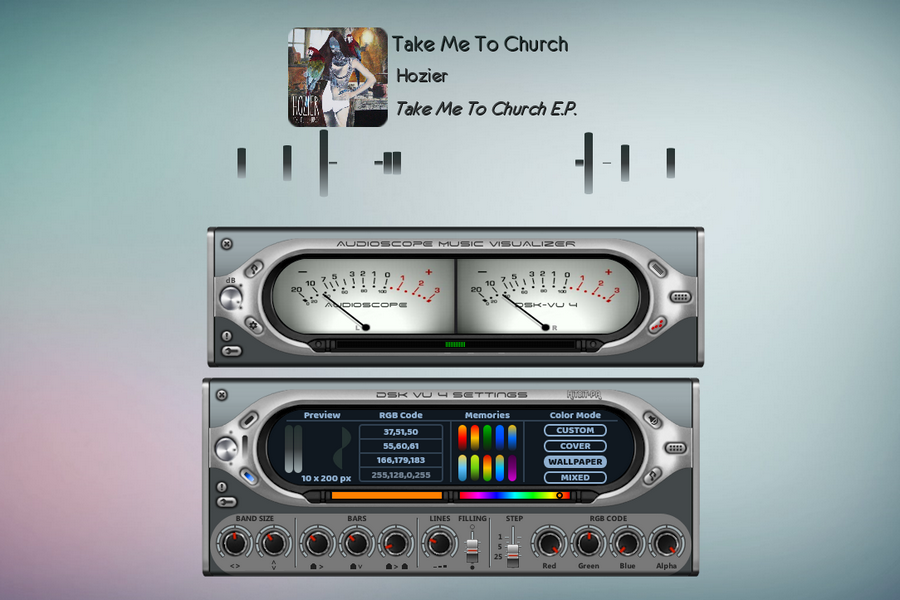
visualskins.com/skin/desktop-vu-meter-4
Source: ~ visualskins.com/tag/music

This program makes a linux computer equipped with a modern sound card behave as a traditional hi-fi preamp, but able also to make advanced DSP equalization and crossover tasks.
That means that, with a proper soundcard, external sources can be used, be them analog or digital, along with digital libraries or streamed sources.
codeberg.org/rripio/pre.di.c
github.com/rripio/pre.di.c

What is it? And a WARNING!
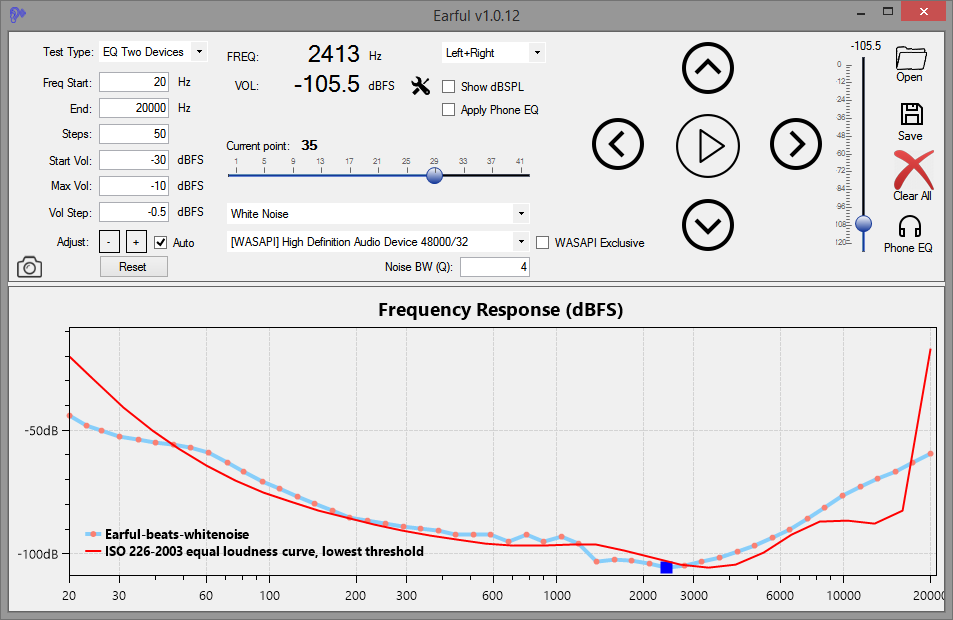
Earful is an app designed to measure and evaluate the lower threshold of hearing across a frequency spectrum. It is designed to run on Windows and support ASIO, WASAPI, and Direct Sound audio devices. Use with headphones is recommended for greater accuracy and noise elimination.
In addition, with version .10, Earful now supports two other types of tests:
- Equal-loudness testing using the same device and 1kHz reference tone
- Two devices equal-loudness testing, using a reference device, such as speakers, and a test devices, such as headphones
The app is free to use, but to use it, you must agree to do so AT YOUR OWN RISK ONLY. Make sure that the volume settings are set such that any loud sounds played through your system will not damage your equipment or your hearing! This is important. Set the frequency range in Earful correctly, and also specify the maximum volume setting at a low number to avoid surprises (default is -20dBFS).
Use is entirely at your own risk.

The AFsp package is a library of routines for reading and writing
audio files. The emphasis is on providing support for the type of
audio file used by the speech processing research community. The
routines have been designed to be easy to use, yet provide transparent
support the reading of several audio file formats. A secondary
purpose for distributing these routines is to encourage the use of a
standard audio file format for the header information in the output
files.
The following file formats are supported for reading.
The audio file open routine automatically senses the file type and
communicates it to the audio file reading routines. Formats are
converted on the fly as the file is read, so the user manipulates
floats and doesn’t need to worry about the underlying data format.
For writing, the routines produce a standard format file, though
options are available to produce headerless files if desired. This
standard format is a compatible with the Sun audio file format. There
is provision for storing extra information in the extensible part of
the header.
Several audio file utilities (for copying, comparing, and filtering
audio files) are included in the package.
www.cs.cmu.edu/afs/cs/project/ai-repository/ai/areas/speech/systems/afsp/0

MicToggle is a lightweight microphone control tool designed for focus and clarity. Instantly mute or unmute your mic using a custom hotkey — no matter what you’re doing. Stay aware of your mic status with a movable on-screen overlay, system tray icon, and optional audio cues. Choose your preferred microphone, set startup behavior, and enjoy a clean, unobtrusive interface. Whether you’re gaming, streaming, or in meetings, MicToggle keeps you in control.
Features:
- Custom Hotkey — Instantly mute or unmute your mic using a hotkey you choose.
- Microphone Selection — Pick which mic to control if multiple devices are connected.
- On-Screen Overlay — Always know your mic’s status with a floating icon that you can reposition or disable.
- Startup Options — Start minimized, run at Windows startup, or launch with mic muted.
- Mic Status on Launch — Optionally hear a sound or get a notification showing your mic’s state when the app starts.
- Visual Status Indicators — Colored icons clearly show your mic state both in the app and system tray.
- Tray Controls — Toggle mute, open settings, or exit — all from the tray.
- Clean Interface — Simple, responsive UI designed to stay out of your way.
- Lightweight & Fast — Uses minimal resources, ideal for streamers, meetings, and gamers.
sourceforge.net/projects/mictoggle

Before layout changes are made and periodically, it’s a good idea to backup your current theme.
Open File > Preferences > Display > Default User Interface
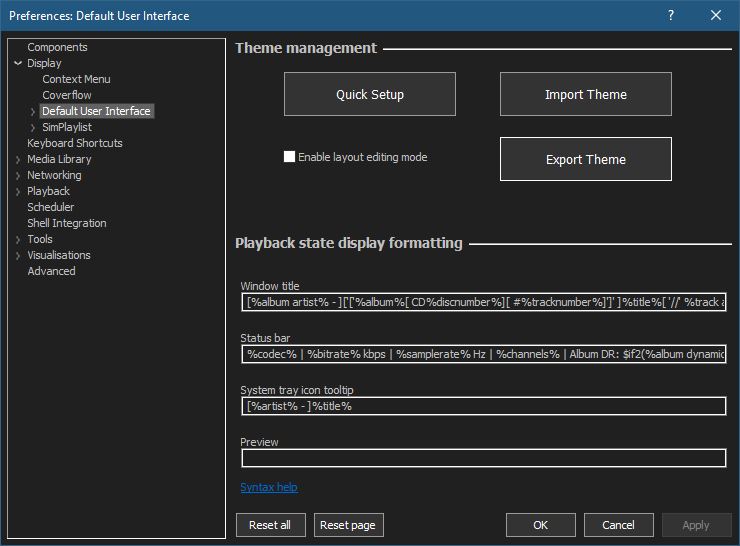
Now select Export Theme to open the Choose Theme Selections to Export dialog
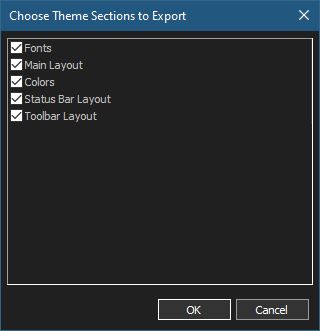
Normally everything is left selected. Click Ok and give the .fth theme backup file a useful name and save it in a folder that itself is backed up.
If you make a layout mistake or need to install a new instance of foobar2000 just import the .fth theme file

shntool is a multi-purpose WAVE data processing and reporting utility. File formats are abstracted from its core, so it can process any file that contains WAVE data, compressed or not – provided there exists a format module to handle that particular file type.
shntool has native support for .wav files. If you want it to work with other lossless audio formats, you must have the appropriate helper program installed. The “Helper programs” section below contains links to helper programs for each format that shntool supports.
shnutils.freeshell.org/shntool
github.com/bayun/shntool

Foo Scrobbler (foo_scrobbler_mac) is a native Last.fm scrobbling plugin for foobar2000 on macOS. Submits tracks based on precise playback rules, caches scrobbles when offline, and operates silently after one-time authentication. Built using the official foobar2000 plugin API, it focuses on reliability, low overhead, and correct metadata handling. Fully open-source under GPLv3.
Supports macOS ≥ 11.5 on both Intel and ARM.
github.com/zfoxer/foo_scrobbler_mac


