Drops is a single audio file sample player plugin in lv2 and vst format for linux.
Load an audio file, play it, loop it, pitch shift it, and make it into something entirely new.
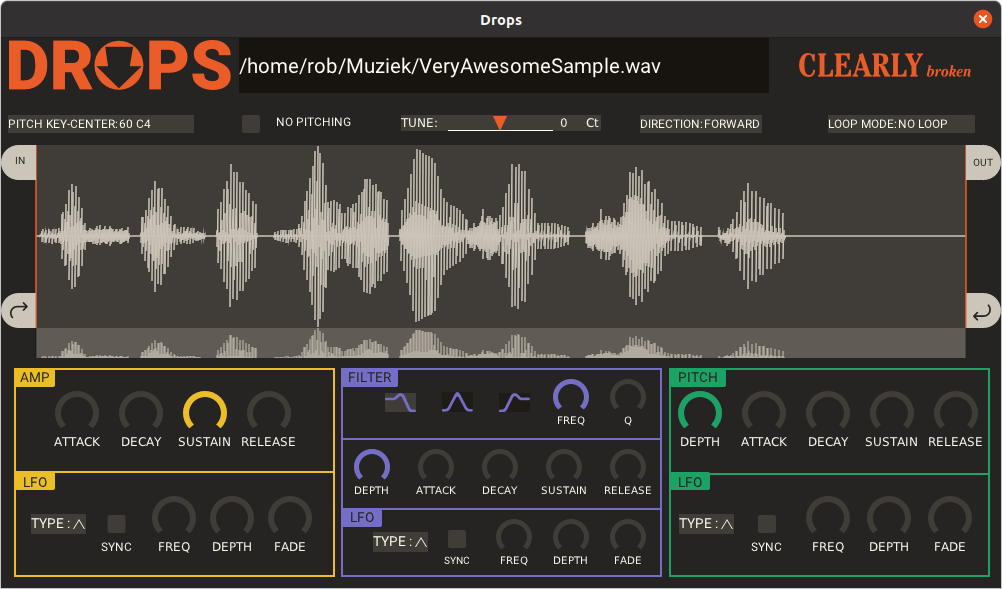
github.com/clearly-broken-software/drops

Drops is a single audio file sample player plugin in lv2 and vst format for linux.
Load an audio file, play it, loop it, pitch shift it, and make it into something entirely new.
github.com/clearly-broken-software/drops

Yet another simple monophonic drum synth. Yes, inspired by 1970’s drum synths.
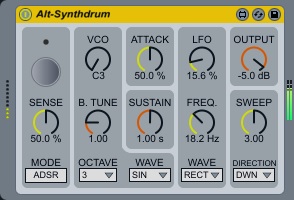
h1data.github.io/m4l
maxforlive.com/library/device/5278/alt-synthdrum
www.ableton.com/trial
maxforlive.com/library

Charlatan is a polyphonic, subtractive virtual analog (VA) synthesizer VSTi plugin with focus on sound quality and easy usability. It comes with a flexible, yet not overwhelming feature set which encourages artists to start tweaking instead of just relying on presets. In spite of it’s simplicity, Charlatan’s architecture is flexible enough to create both classic sounds and rather experimental noises. While making no compromise about sound quality, the sound engine has been highly optimized for efficient CPU usage making Charlatan well suited as a “bread and butter” synth even in projects with a large number of plugin instances. Best of all, it’s freeware! Enjoy!


What is hypercyclic?
- an LFO-driven MIDI arpeggiator, gate effect and step sequencer
- for mangling sustained MIDI input chords
- the output of which can then drive other MIDI instruments
- acts either as a VST or Audio Unit plugin for your DAW, or as a standalone application
- the original hypercyclic won 2nd place in the KVRAudio.com Developer Challenge ‘07
- the sweet spot for hypercyclic is the narrow border between chaos and regularity. Or, in other words, how to induce a certain pleasant randomness and syncopation, yet forcing everything to align again on the bar or beat boundaries
How do you use it?
- the main use for hypercyclic is to generate midi that can be recorded and/or sent to other plugins. However it also features a simple built-in synth for testing purposes
- you can use two tempo-synced LFOs to modulate various parameters for creating interesting rhythmic effects and chord variations
- a unique feature is the possibility to modulate the sequencer step size itself, which is useful for creating glitchy stuttering effects
- another thing you can use is a groove function for playing slightly off the beat. The groove parameters can also be modulated over time by the LFOs, adding to the rhythmic variation
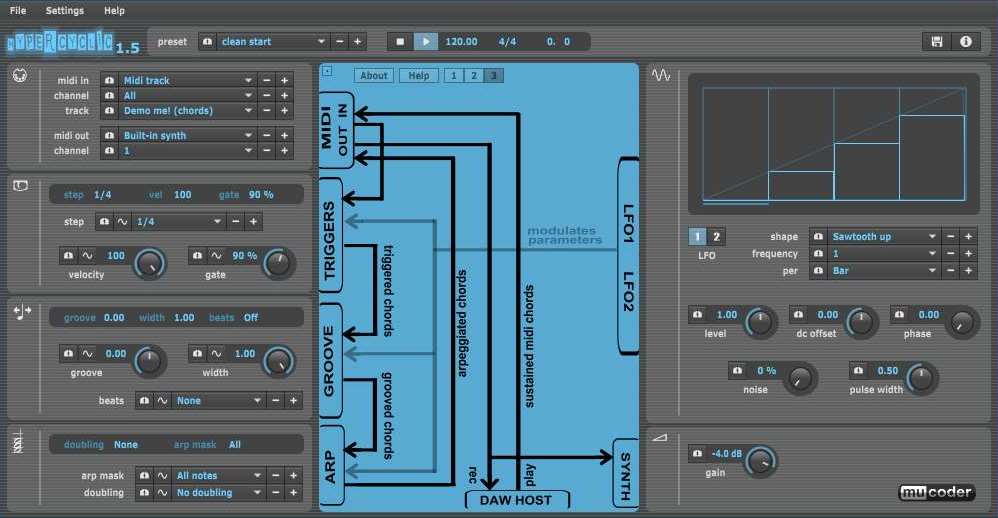
www.mucoder.net/en/hypercyclic

 The Audio File